Disaster Management Act – new regulations download

President Cyril Ramaphosa has moved South Africa back to Lockdown Level 3.

“We are at an extremely dangerous point in our fight against the pandemic.”
Ramaphosa said on Monday, Cabinet has decided to put the country on an adjusted Level 3 from Level 1 with immediate effect.

Under the adjusted level 3 regulations:

  • All indoor and outdoor gatherings will be prohibited for 14 days from the date hereof, except for funerals
  • Funerals may not be attended by more than 50 people with social distancing.
  • Every business premises must determine the maximum number of staff and customers permitted at any one time based on our social-distancing guidelines and may not exceed that limit.
  • The nationwide curfew will be extended from 9pm to 6am. Apart from permitted workers and for medical and security emergencies, nobody is allowed outside their place of residence during curfew.
  • Non-essential establishments – including shops, restaurants, bars and all cultural venues – must close at 8pm. The list of these establishments will be released shortly.
  • From now on it is compulsory for every person to wear a mask in a public space. A person who does not wear a cloth mask covering over the nose and mouth in a public place will be committing an offence.
  • A person who does not wear a mask could be arrested and prosecuted. On conviction, they will be liable to a fine or to imprisonment for a period not exceeding six months or to both a fine and imprisonment.

Under the strengthened regulations:

  • The sale of alcohol from retail outlets and the on-site consumption of alcohol will not be permitted.
  • The prohibition on consuming alcohol in public spaces like parks and beaches remains.
  • Distribution and transportation will be prohibited with exceptions that will be explained by the minister.
  • These regulations may be reviewed within the next few weeks if we see a sustained decline in infections and hospital admissions.
  • In effect, the adjusted Level 3 regulations will keep the economy open while strengthening measures to reduce transmission.
  • With a few exceptions, businesses may continue to operate as long as all relevant health protocols and social distancing measures are adhered to.
  • Night clubs and businesses engaged in the sale and transportation of liquor will not be allowed to operate.

The Level 3 restrictions will remain in place until 15 January 2021.

DearSA’s lockdown court action postponed

… to allow Ministers Dlamini-Zuma and Zweli Mkhize an opportunity to file adequate responses.

DearSA-lockdown-court-action

The Minister of Cooperative Governance and Traditional Affairs (COGTA), Nkosazana Dlamini-Zuma, was served papers three weeks ago and has failed to submit a response, although she intends opposing the matter.

Furthermore, the Minister of Health, Zweli Mkhize has belatedly launched an application to intervene in the matter. DearSA will call on the Minister for his reasons to persist with the State of Disaster and ongoing health precautions, despite conflicting evidence and opinions regarding the effectiveness.

No formal responses in court papers have so far been received from either party.

DearSA intends refiling its court action challenging lockdown extensions early in the New Year to allow the government sufficient time to prepare their responses.

“We decided it would avoid a lot of time-wasting technical arguments to refile the case in January 2021, after the court’s break, by which time the two relevant ministries will have had time to formulate their responses,” says DearSA director Rob Hutchinson. “This is a case that must be brought before the courts, as this is something that we know has huge public support, given the responses to the various campaigns where we canvassed public opinions on the lockdowns and the impact they are having on the country.”

“It is likely that had we gone to court on 1 December, denying the ministers an opportunity to respond, the court would have kicked us out with costs – putting an end to any further challenges from anyone. Furthermore, our bank account was frozen for reasons unknown. However, the delay places us in a far stronger position in Jan as there will be substantially more data in our favour.”

DearSA is working closely together with Liberty Fighters Network and PANDA to ensure a successful approach in Jan.

On Monday 16 November, DearSA served papers on the Minister of Cooperative Governance and Traditional Affairs, Nkosazana Dlamini-Zuma. DearSA asked the Pretoria High Court to declare unlawful and set aside the lockdown extension declared by the Minister on 14 November 2020. Several groups plan to join DearSA as friends of the court, including Pandemic Data and Analytics (PANDA) and Liberty Fighters Network (LFN). Other groups have also indicated their desire to join the court action.

Given the delay in having the court action heard, there is a likelihood that the government will extend the lockdown yet again over the Christmas period.

The tool being used by the government to impose these lockdowns is the Disaster Management Act, which is intended for disasters of a temporary nature, and should not be used as a blunt instrument with which to severely restrict the Constitutional rights of South Africans, such as the right to earn a living, move around, and assemble.

Hutchinson says DearSA is obligated to bring this court challenge to determine the limits of government power and prevent further infringements of human rights.

The overwhelming majority of respondents to various DearSA participation campaigns believe the government has overstepped its powers and that the lockdowns represent an abuse of power.

The rationale behind the DearSA court action is that the original purpose for imposing lockdowns – to prevent the health system being overwhelmed by a virus about which we knew little at the start of the lockdowns – has been achieved. Evidence of this is the fact that the government has closed down temporary health facilities that were hastily assembled for this purpose. The health system has not been overwhelmed, notwithstanding a rise in infections in the Eastern Cape and Western Cape.

DearSA’s court papers argue that lockdown measures have had a devastating impact on the SA economy. In the first three months of lockdown, GDP contracted by more than 16%, giving an annualised decline of -51%. In the second quarter of 2020 alone, SA shed 2.2 million jobs, according to Statistics SA.

The court action challenges the rationality of government’s catastrophic actions on the economic welfare of the country, in the name of saving South Africans from a virus which the World Health Organisation (WHO) calculates has had a global infection fatality rate of less than 0.2%.

“We have decided to give Minister Dlamini-Zuma and Health Minister Mkhize time to formulate their responses to our court papers. This is a case that we believe is vital to the future wellbeing of the country as it will determine the limits of state power no and in the future when it comes to disasters of this nature,” says Hutchinson. “Our case is not going away. It must, and will, be heard early in the New Year.”

DearSA campaign helps avert a potentially disruptive change in voting methods

Thanks largely to a robust campaign by participative democracy group DearSA, the government has decided to ditch two clauses in the Electoral Laws Amendment Bill – which would have allowed a change in voting methods.

DearSA-electronic-vote

These clauses would have allowed a switch from the current paper ballots to electronic voting – potentially sparking the kind of controversy and allegations of fraud now surrounding the recent US Presidential election.

Cybersecurity experts and lawyers have warned of the potential for hacking such electronic systems, and many have cautioned against adopting systems prone to abuse by malign actors.

On Wednesday, 2 December 2020, the Portfolio Committee on Home Affairs approved the Electoral Laws Amendment Bill and said will recommend to the National Assembly to adopt it – but without the disputed clauses 14 and 21 which would have empowered the Electoral Commission of South Africa (IEC) to prescribe a different voting method.

“The committee agreed that voting method is a policy matter that cannot be left to the IEC alone to decide, even though the IEC had mentioned that the intention was to only allow for testing of such alternatives,” says a press release issued by Parliament this week.

Parliament acknowledges the role played by DearSA in having these clauses removed from the Bill. It notes the concerns raised by members of the public in the 12,305 submissions received.

The Electoral Laws Amendment Bill seeks to amend three pieces of legislation:
· the Electoral Commission Act, 1996;
· the Electoral Act, 1998; and,
· the Local Government: Municipal Electoral Act, 2000.

These amendments were deemed necessary to prepare for the forthcoming general local government elections in 2021.

DearSA director Rob Hutchinson says removal of the concerning clauses is as a direct result of the work done by DearSA and the IRR – who brought attention to potentially disruptive changes that could lead to future disputes in election outcomes.

“The last thing we want in SA is to have election results disputed, such as we are currently seeing in the US. There are grave concerns over electronic voting methods”.

While all voting methods have potential for fraud and error, the view comments on the DearSA platform around this campaign, is the existing paper ballot method is the most reliable method we have, since it leaves a paper trail and auditing the results is therefore easier.

“This is a great victory for participative democracy in SA, and we want to thank the thousands of people who took the time to understand and comment on the proposed changes to the law.”

Crypto assets to be declared financial products

more crypto assets DearSA

The Financial Sector Conduct Authority (FSCA) last week issued a ”draft declaration” that will bring crypto assets such as bitcoin under its regulatory watch. The public has until 28 January 2021 to comment.

The burgeoning crypto market has been largely unregulated until now, though purchasing crypto assets does fall under several other laws, notably exchange control, Pension Funds Act (limiting the amount of “alternative assets” that may be held in a pension fund) and the Collective Investment Schemes Act.

What was missing from this arsenal of regulation is what to do about crypto assets, which have the potential to evade regulatory authorities worldwide. As economist Dawie Roodt points out in a Moneyweb Crypto podcast, “private monies” such as bitcoin are easy to hide from authorities and this means they can also be hidden from tax agencies. That potentially poses an existential threat to governments and nation states everywhere.

Regulations such as those proposed by the FSCA rely on public honesty. Crypto exchanges such as Luno and VALR are largely supportive of regulation where these provide better protection for consumers and help week out the many scams proliferating around bitcoin.

Authorities and crypto industry players have been debating for years how to define and regulate this market.

With bitcoin now sailing back towards its 2017 peak of about $20,000, it’s become clear that some form of regulation was on its way.

The draft declaration by the FSCA means crypto assets such as bitcoin and Ethereum will henceforth be classified as financial products under the Financial Advisory and Intermediary Services (Fais) Act.

Crypto operators must now give unbiased advice

This means that anyone giving advice or acting as an intermediary – such as a crypto exchange – would have to register as a financial services provider and comply with the requirements of the Fais Act.

One of the key aims of the FSCA declaration is to emphasise the high risks of investing in crypto assets, and intermediaries involved in this market -0 such as crypto exchanges – will have to do proper risk assessments and give unbiased information when advising clients.

Virtually all exchanges, anticipating that such rules were on the way, long ago implemented Know Your Customer (KYC) and Anti-Money Laundering (AML) rules (as required by the Financial Intelligence Centre Act, or FICA). This means you have to prove where your funds originated before investing in crypto assets.

What the FSCA draft declaration also means is that crypto exchanges and other crypto intermediaries will henceforth be licensed as financial services providers. The licensing and reporting requirements will allow authorities to build a richer database of information around this emerging asset class.

Crypto scam detection

Crypto intermediaries have been broadly supportive of regulation since it brings credibility to this emerging asset class and will help snuff out scams (of which there re many). A general rule of thumb for scam detection is don’t answer a too-good-to-be-true invitation that comes to you via WhatsApp.

The Intergovernmental Fintech Working Group, involving government, regulators and industry players, published a position paper in May 2020 to develop a regulatory framework for crypto assets, focusing on areas such as:

  • The implementation of an anti-money laundering and counter-terrorism financing regime,
  • A licensing and supervisory regime from a conduct of business perspective, and
  • A regulatory regime for the monitoring of cross-border financial flows.

But…there are a few problem areas

The FAIS Act imposes strict rules on how intermediaries market to clients, and the manner in which advice is given. Also covered under this Act is how client data is stored.

Responsible exchanges have invested large amounts of money in securing the crypto assets of clients using “cold storage” (disconnected from the internet) and multi-person authorisations (to prevent any one or two people in an exchange legging it with your crypto – which is, after all, nothing more than information in bits and bytes). These are the type of security questions you would need to ask an exchange before investing with them.

Farzam Ehsani, co-founder of crypto exchange VALR, notes that the FSCA declaration is not one of the 30 recommendations in the Position Paper on Crypto Assets that was published by the regulators in April 2020.

“Furthermore, all of the products in the FAIS Act have a central issuer and crypto assets such as bitcoin do not. Gold, for instance, is not classified as a financial product under the FAIS Act. We look forward to engaging fully with the FSCA during the comment period to ensure a fair, relevant and appropriate regulatory position for the benefit of all South Africans.”

Rocelo Lopes of crypto company Stratum says there are some benefits to the FSCA proposed regulation in that it would allow customers to weed out bad actors in the crypto space by establishing a hierarchy of credibility around responsible players, but the FSCA needs to take great care how it stores and secures the information it proposes gathering so as not to expose clients’ crypto portfolios to hacking or other intrusions.

“The FSCA would need to realise the enormous responsibility that comes with this appointed task and know that the crypto industry leaders will be keeping a close watch as it all unfolds,” says Lopes.

It is clear from the FSCA statement that this is the first of several regulatory steps affecting crypto assets that we can expect going forward.

What’s your view?  Is regulating crypto assets a good thing?

Dear South Africa asks high court to set aside latest lockdown

Intro: The lockdown restrictions are illogical and are done without Parliamentary oversight

Participative democracy group Dear South Africa has filed an urgent application in the Pretoria High Court to set aside the lockdown extension imposed on 13 November 2020.

The court application says the lockdown extensions are illogical and are being done without Parliamentary oversight, as required by the Constitution.

NDZ-state of disaster - DearSA

The only respondent in the case is the Minister of Cooperative Governance and Traditional Affairs, Nkosazana Dlamini-Zuma. She has until 18 November 2020 to oppose the matter.

Dear South Africa is also asking the court to declare the latest lockdown extension under the Disaster Management Act unlawful.

“South Africa is no longer faced with the uncertainties that it was confronted with when the initial state of disaster was enacted,” says Daniel Eloff of Hurter Spies, the attorneys representing Dear South Africa. “Consequently, government cannot continue to piggyback on a state of disaster for which the underlying and motivating reason has largely dispersed eight months since the initial declaration of the national state of disaster.”

In an affidavit before the court, Dear South Africa director Rob Hutchinson argues that Constitutional rights have been curtailed by the disaster regulations, including the rights to freedom of movement, residence, assembly, economic activity and education.

Businesses were shut down at the start of the Covid lockdown, schools were closed, and citizens’ rights to move and practice their professions and trades were severely curtailed.

“While many of these restrictions on fundamental rights have been lifted, the (minister) has imposed these restrictions without parliamentary oversight and may reimpose them. The (minister) is empowered to extend the state of disaster monthly ad infinitum without such oversight,” says the court application.

Regulations under the act may only be made to: protect or provide relief to the public; protect property; prevent or combat disruption; deal with the destructive and other effects of the disaster.

The original purpose of the lockdowns which commenced in March 2020 was to “flatten the curve” and slow the spread of the Covid-19 virus. Little was known about the virus at the time. Now we know much more.

Lockdowns will not save the lives of those who contract COVID-19 and do not require hospitalisation, according to Dear South Africa. Expert analysis by medical experts and epidemiologists conclude that the case fatality rate from the virus is 0% for those under 19, and for adults under 50 it is 0.5%.

The case fatality rate for SA is 2.7%. The World Health Organisation (WHO) noted on 22 October 2020 that 10% of the world’s population were reckoned to have been infected with the virus. Of these, 1.3 million people have died as of 14 November 2020, an infection fatality rate of 0.17%.

The lockdown measures have had a devastating impact on the SA economy. During April, May and June, when the most severe lockdown restrictions were in place, gross domestic product contracted by more than 16% giving an annualised decline of -51%. By comparison, in 2009, during the global financial crisis, the annualised decline was -6.1%. In the second quarter of 2020 alone, SA shed 2.2 million jobs, according to StatSA.

The South African Centre for Epidemiological Modelling and Analysis (SACEMA) provided models to the National Institute for Communicable Diseases (NICD), though it was not aware that these models were being used to inform policy. SACEMA abandoned its model soon after it was published and advised that it was not a tool for decision-making. That model’s replacement, the NICD’s “Epi Model” has not been updated since June 2020 and also appears to have been abandoned. When last updated, it forecast 40 000 deaths by the end of November 2020 – which has also proven to be wildly inaccurate. The actual number of fatalities currently sits at just above 20 000.

South Africans appear to have a high level of compliance with recommended rules regarding sanitation, wearing of masks and social distancing.

Dear South Africa says the recent extension of the lockdown is an “administrative act” which is reviewable by a court in terms of the Promotion of Administrative Justice Act (PAJA). Reasons given for seeking to set aside and declare the extension unlawful include:

  • They were not rationally connected to the purpose for which they were taken
  • Irrelevant considerations were taken into account, or relevant considerations ignored
  • The extension is unconstitutional and unlawful.

While it may have been rational to have declared a state of disaster in March, much has changed since then. It is no longer rational to have the declaration in place and it should not have been extended.

The state of disaster grants the executive the power to pass draconian legislation which weakens the rights of all those who live in South Africa. The state of disaster can be extended ad infinitum by the minister without a requirement of parliamentary oversight. This has occurred, and continues to occur, which undermines our constitutional democracy, premised on a genuine separation of powers, says the court application.

If a second wave of infections occurs, the state has had ample time to prepare for this and a new state of disaster could be declared based on new circumstances that may arise. “It is improper to keep the current state of disaster perpetually in force on the basis that some new disaster may occur on some unknown date,” says the application.

Letter to Minister Dlamini-Zuma (current challenge)

Loader Loading...
EAD Logo Taking too long?
Reload Reload document
| Open Open in new tab

Download [164.29 KB]

First letter (challenge successful)

Loader Loading...
EAD Logo Taking too long?
Reload Reload document
| Open Open in new tab

Download [388.43 KB]

Second letter (challenge successful)

Loader Loading...
EAD Logo Taking too long?
Reload Reload document
| Open Open in new tab

Download [224.15 KB]

SABC wants to bring in the heavies to collect license fees

SABC-licence-DearSA

As compliance levels, already at just 30%, are tanking.

By Ciaran Ryan

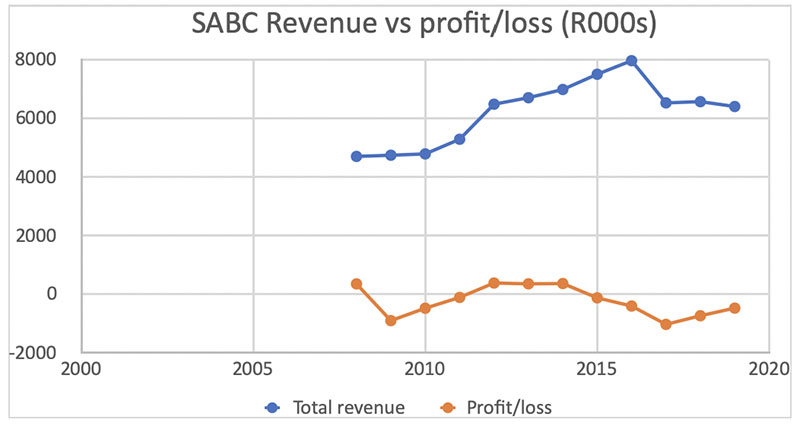
The SA Broadcasting Corporation (SABC) is in a financial pickle. Revenue has been in steady decline since 2016, and the broadcaster has made profits in just four of the last 12 years.

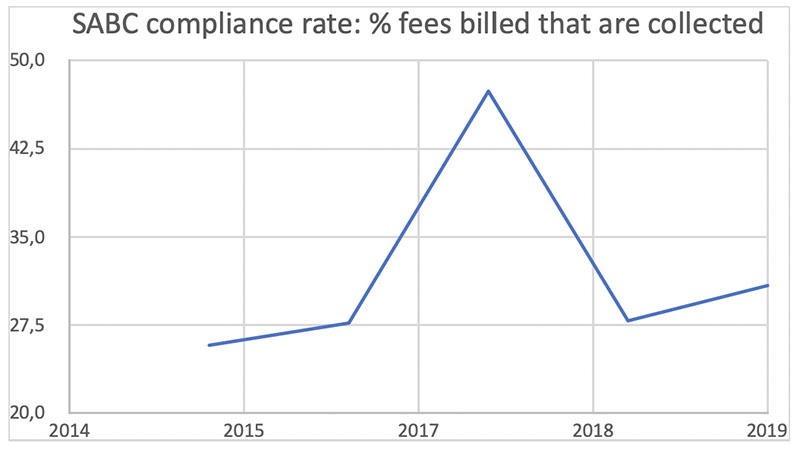
We recently learned from an SABC presentation to Parliament that license fee collections have been in decline during the Covid lockdown. Collection rates are already low at about 30% – or just short of R1 billion out of the R3.3 billion billed to TV viewers annually.

The SABC’s apparent solution to this is to bring in the heavies – the debt collectors (including getting Multichoice and Netflix to collect on its behalf). That will require a change to the Broadcasting Act and, of course, with that will come heavier penalties for non-payment.

Its revenue comes from advertising for the most part, sponsorships, license fees and government grants.

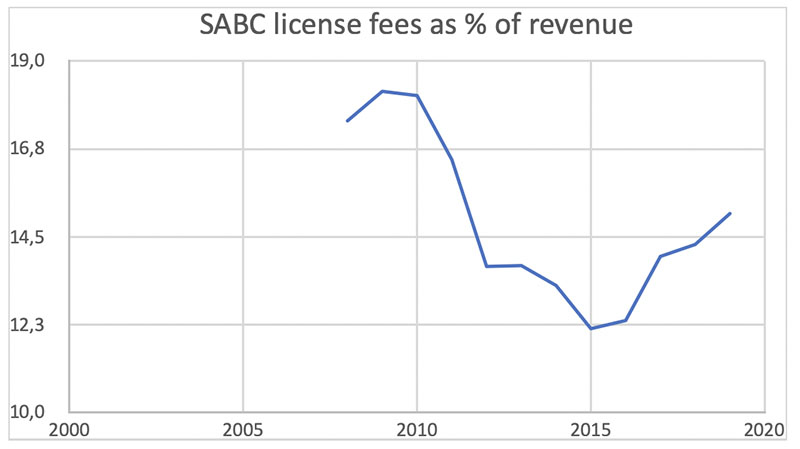
Ten years ago, license fees accounted for more than 18% of total revenue. Today it is about 15%, having been as low as 12% in 2016 during the dark days of Hlaudi Motsoeneng’s bizarre rampage through the corporation (he lied about his qualifications, awarded himself a fat salary increase and insisted on covering cuddly stories about ANC ministers attending luncheons).

The SABC finally sacked Motsoeneng as chief operating officer in 2017, but the damage was done. The graph below paints a picture of a state-owned broadcaster in the throes of state capture.

SABC-graph1 DearSA

During the Covid lockdown, levels of compliance in license fee payments has deteriorated below the already weak 31% reported in 2019. The Department of Communications and Digital Technologies, under which the SABC falls, wants to overhaul the Broadcasting Act to beef up the broadcaster’s powers to collect TV licenses and impose tougher penalties for non-payment.

Among the ways it plans to do this is by handing over accounts that are 60 days overdue to debt collection agencies to collect the R265 annual license fee. This has drawn robust comment from South Africans fatigued by stories of yet another distressed state-owned company in search of rescue. This time, however, the state broadcaster sees a way to use the law to enforce not so much its monopoly – which has long since been eaten away by competitors – but its right to claim a fee whether you watch SABC or not.

During the presentation to Parliament’s Portfolio Committee in October 2020, the SABC proposed using service provides such as Multichoice and content providers like Netflix to collect on its behalf. This will require a change in regulations to broaden the definition of a TV license to embrace newer platforms where people consume SABC content. It remains to be seen whether Multichoice and Netflix customers will comply with what may be seen as a cunning shake-down by the SABC.

SABC-graph2 DearSA

The SABC provides 18 radio stations, five television channels as well as a digital media offering. Channel Africa is an additional radio station managed by the SABC on behalf of the government. Two other channels are delivered through DStv.

The three terrestrial television channels (SABC 1, 2 and 3) attract, on average, 28 million South Africans in a typical month. Seventeen of the nation’s top 20 television programmes are broadcast by the SABC’s television channels

It’s not hard to see why license fee delinquency is on the up. The annual fee is R265 but the fine for non-compliance may not exceed R500. Many people choose to take that rather low financial risk. Others prefer to get their content outside of the SABC and, certainly until recently, believe that they were paying for political propaganda.

SABC-graph3 DearSA

Should the government decide in the middle of a Covid crisis, when income levels have collapsed, to take a battering ram to TV viewers in the hope of improving collection rates, there may well be a Constitutional Court challenge on the matter. After all, many South Africans long ago tuned out of SABC in favour of content more to their liking elsewhere.

What do you think? Should we support tougher enforcement of TV license fee collections? Or should the SABC ditch the license fees altogether and start finding more creative and less expensive ways to make up the revenue shortfall (such as through better, more targeted content)?

EFF wants to expropriate Reserve Bank private shareholders

DearSA-reserve bank amendment bill

The EFF has introduced the South African Reserve Bank Amendment Bill which seeks effectively to nationalise the SA Reserve Bank (SARB) by removing private ownership of shares in SARB and vesting these with the state.

The EFF bill has the explicit aim of expropriating the shares of 802 private shareholders, who include finance minister Tito Mboweni (10,000 shares), DA shadow finance minister Hill Lewis, the Anton Rupert Trust, Discovery, Absa, Nedcor, FirstRand Bank and Nedcor.

These shares would be expropriated without compensation and vested in the state on behalf of 57 million South Africans. “For true sovereignty and autonomy, the SA Reserve Bank must be transferred to the state,” says the EFF in a Parliamentary presentation. “The next debate will be on its mandate.”

While it would cost billions of rands to nationalise the Reserve Bank, the EFF sees a more expedient solution as the expropriation of private shareholders. The share capital of the Reserve Bank is set at R20 million, and the dividend per share at R1,000. Hence, the party says the financial loss to shareholders is limited.

Parliament’s Standing Committee on Finance and Select Committee was given a briefing on the proposed bill on 25 August 2020, when the DA questioned its constitutionality, particularly Section 25 which prohibits arbitrary deprivation of property. At the presentation to Parliament, the EFF’s Floyd Shivambu said the majority of the Reserve Bank’s existing shareholders were white and non-South African citizens, and that the aim of the proposed amendments was to protect the Bank from the abuse suffered by many state-owned companies.

Parliament’s legal services unit has also raised concerns over the constitutionality of the proposed amendments. The law as it stands – underpinned by Constitutional Court findings – require expropriation to be accompanied by compensation. Adv Noluthando Mpikashe, the Parliamentary Legal Advisor, told the Standing Committee that the law is vague as to what is considered just and equitable compensation, and that the EFF bill may not pass constitutional muster.

The EFF bill seeks to give the minister of finance powers to regulate the appointment of directors to the SARB, and to further regulate the tenure of these directors and how they are to be appointed.

The bill further proposes allowing the minister of finance to appoint the SARB auditors.

The EFF bill proposes amending several sections of the South African Reserve Bank Act of 1989:

Section 4 of the SARB Act, particularly that section which allows shareholders to elect directors. The EFF wants the minister of finance to perform this function.

Section 4A, which requires the SARB to submit annual financial statements to shareholders (as well as the minister of finance and Parliament). The EFF wants this section amended to exclude private shareholders.

Sections 5, 6 and 9, which deal with the appointment of directors, their tenure and conditions of appointment. The EFF wants the state to step into the shoes of the private shareholders when it comes to directorial issues. Section 9 deals with the validity of board decisions. The current SARB Act deems board decisions invalid only when there are insufficient board members or when a disqualified person sits on the board. The current Act requires shareholders to elect seven directors from candidates confirmed by a panel, though the Act also allows any member of the public to nominate directors for selection. It is uncertain whether the EFF wants this function to be performed by the state, or whether SA citizens should be allowed to continue nominating their preferred directors.

The EFF wants Section 10, which deals with the powers of the SARB, to be amended to remove its power to “form shares” for issue to private owners, as these will henceforth be owned by the state.

Section 13 of the SARB outlines certain prohibited businesses, such as the purchase of its own shares, or the purchase of shares in a bank (without the minister of finance’s approval). The bill seeks to remove these prohibitions, which would allow the Reserve Bank to purchase it own shares, buy shares in a bank, would remove limitations on the SARB’s ability to purchase government bonds from Treasury.

Section 21 of the Act sets the share capital of the Reserve Bank at two million ordinary shares of R1 each. The Bank is allowed to increase its capital with board approval. The EFF proposal would make the state the owner of these shares.

Section 30 authorises the appointment of two firms of public accountants by shareholders to act as auditors of the Bank. The bill proposes vesting this authority with the state.

At a recent presentation, the EFF outlined the motivation behind the proposed amendments: “The South African Reserve Bank as one of the apex of the financial system in the country should be democratically owned by the people as a whole as a necessary and important building block towards complete overhaul of the currently white-owned financial sectors.

“A state owned SARB must pursue decisive transformation of the financial sector in a manner that will change its current dominance of descendants of colonial settlers.”

What’s your opinion on the EFF’s South African Reserve Bank Amendment Bill? Is it time to place ownership of the bank in state hands? Or would this open the door to the possibility of state meddling in the economic life of the country?

The Medium-Term Budget and the outrage over another SAA bail-out

DearSA-Budget-2020

You can feel the public anger

By Ciaran Ryan

Reaction to Finance Minister Tito Mboweni’s Medium-Term Budget was fast and furious.

The most obvious source of public anger centred around another bail-out for SAA: this time R10.5 billion, on top of the more than R16 billion received earlier this year. And this at a time of lockdowns, business closures and real suffering.

“SAA should not receive R10.5 billion. Give enough for the retrenchment packages and let it close down!” wrote one Dear South Africa commentator, responding to the budget.

“The continued funding of maladministered state-owned enterprises (SOEs) is both perplexing and maddening. Why? These organisations should all be sold-off, privatised or shut down,” noted another.

The IMF, in characteristically polite language, has already warned SA against continuing to subsidise loss-making SOEs like SAA and rather use that money to promote growth or reduce poverty.

One of the more disturbing aspects of the budget is the miserable outlook for growth: 3.3% next year, and between 1.5% and 1.7% for the following two years.

“Is that the extent of our ambitions?” asked Martyn Davies, head of emerging markets at Deloitte Southern Africa: “That’s below our population growth. I cannot understand the lack of ambition. We seem to be stuck in this funk of low growth, we need to be growing 3-4% on a continuous basis.”

If we can look forward to many more years of 1.5% growth, there is virtually no hope of growing the tax base, and the tax base that does exist will be squeezed even harder than it is. Bear in mind that only 13% of SA’s population of 57 million pay any income tax at all (though they do pay VAT).

This is often portrayed as a sign of inequality, the cure for which is even more taxation. Even more shocking is that 1% of the population pay more than 60% of the total income tax.

South Africa has now hit the Laffer Curve peak – a principle that proves you can only increase taxes so long before tax receipts start declining. Any attempt to eek further revenue out of an already bludgeoned population will prove this.

More wealthy South Africans – prompted by talk of introducing a wealth tax – will seriously consider emigration. The South African Wealth Report for 2020 shows a decline of 27% over the last decade. That trend will likely accelerate.

Many people were left scratching their heads once Mboweni presented his budget. “There seems to be no concrete plan to get out of the fiscal mess we are in,” says Mike van der Westhuizen, a portfolio manager with Citadel. And those plans that have been announced – such as reduced spending on wages and increased infrastructure investment – rely on cooperation from trade unions (unlikely) and government’s ability to implement and manage massive spending projects which it has promised for years, but failed to deliver.

Perhaps the most alarming aspect of the budget was the debt: expected to reach 95% of GDP by 2025/6. And even that horrifying prospect rests on some optimistic assumptions:

“Government’s economic recovery plan centres around two key pillars: increasing spending on infrastructure development, and reducing expenditure by cutting back on the public sector wage bill,” says van der Westhuizen. “On the first point, it is positive to see that government wishes to unblock investments into infrastructure, driving productive spending. Possible changes to Regulation 28 (which currently prevents infrastructure spending on behalf of retirement funds) and efforts to ensure good governance could therefore see significant funds flow into bankable infrastructure projects.”

However, this plan carries significant implementation risk, as it does seem to rely heavily on the pockets of the private sector – which will require a dramatic about-turn in sentiment in a very short space of time.

Reducing expenditure through wage cuts relies on the assumption that government will prevail in its ongoing struggle against labour unions. Again, it was positive to see that Mboweni made a firm commitment to the reduction of senior management salaries across the entire public sector.

The SA economy is likely to contract 7.8^% in 2020 before rebounding from a low base to achieve 3.3% growth the following year. The spending deficit this year will likely reach 16%. Other emerging and developing economies are expected to contract 3.3% this year before rebounding to grow 6% in 2021. “In other words, the local economy is expected to drop twice as much as our peers, and bounce back by only half the amount,” says van der Westhuizen.

SA’s needs to achieve at least 3% economic growth to escape its current debt spiral. That does not seem anywhere on the horizon. Government is shifting funds away from productive spending in education and healthcare to prop up financially insolvent SOEs.

Mboweni’s budget lacked any sense of urgency, nor any realistic plan on plugging the yawning deficit. He said he would not rely on higher taxes come the February 2021 budget, but that, too, seems unrealistic. The most contentious of these tax increases would be the rumoured “Solidarity Tax”, which would simply place a positive spin on a wealth tax in an attempt to foster goodwill.

Mboweni is one of the better and more competent ministers, but he has a horrible job. This time he seems to have made a royal mess of things. If we are to forgive him anything, it’s that the mess he inherited was more than a decade in the bake. The ANC he is a part of is by no means a reform party. And that is reflected in this budget.

Dlamini-Zuma asked to provide reasons for extending lockdown – or see you in court.

DearSA attorneys Hurter Spies this week sent a letter [view below] to Cooperative Governance and Traditional Affairs Minister Nkosazana Dlamini-Zuma asking her to provide reasons why she extended the lockdown earlier this month and to give an undertaking no further extensions will be given.

DearSA-NDZ-South-African-Flag

She has also been asked to support her reasons with documents and expert evidence.

The minister has been given until 30 October 2020 to reply, failing which DearSA says it will approach the High Court for relief.

DearSA has run several public participation campaigns showing an overwhelming majority are against any further lockdowns.
The letter to the minister says DearSA believes that the extension published on 14 October 2020 “is irrational, unlawful, unreasonable, and therefore reviewable.”

Says DearSA project leader Rob Hutchinson: “After seven months of lockdown we now have a better understanding of the risks of Covid, and the best evidence tells us that further lockdowns will not materially impact the spread of the virus, but will do far more damage to the livelihoods of South Africans who have suffered a loss of income or jobs. Given the massive response to our public campaigns around various aspects of the lockdown, we are obligated to act in the public interest.”

The letter to the minister spells out why her decision to extend the lockdown is irrational:

  • The Covid-19 infection rate peaked several months ago, and the additional facilities provided by the health system to cope with the expected surge in traffic have been closed because the “wave has passed”. It is irrational to suggest that the healthcare system is still being prepared for a peak.
  • SA has conducted about 4.5 million tests is among the world leaders in tracking and tracing the spread of the disease.
  • Education on sanitisation and social distancing has been successful, with high levels of compliance. The lowering of the lockdown stringency levels has not resulted in any material increase in mortality or infections.
  • SA had about 50 000 active cases of Covid-19 over the course of the past week, well below the July peak of 173 590 active cases. At its peak, the death rate was about 300 per day. In the five days running up to the extension of the disaster, only 10 deaths per day were recorded. Influenza kills approximately 23 South Africans per day. TB kills more than 300 South Africans per day, AIDS another 300 South Africans per day.
  • The number of recorded Covid-19 deaths has been far lower than expected and currently totals just over 18 000 deaths.
  • The modelling relied upon by government have been shown to be wildly inaccurate and have been abandoned. It projected 40 000 deaths by the end of November this year, while the Actuarial Society of South Africa’s model has been trimmed to an estimate of 27 000 deaths from the virus. “PANDA – Pandemics and Data and Analytics, whose model is updated regularly, estimates 20,000 deaths by the end of the year and plots real-world data against the prediction which suggests this number to be accurate,” says the letter to the minister.
  • The World Health Organisation (WHO) recently published a paper by world-famous epidemiologist John Ioannidis which estimates the Infection Fatality Rate of the virus is less than 0.2%.

“As is evident from the above synopsis, South Africa is no longer faced with the uncertainties that it was confronted with when the initial state of disaster was enacted and declared. Consequently, the circumstances that prompted the declaration have disappeared and therefore the underlying motivation for the national state of disaster has as well,” says the letter.

In terms of Section 37 of the Constitution, a state of emergency may only be maintained for 90 days before its extension must be approved by Parliament. No such parliamentary approval has been obtained for the latest extension.

The letter asks the minister to provide written reasons for the lockdown extension, backed by supporting documents and expert evidence. It also requests that the minister immediately terminate the national state of disaster and provide an undertaking that there will be no further extensions of the disaster.

The minister has until 30 October 2020 to reply, failing which DearSA will be forced to approach the High Court for relief.

Letter to Minister Dlamini-Zuma (current challenge)

Loader Loading...
EAD Logo Taking too long?
Reload Reload document
| Open Open in new tab

Download [164.29 KB]

First letter (challenge successful)

Loader Loading...
EAD Logo Taking too long?
Reload Reload document
| Open Open in new tab

Download [388.43 KB]

Second letter (challenge successful)

Loader Loading...
EAD Logo Taking too long?
Reload Reload document
| Open Open in new tab

Download [224.15 KB]

New expropriation bill narrows the focus for no compensation

But continues a long-standing disrespect for property rights in South Africa

By Ciaran Ryan

Private Property - DearSA

The expropriation without compensation (EWC) debate refuses to die. In 2018, when EWC first entered public debate, the idea was to amend Section 25 of the Constitution which protects South Africans against arbitrary deprivation of property.

Section 25 has been an impediment to those pushing for Expropriation without compensation, but to amend it would require a 75% – or two-thirds – majority in Parliament, depending on which legal advisor you talk to.

The new Expropriation Bill introduced early in October 2020 will replace the 1975 Expropriation Act, and should have an easier passage through Parliament, requiring a majority of just 50% plus one.

However, it still has to go through the public comment stage, which so far has been stridently against any tampering with property rights. So this is your chance to make your voice heard.

Expropriation has been a feature of SA’s legal landscape since the apartheid years, but compensation was always part of the equation (and since 1994, protected by the Constitution).

The new Expropriation Bill will allow Expropriation without compensation when it is in the public interest or for “public purpose”.

The introduction of this new bill does not mean amendment of Section 25 of the Constitution has been buried despite there being very little public support for it (and what support there is, is getting smaller, as the Dear South Africa campaigns demonstrate).

If you’re looking for reasons behind rising capital flight and emigration, Martin van Staden, legal researcher at the Free Market Foundation, reckons he has found the answer: “Even discussing EWC has triggered capital flight,” he says. “This shows up in the Fraser Economic Freedom of the World 2020 report, where there is declining trust in SA’s property rights.”

Going down the EWC road puts us in company with the likes of Zimbabwe and Venezuela, says van Staden, with all that implies: rising emigration, currency debasement and economic collapse. The emigrants are those with the skills and the money.

Those in favour of EWC point to the disproportionate amount of land still in white hands and the lack of restitution for apartheid- and colonial-era land grabs. Despite many surveys attempting to quantify this disparity, there remains doubt as to the actual state of land ownership. Nor do we have much idea of what land is owned by the state, much of which could be made available for distribution to the poor. 

EWC has become a racial profiling exercise influenced by political agendas, and that has made it potentially poisonous. Owning 10,000 hectares in the Karoo, compared to five hectares in Stellenbosch, means very little unless we start to look at the economic usefulness of the land.

Van Staden believes the government may be getting ahead of itself in trying to pass the new Expropriation Bill without first amending Section 25 of the Constitution. Any attempt to expropriate property without compensation is sure to end up in the Constitutional Court. 

Should the bill get passed into law, the government may simply not enforce it, a way of sterilising its own legislative decisions. But should it enforce it, our descent to a failed state will be virtually assured. Either way, foreign investors – who suspect a government capable of taking land without paying for it might also do the same to other assets – will avoid South Africa, even more so than is currently the case.

The new Expropriation Bill proposes leaving it to the courts to decide on the level of compensation in the case of Expropriation, but defines the following circumstances where nil compensation will be paid:

  • Where land is unused, and the owner has no intention of developing or using it to generate income, but to hold it for capital appreciation;
  • State-owned land acquired for “no consideration” that is not being used for its core functions, nor likely to be used for these functions in future;
  • Where the owner has abandoned the land and exercises no control over it, despite possession of a title deed;
  • Where the market value of the land is equivalent to, or less than, the present value of direct state investment or subsidy in the acquisition and beneficial capital improvement of the land; 
  • When the nature or condition of the property poses a health, safety or physical risk to persons or other property;
  • Should a court or arbitrator determine that an amount of compensation in terms of section 23 of the Land Reform (Labour Tenants) Act, “it may be just and equitable for nil compensation to be paid, having regard to all relevant circumstances.”

Public Works and Infrastructure Minister Patricia de Lille explained the new bill had passed Constitutional muster with the Chief State Law Advisor, while the previous Expropriation Act was inconsistent with the Constitution.

Van Staden says one of his chief concerns with the new bill is that it treats government and citizens differently, and that could further eviscerate the rule of law in SA. It follows a long-standing pattern of disrespect for property rights dating back to apartheid and pre-apartheid years. 

Make sure to have your say on the new Expropriation Bill.