
This is an extremely important campaign that could require legal action.
Please chip in to help reach more participants or towards our legal efforts.
Enter any amount. Click YES. Create as much impact as you can.
* after you click YES you’ll be directed to a secure page managed by PayFast
Please note we no longer run debit orders and will never phone you to ask for a donation or membership. Beware of scammers.
DearSouthAfrica.co.za is a free service made available to everyone. Without your contribution we would not be able to provide this public participation platform.
Thank you!
Feel free to contact me if you have any questions or suggestions.
Robert Hutchinson, Founder, Dear South Africa (est. January 2018)
Prefer EFT? Here are our details:
DearWorks
FNB cheque account 63039309588
Branch code 210835


Had a say on these?
The Department of Forestry, Fisheries and the Environment (DFFE), under Minister Aucamp, has published a notice of intention to set and allocate the 2026 and 2027 CITES export quotas for elephant, black rhinoceros, and leopard hunting trophies.
The proposed annual quotas for both 2026 and 2027 are as follows:
-
- Elephant: A quota of 300 tusks, derived from no more than 150 individual elephants. The DFFE states the national wild population is approximately 43,681 and growing at 5.5% annually, making an offtake of 0.35% to 0.7% sustainable.
- Black Rhinoceros: A quota of 12 hunting trophies (allocated as 3 D.b. bicornis, 8 D.b. minor, and 1 D.b. michaeli ). The DFFE notes this complies with CITES resolutions allowing an export of up to 0.5% of the population of each subspecies to incentivise habitat protection and remove surplus males.
- Leopard: A quota of 11 leopard hunting trophies. These are limited to 11 specific designated zones across KwaZulu-Natal, Limpopo, Mpumalanga, and the North West. Hunting is restricted to male leopards 7 years of age or older in areas with stable or increasing populations.
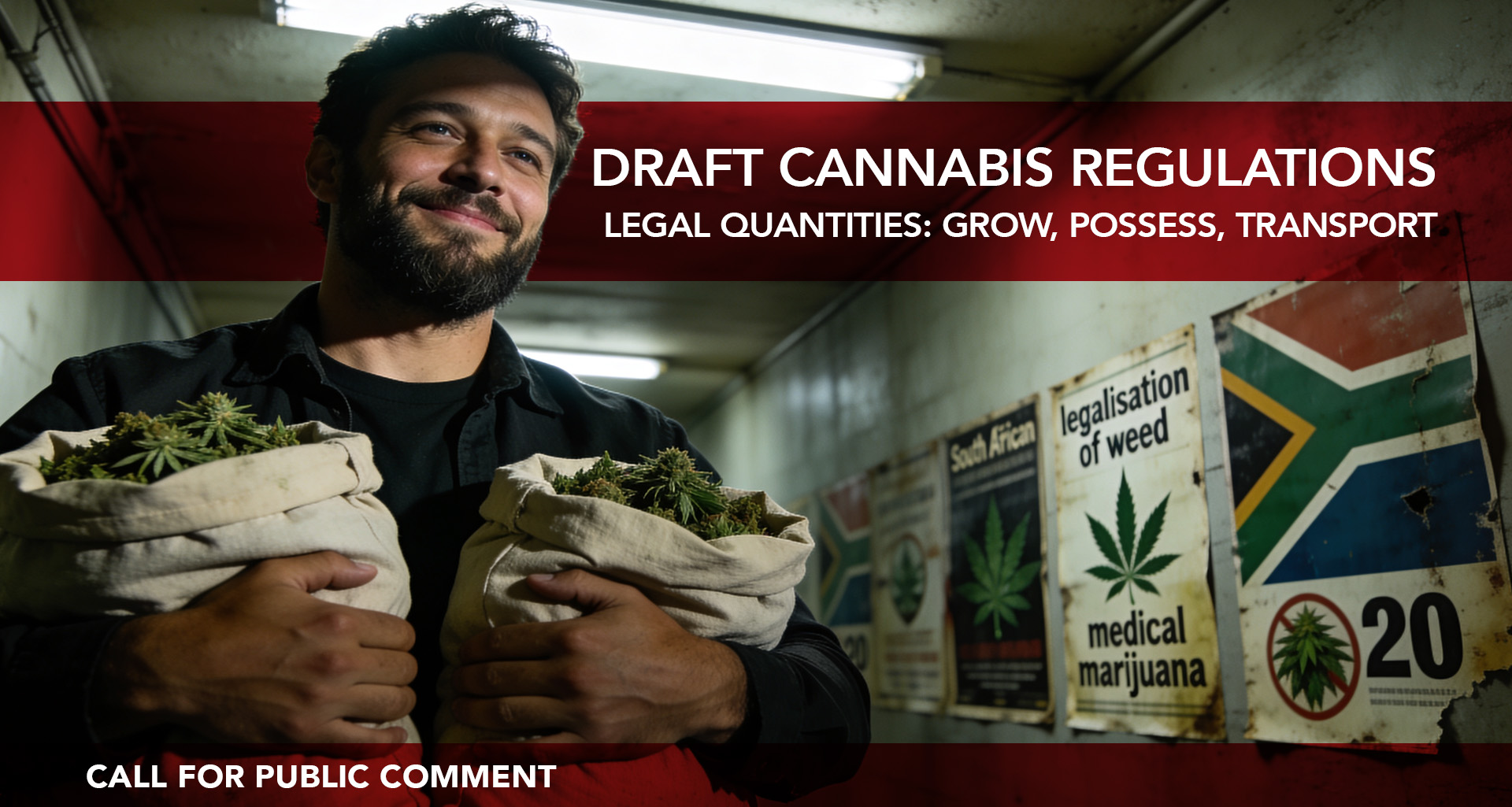
The Department of Justice and Constitutional Development has officially published the long-awaited draft regulations to enforce the Cannabis for Private Purposes Act, 2024. Following the landmark 2018 Constitutional Court ruling that decriminalised the private use of cannabis by adults, these new regulations finally set the specific legal boundaries for how much cannabis South Africans can grow, possess, and transport.
While the stated goal is to protect vulnerable workers, industry professionals warn that applying a blanket, “one-size-fits-all” approach will destroy the flexible, project-based nature of the creative sector.
If implemented, all freelancers would fall under the Basic Conditions of Employment Act, the National Minimum Wage Act, and the Labour Relations Act. This could drastically increase production costs, remove vital tax deductions for independent contractors, and ultimately drive international film and advertising work out of South Africa.
