

- No I do not support the Bill 52
- Yes I do 1
- Not fully 4
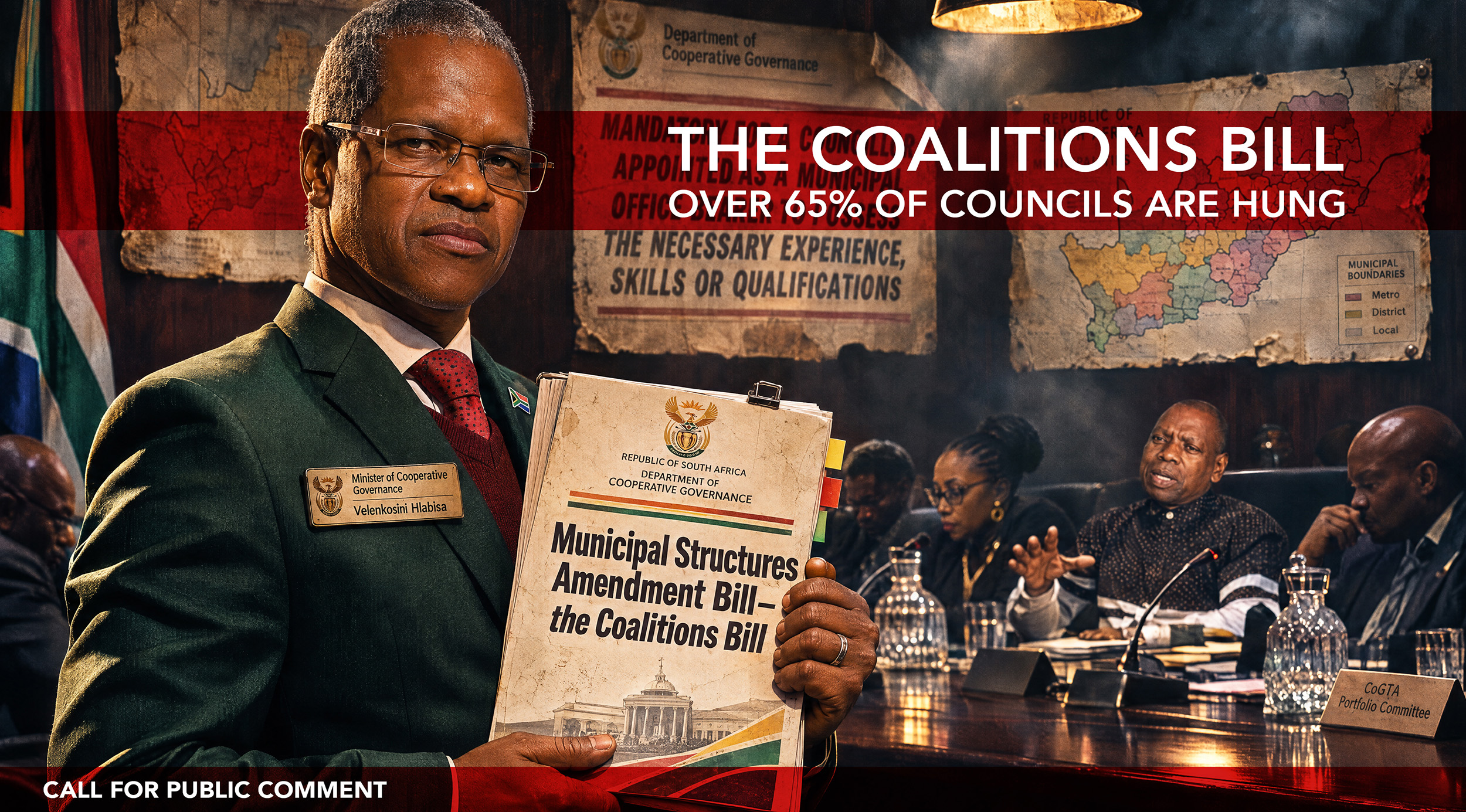
The Portfolio Committee on Cooperative Governance and Traditional Affairs invites stakeholders and interested individuals to submit written comments on the Local Government: Municipal Structures Amendment Bill (B23-2026).
Following the 4 November 2026 Local Government Elections, which produced a record wave of hung councils across South Africa—with roughly 65% of metropolitan and local municipalities (well over 100 councils) failing to produce an outright single-party majority—Parliament is prioritising what is widely known as the “Coalitions Bill”
The Bill seeks to institutionalise and regulate coalition governments to end the “revolving-door” instability, opportunistic motions of no confidence, and service delivery paralysis that have plagued hung municipalities since 2016. Because Parliament halted an earlier attempt to rush the Bill through before the November elections, current post-election coalition talks are still operating under the old 14-day rules and non-binding COGTA guidelines (published on 10 November 2026), making public participation right now critical to shaping the permanent law that will govern these councils for the rest of the 2026–2031 term.
click the link for more info, or scroll down to have your say
Where Do You Stand?
🔴 I OBJECT to the Municipal Structures Amendment Bill in its current form (I oppose restricting council accountability through 12-month removal bans, granting national ministerial control over local coalitions, and leaving loopholes for secret ballots or vague qualification gatekeeping).
🟡 I AMEND / NOT FULLY (I support mandatory public gazetting of coalition agreements and independent opposition-led MPACs, but demand the removal of the 12-month no-confidence freeze, tighter limits on national ministerial regulations, and mandatory open voting).
🟢 I SUPPORT the Municipal Structures Amendment Bill as published (I support establishing binding, gazetted coalition contracts, extending post-election negotiation windows to 30 days, and curbing destabilising motions of no confidence to restore municipal service delivery).
Have your say – shape the regulations.

Top concerns
-
- The Core Risk & Impact:
The Bill imposes a mandatory 12-month “cooling-off” period on motions of no confidence against a municipality’s Speaker (Section 40), Council Whip (Section 41E), Executive Committee members (Section 53), and Executive Mayor or Deputy Executive Mayor (Section 58). Within that 12-month cycle, an office bearer can only be removed if a council proves one of five narrow legal thresholds (constitutional violation, criminal conviction, MFMA financial misconduct, serious Code of Conduct breach, or inability to perform functions). While aimed at stopping frivolous leadership changes, legal analysts and governance watchdogs warn that this turns coalition stability into guaranteed job security—trapping ratepayers and elected councillors under an incompetent, obstructive, or underperforming mayor for an entire municipal budget year.
- The Core Risk & Impact:
Suggested Submission Wording:
“I object to Clauses 6, 8, 10, and 12 of the Bill, which restrict motions of no confidence against municipal office bearers to once every 12 months. Insulating an Executive Mayor, Speaker, or Whip from political removal for a full year—unless a criminal conviction or formal constitutional breach is already proven—strips elected councillors of their primary oversight tool under Section 160 of the Constitution and leaves ratepayers trapped under failing administrations.”
-
- The Core Risk & Impact:
Proposed Section 60A(3) empowers the national Minister of COGTA to prescribe by regulation “the form and manner in which a coalition agreement may be concluded, including dispute resolution mechanisms”. Under Section 151 of the Constitution, local government is a distinct, autonomous sphere of government—not an administrative branch of a national ministry. Allowing a national cabinet minister to dictate how local councils structure and resolve political partnerships invites centralised political interference in opposition-led or multi-party councils. Furthermore, turning political agreements into rigid contracts governed by ministerial dispute rules risks dragging routine municipal disagreements into protracted High Court litigation, especially when COGTA’s own SEIAS risk matrix offers no practical arbitration mechanism beyond “sensitising” parties.
- The Core Risk & Impact:
Suggested Submission Wording:
“I object to proposed Section 60A(3), which empowers the national Minister of COGTA to prescribe the form, manner, and dispute-resolution mechanisms for local coalition agreements. Granting a national cabinet minister regulatory control over local political partnerships encroaches on the constitutional autonomy of municipalities under Section 151 of the Constitution and invites national political interference into local governance.”
-
- The Core Risk & Impact:
Clauses 6, 8, 10, 12, and 17 (amending Schedule 3) codify that the election and removal of a Speaker, Whip, Executive Committee member, or Executive Mayor may be conducted “by show of hands or secret ballot, as decided by the municipal council”. Voters elect ward and proportional representation councillors to represent their mandate openly on the council floor. When a council votes by secret ballot to install or remove an Executive Mayor, ratepayers have zero visibility into whether their councillor honoured their election promises or secretly traded their vote in a backroom deal. Secret ballots in municipal councils shield councillors from electoral consequences and enable clandestine floor-crossing behaviour.
- The Core Risk & Impact:
Suggested Submission Wording:
“I object to provisions in Clauses 6, 8, 10, 12, and 17 that permit municipal councils to elect or remove office bearers via secret ballot. Ratepayers have a democratic right under Section 195 of the Constitution to know how their elected councillors vote on executive leadership. Secret ballots shield councillors from voter accountability and enable clandestine backroom deal-making. Council votes on office bearers must be conducted openly by a recorded show of hands or roll-call vote.”
-
- The Core Risk & Impact:
Clause 2 (proposed Section 21(3)) stipulates that any councillor elected as a municipal office bearer or committee chairperson “must possess the experience, skills or qualifications relevant to local government or be capacitated to perform such functions optimally”. However, the Bill fails to define what constitutes “relevant experience, skills or qualifications” or who adjudicates whether a councillor is sufficiently “capacitated”. Without objective, non-partisan statutory criteria, this vague wording invites subjective political gatekeeping to disqualify legitimate opposition councillors or independent ward representatives from chairing oversight committees or holding office.
- The Core Risk & Impact:
Suggested Submission Wording:
“While I support professionalising local government, Clause 2 (proposed Section 21(3)) introduces vague, undefined requirements that office bearers and committee chairs possess ‘relevant experience, skills or qualifications.’ Without objective statutory benchmarks or an independent verification mechanism, this clause invites subjective, partisan gatekeeping to disqualify legitimate opposition and independent councillors.”
-
- The Core Risk & Impact:
An earlier pre-tabling draft of the Coalitions Bill proposed mandatory electoral thresholds (requiring political parties to win a minimum percentage of votes to qualify for council seats or coalition executives). Although the Office of the Chief State Law Adviser (OCSLA) forced the removal of threshold clauses on 27 May 2026 because they violate Sections 158 and 160(8) of the Constitution, senior leadership within Parliament’s Portfolio Committee on COGTA explicitly stated during briefings that Parliament intends to revisit thresholds during public deliberations. Following the 4 November 2026 elections, smaller community-based parties, ratepayer movements, and independent ward councillors hold the balance of power in dozens of hung councils; re-introducing thresholds would disenfranchise their voters and undermine proportional representation.
- The Core Risk & Impact:
Suggested Submission Wording:
“I strongly oppose any attempt by the Portfolio Committee on COGTA to re-insert minimum electoral thresholds into the Municipal Structures Amendment Bill during public deliberations. As confirmed by the Office of the Chief State Law Adviser, electoral thresholds violate Sections 158 and 160(8) of the Constitution, undermine proportional representation under Section 157, and disenfranchise voters who support smaller civic parties and independent ward councillors.”
-
- The Core Risk & Impact:
COGTA’s own Final Socio-Economic Impact Assessment System (SEIAS) Report (dated 25 June 2026) exposes severe administrative flaws. Despite mandating councillor capacitation, legal drafting, and Provincial Gazette publication of coalition agreements across dozens of hung councils, COGTA budgets R0 (“None”) in the Medium-Term Expenditure Framework (MTEF) and Human Resource Plans. Even more alarmingly, COGTA left the “Constitutional?” verification box blank in Part 3 (Section 8a), falsely claimed there were “None” (zero) stakeholder disagreements despite documented objections from PARI and ACCORD, and explicitly classified “Communities spreading their votes amongst a number / magnitude of political parties” as a voter behaviour that “must be changed”.
- The Core Risk & Impact:
Suggested Submission Wording:
“I draw the Committee’s attention to critical administrative defects in COGTA’s Final SEIAS Report (dated 25 June 2026). The Department’s impact assessment allocates zero budgetary or human-resource provisions for councillor capacitation and legal compliance, fails to confirm the Bill’s constitutionality in Part 3 (Section 8a), and improperly characterises citizens exercising their multi-party democratic right to distribute votes across smaller parties as a ‘behaviour that must be changed’ (Section 2.2). Under Section 195 of the Constitution and PAJA, Parliament cannot enact legislation predicated on an incomplete impact assessment that seeks to engineer voter behaviour rather than enforce executive accountability.”
-
- Why Choose This Option:
Select this option if you broadly support the Bill’s core governance reforms—specifically mandatory publication of coalition agreements in the Provincial Gazette (Section 60A), extending post-election negotiation windows from 14 to 30 days (Clauses 3, 4, 9, & 11), immediate dissolution and prompt replacement of Mayoral Committees when a mayor vacates office (Section 60(5)), and requiring Municipal Public Accounts Committees (MPACs) to be chaired by non-coalition opposition or independent councillors (Section 79A).
- Why Choose This Option:
Suggested Submission Wording:
“I support the core transparency and governance reforms in the Municipal Structures Amendment Bill [B23–2026], specifically the mandatory publication of signed coalition agreements in the Provincial Gazette (Section 60A), the extension of post-election negotiation deadlines from 14 to 30 days, the automatic dissolution and prompt replacement of Mayoral Committees when a mayor vacates office (Section 60(5)), and the requirement that Municipal Public Accounts Committees be chaired by non-coalition opposition or independent councillors (Section 79A).”
Perspectives: What is the debate?
The November 2026 local elections confirmed that coalition governance is no longer an exception—it is the permanent reality for the majority of South Africa’s metros and local towns. The debate over Bill [B23–2026] centres on a fundamental constitutional tension: how to engineer administrative stability without suffocating democratic accountability.
-
- Ending “Revolving-Door” Mayors & Service Collapse:
Since 2016, major metros like Johannesburg, Tshwane, Ekurhuleni, and Nelson Mandela Bay have cycled through mayors every few months. Supporters argue that endless motions of no confidence halt budgets, stall capital projects, and leave residents without water or electricity while councillors trade positions. - Bringing Secret Deals into the Sunlight:
Currently, coalition pacts are often treated as private party documents hidden from voters. Requiring every coalition agreement (and any amendment) to be published in the Provincial Gazette allows ratepayers and civil society to hold coalition partners directly accountable for broken promises. - Protecting Public Watchdogs (MPACs):
Governing coalitions frequently capture Municipal Public Accounts Committees to bury irregular expenditure. Mandating that the MPAC Chairperson come from an opposition party or non-coalition independent councillor—and protecting them from arbitrary firing—restores genuine financial oversight. - Realistic Negotiation Timeframes:
Expanding the post-election window from 14 days to 30 days stops rushed, panic-driven coalitions and gives parties time to negotiate coherent service delivery programmes rather than merely dividing up mayoral committee seats.
- Ending “Revolving-Door” Mayors & Service Collapse:
-
- Insulating Incompetence for a Full Year:
Civil society watchdogs (such as My Vote Counts) and governance analysts warn that stability is not an end in itself. Freezing motions of no confidence for 12 months—unless a leader commits a crime or violates the Constitution—means ratepayers are stuck with an ineffective or paralysed mayor for an entire budget cycle. - Centralising Control in Pretoria:
Allowing the national Minister of COGTA to dictate the structure and dispute-resolution rules of local coalition agreements encroaches on the constitutional autonomy of local government (Section 151 of the Constitution) and creates an opening for national political interference in local councils. - Undermining Representative Accountability via Secret Ballots:
Voters elect councillors to take public stances on who governs their town. Permitting councils to vote by secret ballot on mayors and speakers removes transparency, making it impossible for citizens to know whether their ward councillor honoured their mandate or sold their vote. - Creating Unworkable Legal Deadlocks:
Making coalition agreements legally binding contracts enforceable through prescribed dispute mechanisms risks turning routine political disagreements into protracted High Court battles that freeze municipal administration even further. - Flawed Policy Foundation & Unfunded Mandates:
COGTA’s own Final SEIAS Report (25 June 2026) budgets R0 (“None”) for councillor capacitation and legal compliance, leaves the constitutional verification box blank, and improperly blames voters for “spreading votes amongst a magnitude of political parties” rather than addressing political party misconduct.
- Insulating Incompetence for a Full Year: