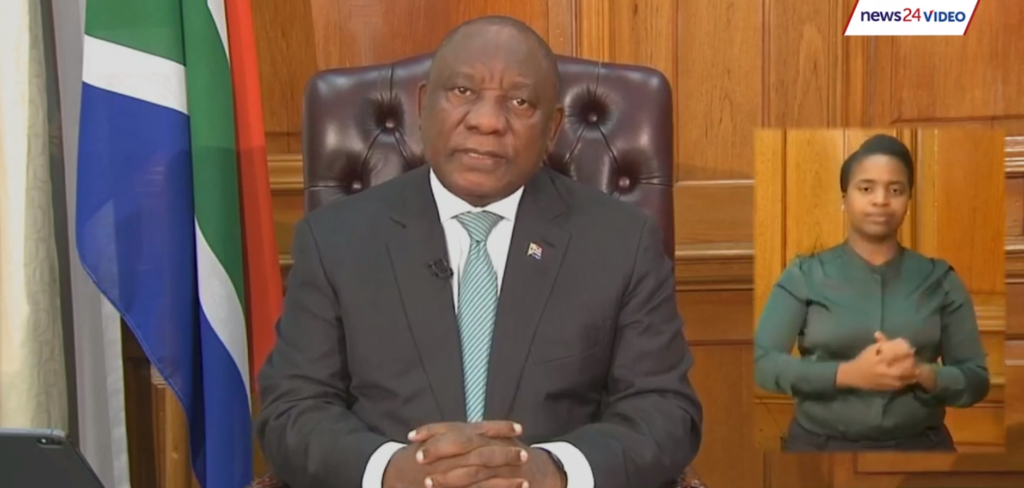
LIVE | Covid-19: Ramaphosa addresses the nation on economic and social relief

SANDF mobilised in one of the biggest deployment in country’s history

President Cyril Ramaphosa has informed Parliament that he authorised the deployment of an additional 73 180 members of the South African National Defence Force (SANDF) to assist the police in battling the spread of Covid-19.

In a letter to the joint standing committee on defence – tweeted by John Steenhuisen, DA leader in the National Assembly – Ramaphosa says the extra service members will be deployed until 26 June 2020 and will augment the 2 280 troops already deployed.

The deployment will cost the fiscus almost R5 billion. The deployment force will consist of regular, reserve and auxiliary forces.Steenhuisen says the development is “very worrying”.

“This seems to suggest that the ‘hard lockdown’ will be enforced longer, beyond next Friday’s deadline. We can’t extend the lockdown into perpetuity. I would rather spend the money on testing and tracing to make sure we know exactly what the extent of the virus is. This (the deployment) is not a good sign.

Friday is going to be a turning point when people get their reduced salaries, debit orders start going off…we hope the soldiers aren’t being called up to enforce the lockown.”

Helmoed-Romer Heitman, an independent defence analyst and correspondent for Jane’s Defence Weekly, says the deployment will rank among the biggest in the country’s history.

“The biggest I can recall was during the election in 1994, and that was certainly bigger than anything during the Bush War. It also seems that almost the entire SANDF is being called up. The total complement is something like 73 000, 74 000, so this is all of it. The Reserve Force takes it up to 85 000, 86 000 service members. So, this is a biggie.”

Cyril Xaba, chairperson of the joint standing committee of defence has confirmed the authenticity of the letter.

– Pieter du Toit

An appeal by 19 SA doctors to President Ramaphosa: End hard lockdown now

Ongoing ‘hard lockdown’ will likely cause far greater suffering in the short and long term than the pandemic itself. As medical doctors who are most at risk, we do not request the easing of the lockdown lightly. But we see far greater harm to our healthcare system and our economy by further delaying the inevitable spread of the virus.

Dear President Ramaphosa,

We, the undersigned doctors, admire the leadership you have shown in managing the outbreak of Covid-19. You have successfully galvanised unanimous support for the tremendous challenge facing us as a country and specifically as the healthcare profession.

It has given the medical community time to prepare for the predicted surge of seriously ill patients. The public has also been handed a clear indication of the gravity of the situation. It has not, however, eradicated the anticipated pandemic from our country, merely delayed it. While in Europe and North America, funding might be available to balance the number of severely ill with the number of hospital beds and ventilators, we do not see this as a viable option for South Africa.

Our healthcare system and the economy were already on their knees at the outbreak of Covid-19. The negative effects of keeping the country on the present “hard” lockdown – or even a relatively “light” lockdown – are innumerable. We appeal to you to lift the hard lockdown as soon as possible.

Many patients without Covid-19 are not getting the treatment they require due to the hospitals being emptied for Covid-19 patients. Many of these patients are avoiding hospitals and having their out-patient appointments cancelled. Disruptions in regular prevention programmes, such as immunisation schedules for infants or sexual and reproductive health promotion will undercut our few hard-won health gains since democracy. Together these are steadily building up a backlog of health care that is potentially a crisis in itself.

Doctors in South Africa have sadly had to become accustomed to the harsh realities of limited funding and limited beds for very sick patients. This means giving less than optimal care and even letting patients die as comfortably as possible on a regular basis. As a country we have bought into an international rhetoric which is a poor fit for local circumstances. We are lucky that the present Covid-19 virus does not predominantly kill young people as the flu virus of 1918 did. It does sadly kill many elderly, but this is still a relatively small percentage of the population; at this stage, we do not know the effects on people living with HIV who are not on treatment and those with TB.  If at all, a vaccine is unlikely to be developed and distributed within less than 18 months. Our economy and our healthcare system will be destroyed if we wait much longer and as always, our poorest citizens will suffer the most.

Although current estimates of mortality are more than six times less than initially estimated, at 0.5%, we are approaching winter and there are myriad reasons why the pandemic will hit South Africans harder in winter months. We cannot afford to stay on “hard” lockdown any longer. Each week that we delay is likely to worsen the outcome of the pandemic.

As the health-related, social and financial side effects start to mount, we would strongly urge a return to work for most people.

Those who can work from home or in isolation should be encouraged to do so, but we feel it is critical that the fit and robust return to work, in a staggered fashion wherever possible. Close attention should be given to ensuring that public transport operators adhere to the revised regulations to minimise the transmission risk to their passengers. It might be prudent to keep certain forms of business closed, especially where people congregate, including bars, clubs and any meetings of groups of people, including faith-based gatherings. Restaurants may be allowed to prepare take-away food or arrange home deliveries.

Some restriction on the sale of alcohol during this crisis probably continues to make sense, as it probably reduces the burden on hospitals from alcohol-related traffic accidents and violence resulting in trauma. Limited household budgets may then be spent on food rather than alcohol. People withdrawing from alcohol may consult doctors for help.

Schools (and higher education institutions) that are able to teach via the internet, may continue to do so if they choose, but the vast majority of children cannot do this and their parents need to go back to work to earn money to feed them. Many of these children need to go to school to access food programmes.

All South Africans should be encouraged to continue washing their hands, maintaining physical distancing and taking other steps to slow the spread. Those that are most at risk, the elderly and the health-compromised, need to continue to try to socially isolate as much as possible and be helped to do so by their communities. Clear guidelines describing how access to different levels of healthcare interventions will be prioritised should be established and widely publicised in a transparent way. This will allow South Africans who are at risk to be forewarned and allow them to take extra precautions to reduce their risk of acquiring the virus.

We have a limited number of healthcare workers so prioritising their health is important. Personal protective equipment (PPE) for healthcare workers needs to be a national priority throughout the pandemic and we hope the government is actively encouraging local industries who can manufacture these to specification to do so immediately.

Last and by no means least, it may be well served to reassure the public, as there is an ill-founded fear that contraction of Covid-19 is fatal, and the misconception that a lockdown would purge us of Sars-CoV-2.  This present fear has caused many people to discount the future of our country, which is currently at risk.

Sars-CoV-2 is here to stay.  The truth is that people will die, but even more will recover. We will do our best as a country and medical fraternity to treat the infected patients, but we also need to start paying attention to the other illnesses which have continued to progress relatively untreated.

As those who are most at risk once the pandemic takes off in South Africa, we do not request this lightly. We see far greater harm to our healthcare system and our economy by further delaying the inevitable spread of the virus. Ongoing “hard lockdown” will likely cause far greater suffering in the short and long term than the pandemic itself.

Sars-CoV 2 and Covid-19 have given us a moment of pause to reflect on many things. We’ve examined our priorities. We’ve refocused on important issues like healthcare and support of the less privileged.

While we hope that lessons learnt will contribute positively to our new normal, it’s time to hit the play button again. If we start the wheels turning soon, we stand a chance of recovering. If we languish at the bottom of this pit, we will do irreparable damage to our future and those of our children.

Life needs to go on if we are to survive in any respectable form. DM

Government explicitly bans sale of all cooked hot food, shutting down planned legal cases

The DA and Sakeliga planned to take the trade and industry minister on, but Cogta has now formalised the ban in new gazetted regulations.

In a statement on Monday, the Democratic Alliance said that Cooperative Governance and Traditional Affairs Minister (Cogta) Nkosazana Dlamini-Zuma had “swooped in at the last minute” to rescue Trade, Industry and Competition Minister Ebrahim Patel from a legal challenge the party was set to announce at 2pm.

Previously, the disaster regulation simply stated that “any food product including non-alcoholic beverages” was fine to be sold.

But a new amendment today has tidied up the loophole, with the new regulations reading “any food product, including non-alcoholic beverages, but excluding cooked hot food”.

Dlamini-Zuma “hurriedly amended the lockdown regulations to explicitly ban the sale of cooked foods in an attempt to put a lid on the public humiliation Minister Patel was subjected to after he stated on the 16th of April that ‘as the law stands’, the sale of cooked food was banned”, according to DA MP Dean Macpherson.

He said this statement had been unlawful at the time and “Patel had to rely on his Cabinet colleague to cure his legal nightmare”.

Only Dlamini-Zuma has the power to gazette new regulations related to the state of disaster declared by the president last month.

The DA was set to approach the High Court in Pretoria to lodge urgent papers to have Patel’s comments declared unlawful as well as seek a personal costs order against him.

However, Monday’s new amendment to the law legalised the previously illegal ban on cooked food.

The party called the move by government both “short sighted and mean spirited, especially for frontline health care workers, members of the security services, essential service workers and transport workers like truck drivers who rely on cooked food due to the work they are doing”.

Macpherson said it would also prove to be particularly devastating for the elderly, who may be unable to cook food due to their frailty.

“I will now write to Patel through our lawyers requesting the reasons for this ban on cooked and prepared food which should be provided to us by midday on Tuesday. We will then be able to decide on our next course of action.”

The DA said they would remain committed to ensuring the executive did not overreach its mandate.

“It is an important test case in the lockdown to ensure that ministers treat citizens with the respect they deserve and are held to account for their actions.”

Business group Sakeliga also threatened legal action against the department of trade and industry unless Patel reversed restrictions on warm or cooked foods.

The group had given Patel until 9am on Monday to respond or they would take legal action.

An unverified legal letter that did the rounds on Twitter said Woolworths’ lawyers also labelled the DTI announcement illegal.

One of its points read: “There is no other provision in the lockdown regulation which prohibits the sale of any category of food.”

However, that has now changed with the new gazetted regulation.

Article by The Citizen

South Africa to Weigh a Wealth Tax to Aid Recovery, Rapport Says

The South African government will consider a proposal for a one-off wealth tax during an economic recovery planning meeting on Monday, according to a report in Rapport.

Such a tax could assist Africa’s most industrialized economy as it bounces back from the coronavirus outbreak and a five-week lockdown that is scheduled to be lifted on April 30. The proposal comes from a group of economists, led by former South African National Treasury budget chief Michael Sachs, the local newspaper reported, citing a plan that was presented to the cabinet last week.

A number of South Africa’s richest citizens, such as Johann Rupert, Patrice Motsepe and Nicky Oppenheimer have already committed large sums to help the country’s government during the crisis. Many executives across the country have also donated one-third of their salaries to the cause.

South Africa plans to slowly reopen parts of the economy, restarting about 50% of its mining production in coming days. It has had more than 3,000 coronavirus infections, with 52 deaths, since its first reported case on March 5.

Article by Bloomberg

President’s co-ordinating council agrees to gradual easing of lockdown

The president’s co-ordinating council on Saturday agreed to the gradual easing of regulations after the lockdown period in an effort to contain the Covid-19 pandemic.

President Cyril Ramaphosa chaired the virtual meeting that brought together ministers, premiers, mayors and local government leaders to assess government’s efforts to curb the spread of the coronavirus.

“The PCC today agreed on the need for a risk-adjusted approach to the resumption of economic activity at the completion of the lockdown period,” a statement from the presidency read.

Presidency spokesperson Khusela Diko said government will be guided by available evidence which supports the ongoing containment of the virus.

This comes after local government minister Nkosazana Dlamini-Zuma said this week that government will not “open the floodgates” by allowing a wholesale end to the lockdown at the end of the month.

This, government conceded, will further impact an already ailing economy.

“The meeting was unanimous that the impact on the SA economy would depend on the pace and magnitude of the interventions which would be required of all social partners,” Diko said.

The PCC meeting agreed that government must put measures in place “to ensure that more cash is put in the hands of households to induce economic activity in the medium term”.

She said this includes the need to fast track the implementation of identified structural reforms — without detailing what this would be.

“Government must also develop an economic recovery plan for municipalities which are expected to bear the brunt of the economic, political and social fallouts from Covid-19 as engines of our national economy and the coalface of delivery.”

Cabinet was expected to come up with an economic plan on Wednesday but that was deferred to a meeting on Monday after consensus could not be reached.

“The meeting further made inputs for Cabinet’s consideration when it meets on Monday, 20 April 2020, relating to the need for an economic reconstruction plan which appreciates the huge damage that Covid-19 would have wrought on the SA economy,” Diko said.

“Since the lockdown, over 100,000 households across the country have been provided with food parcels, with further households being targeted through the  Solidarity Fund and department of social development’s Disaster Relief Fund. The SA Social Security Agency (Sassa) has also set aside over R400m for social relief of distress through food parcels and vouchers to be rolled out on a larger scale. The PCC agreed that these efforts needed to be significantly expanded as a matter of urgency. PCC further emphasised the need for social distress efforts to be dispensed in a manner that upholds the dignity of all beneficiaries,” Diko said.

The top tier of government also agreed to ramp up water provision across the country.

On Friday, there were 50 deaths linked to Covid-19 with 2,783 confirmed cases.

Article by Times Live

‘We are going to court,’ says Tobacco Association over cigarette ban during lockdown

Johannesburg – South Africans will be without alcohol and cigarettes for as long as the lockdown continues.

President Cyril Ramaphosa rejected calls for the lifting of the alcohol ban. He has instead directed liquor sellers to seek economic relief through programmes offered by the government.

This after the Gauteng Liquor Forum demanded that the total ban on alcohol sales be lifted. The forum had previously threatened court action if the ban was not lifted.

It said the ban was unreasonable and unconstitutional. South Africa’s largest brewery, SAB, said while it supported the government’s stance on the ban, it was hoping the government would consider loosening regulations.

“As beer is a product of moderation, we are in full agreement that the responsible consumption of beer should be allowed under strict conditions and we are sensitive to the requirements of the government’s strategy to effectively contain the Covid-19 pandemic,” said spokesperson Refilwe Masemola.

Meanwhile, the Fair-Trade Independent Tobacco Association (Fita), which represents 80% of legitimate and licensed cigarette manufacturers in southern Africa, said it was prepared to go to court should the government persist with the ban on the sale of cigarettes

“We thought that if a positive outcome was achieved with the alcohol ban then the cigarette industry would receive the same treatment. We are going to court,” said chairperson Sinenhlanhla Mnguni.

Fita said it was puzzled by the government’s decision since it would have a devastating impact on South Africa’s economy.

“Government is losing, according to estimates, in the region R1.5 billion a month on excise alone with the ban. When you factor in VAT, corporate income tax and other tax types the figure becomes even greater,” he said.

”This at a time when we are already dealing with huge deficits as far as our tax collections are concerned, with the recent announcement that the SA Revenue Service collected R 66.2billion less than estimated for the last financial year.”

According to the World Health Organization, smokers are likely to be more vulnerable to the virus as they touch their lips while smoking, which increases the possibility of hand-to-mouth transmission.

Mnguni said the ban had not stopped smokers from continuing to buy cigarettes.

“People are sourcing them from underground markets, to the detriment of, inter alia, the fiscus. And this is illegal. “We just want government to authorise, at a minimum, the distribution and sale of cigarettes at retail stores, spaza shops and filling stations.

“This would give the economy a much-needed boost and avoid a situation where our citizens, out of desperation, contravene the regulations.

“The current restrictions cannot be endured for much longer without severe consequences, including for farm workers, factory workers, informal traders, and the many other ordinary South Africans who rely on the tobacco industry for a living.

“This will in all likelihood lead to job losses and/or loss of income for many along the tobacco industry value chain.”

SAB said more than 200000 jobs had been affected.

“Our expansive value chain incorporates a total of almost 4000 suppliers of which 1345 are mostly SMMEs (small, medium and micro enterprises) supporting in excess of 140000 jobs,” said Masemola.

“In addition, our business sources agricultural inputs from more than 1300 farmers of which 750 are emerging farmers.

“Our products are purchased by 34000 wholesale and retail companies, of which the vast majority are SMMEs. We estimate that these wholesalers and retailers support at least 250 000 jobs on their own.”

Saturday Star

SA Lockdown: Hardware stores to reopen

CAPE TOWN – Tradesmen should find it easier to do emergency repairs now in the second phase of the lockdown.

Regulations have been relaxed to allow for the sale of hardware products and motor vehicle components to essential workers.

But they will have to show the necessary permits first.

Plumbers, electricians, locksmiths and roof repairmen.

They are among those who will be allowed to buy from hardware stores under amended regulations.

But still, no items such as paint are allowed to be sold.

Even smaller hardware stores like this, are keeping records of all customers, and what they buy.

Hardware chain Buco has already been operating with selected stores for a few hours each day during the lockdown, allowing regular clients to get what they need.

“It’s been very slow, maybe 10 or 12 clients during the previous three weeks, currently we’ve had 4 or 5 customers this morning. It will be quiet for a while. I think people aren’t aware they can purchase under extreme, or essential,” said BUCO Montague Gardens manager, Brett Schonfeldt.

Schonfeldt says over the past three weeks, clients have mainly needed plumbing supplies and geysers have been the top-selling items.

Major hardware retailer, Builders Warehouse is preparing to open some of its stores from Monday.

Article by ENCA

Khosa family demands an end to abuse of power

The family of Collin Khosa — allegedly killed by members of the South African National Defence Force (SANDF) in Alexandra — have sent a letter of demand to President Cyril Ramaphosa, asking him to explain what steps will be taken to ensure there is no abuse of power during the Covid-19 lockdown.

Khosa — a father of three — died on Friday April 10. A “preliminary medical opinion is that the cause of death is directly related to the assault by the members of the SANDF”, said the letter of demand. A charge of murder has been laid. His family have now also demanded financial compensation for the loss of support.

In the letter, attorney Wikus Steyl of Ian Levitt Attorneys detailed the assault — according to people that were there. He said that female SANDF soldiers came into Khosa’s yard with sjamboks and accused him of breaking the lockdown regulations because they noticed an unattended camping chair in the yard and a “half-full cup of alcohol”.

When Khosa protested that this was lawful, they became agitated, raided his fridge and ordered him outside. They called for backup, said the letter, which included a number of vehicles from the SANDF and the Johannesburg Metro Police Department (JMPD).

Three more SANDF soldiers arrived and, without inquiring any further details from Khosa, they “manhandled and assaulted Mr Khosa in the following manner. In particular, they: poured beer on top of his head and on his body; one member of the SANDF held his hand behind his back, while the other choked him; slammed him against the cement wall; hit him with the butt of the machine gun; kicked, slapped him, punched him on his face and on his stomach and ribs; and slammed him against the steel gate”.

Videos taken by witnesses were deleted by SANDF members, said Steyl. When he was taken to his house, he “later presented with certain signs such as vomiting, losing speech and consciousness and progressively lost his ability to walk”, said the letter. He was declared dead by emergency services, after they arrived.

The letter is also addressed to Defence Minister Nosiviwe Mapisa-Nqakula and to the JMPD’s David Tembe.

Non-derogable constitutional rights 

“In our submission there is no justification of the actions by SANDF and JMPD,” said the letter. The assault was a violation of the constitutional rights to life, dignity and freedom and to be free from all forms of violence, said Steyl.

“Despite the national lockdown, every South African enjoys these rights. As per the provisions of section 37 of the Constitution, these rights are so fundamental that they may not be derogated from, even during a state of emergency,” said the letter.

The letter from Khosa’s family also demands that the SANDF and JMPD publicly condemn the conduct of their members, and for a report on what steps have been taken to discipline them. They also asked for confirmation that the relevant soldiers and police officers “be immediately removed from the public and be placed on suspension, while an investigation is ongoing”.

“This incident shows that members of the defence force believe that they can act with impunity towards vulnerable and poor South Africans. We ask that you explain what steps will be taken to ensure that there is no abuse of power by the SANDF during the lockdown.”

article by Mail and Guardian

SA government plans for Covid-19 to peak in September but questions about data remain

The extended five-week national lockdown has postponed South Africa’s worst-case Covid-19 scenario to September, a government projection shows.

With no lockdown, South Africa was estimated to reach its peak coronavirus infections in July. A five-week lockdown, that has paralysed the economy, is buying the government two more months to prepare for a flooding of hospitals at the end of winter.

This is according to a presentation made to Parliament’s portfolio committee on health this week by the acting director general of the department of health, Anban Pillay, a copy of which News24 has obtained.

It is the most detailed official analysis yet of the current situation that has been made public since the first infection was reported at the beginning of March.

Other key findings in Pillay’s presentation include:

  • In a worst-case scenario, Gauteng would see over 1.5 million Covid-19 infections at the end of winter, followed by KwaZulu-Natal with one million;
  • The country has less than half the number of ventilators needed to deal with peak infection. Public and private hospitals currently have a total of 3 216 ventilators, compared to the 7 000 we need, and
  • The country currently has 4 909 critical care hospital beds available, but the need for beds in intensive care units could exceed 14 700 at the highest level of infection.

Only “severe to critical Covid-19 patients” will be treated at hospitals, while “mild to moderately infected patients” will be accommodated at field hospitals where basic medical care will be provided.

The government’s “readiness for worst case scenario” plan was informed by research from UCT’s Modelling and Simulation Hub Africa. According to this scenario, if the lockdown was suspended this Thursday after three weeks, the peak would have hit the country around 18 August.

Pillay told MPs during a digital meeting of the committee that the health department is seeing a different trajectory in the infection rate compared to countries such as South Korea, Britain, the United States and Spain.

According to Pillay’s presentation, based on statistics prepared by Professor Tulio de Oliveira of the KwaZulu-Natal Research Innovation & Sequencing Platform (KRISP), the gradient of the curve is flatter than some countries which have been seriously affected.

The presentation, which also covers the state of readiness of both the public and private sector, tracking and tracing strategy as well as detail about hotspots across the country, was given to MPs the day after President Cyril Ramaphosa on Wednesday announced an extension to the lockdown until the end of April.

Although Ramaphosa said there is “sufficient evidence” to show the lockdown is working, but that it is too early to make a “definitive analysis of the progression of the disease”, he did not expand on which datasets, epidemiological modelling, or projections the government used to base its decision on to expand the lockdown.

It is known that the National Health Laboratory Service (NHLS), that conducts testing on behalf of government, is not close to reaching is target of 36 000 tests per day.

The president did consult widely before he announced his decision, including with opposition leaders, provincial premiers and representatives of business and labour, but he has not made public what the exact statistics or projections which informed the decision to extend the lockdown from three to five weeks are.

‘Scary’ projections

The presidency on Friday and Saturday did not respond to questions for comment.

A detailed set of questions was sent to presidential spokesperson Khusela Diko on Friday enquiring what metrics the national command council, which is co-ordinating the government’s response to the coronavirus, used to determine that the lockdown must be extended. She did not return a call or respond to a message on Saturday.

John Steenhuisen, the DA leader and leader of the opposition in the National Assembly, says the lack of data on the spread of the virus is concerning.

“There’s a complete absence of empirical data or detail about which metrics government will use to measure whether the lockdown is successful or not. They’re not playing open cards with the public.”

A senior government official privy to the decision-making process said on Saturday afternoon Ramaphosa is informed “by the best brains in the country” before he makes decisions and that extending the lockdown was based on scientific evidence put before him.

The projections which swayed Ramaphosa are “scary”, the official said, and added that government did not want to create panic.

Professor Cheryl Cohen, one of the lead epidemiologists at the National Institute for Communicable Diseases (NICD) told News24 that she hopes the projections given to government will be released soon.

Martin Kingston, the executive chairperson of Rothschild & Co in South Africa, who is co-ordinating the response to Covid-19 by all business formations through Business for South Africa, told News24 he is “satisfied” that the decision to extend the lockdown was based on “the best available scientific evidence at the time”.

“We are in constant dynamic contact with government, from the minister of health to National Treasury, the department of labour and the department of trade and industry. I am absolutely satisfied that the decision was taken with the best available scientific evidence at the time.

“But we all know, and government acknowledges it, that testing is inadequate and needs to be expanded,” he said.

The presentation made to MPs gives insight into the the healthcare system’s state of readiness:

  • According to the latest available information the country has less than half the number of ventilators needed to deal with peak infection. The public healthcare system currently has 1 111 operational ventilators, with 2 105 operational in the private healthcare system for a total of 3 216 ventilators. According to projections the healthcare system would need 7 000 ventilators to deal with the virus, a shortage of 3 784.
  • There are currently only 3 318 critical care beds available, with 2 140 of those in private hospitals; there are 2 722 high care beds in the country, with only 1 082 of those in the public sector; there is a total of 119 416 hospital beds available, across South Africa.
  • During peak infection in an optimistic scenario, and with one lockdown enforced, the peak need for beds in intensive care units could exceed 14 700 beds at the highest level, and 4 100 in the lowest level.

Siviwe Gwarube, the DA’s spokesperson for health, says she is concerned that although the presentation went into more detail than anything seen before, there is still a lack of data available.

“We’re trying to access data, but what we’ve got now is wholly inadequate.”

Article by News 24

EFF reps take salary cuts and welcome lockdown extension — but DA says it’s a ‘mistake’

The EFF has announced that all its public representatives will contribute a third of their salaries to the Covid-19 Solidarity Fund.

The announcement came less than two hours after President Cyril Ramaphosa announced a similar contribution by himself, members of his cabinet, deputy ministers and premiers for the next three months.

Ramaphosa made the announcement while telling the nation that the nationwide lockdown had been extended by two weeks, taking us to the end of April.

The EFF welcomed the extension, but the DA wasn’t convinced, saying that Rampahosa had made a mistake in believing that the decision to extend was a “binary choice between health concerns and economic concerns”.

The EFF said: “As part of our contribution to the fight against Covid-19, all EFF public representatives, inclusive of MPs, members of provincial legislatures, and councillors, will contribute a third of our monthly salaries to the Covid-19 Solidarity Fund,” said party spokesperson Vuyani Pambo.

The party welcomed the decision of the national executive and all premiers of contributing a third of their salaries to the fund, and called on all public representatives in all spheres of government — and all employed people with adequate disposal income — to do the same so that the country can assemble enough resources to fight the rapid spread while still safeguarding SA’s fiscal sovereignty.

It also registered opposition to the government asking for loans from “rapacious” international institutions such as the World Bank and International Monetary Fund, whose loans, it said, will come with irrational and often dangerous conditions.

The EFF welcomed the extension of the lockdown by an additional 14 days as a measure to contain and subsequently eliminate the spread of the coronavirus.

It called upon all South Africans to abide by the lockdown regulations.

“We believe that it should only be a scientific and data based analysis of the spread that should lead to the suspension of the lockdown.

“While we welcome the extension of the lockdown, we are not convinced that government has taken adequate measures to mitigate against the economic and subsistence consequences on ordinary people,” he said.

The party called on the government to impose an interest-free payment holiday for three months for all people who cannot afford to make the monthly payments due to the lockdown.

The DA was critical of Rampahosa’s decision to extend the lockdown, labelling it a mistake.

The party said it would have preferred a gradual phasing out of the current lockdown over the coming weeks, as opposed to a continuation of the severe and economically-crippling regulations.

“Our great concern is that President Ramaphosa has justified this extension as if we face a binary choice between health concerns and economic concerns. We believe it is a great mistake to think in terms of lives versus livelihoods.

“This is a false dilemma. Rather, the difficult trade-offs to be made are between lives lost or damaged by Covid-19, and lives lost or damaged by the drastic measures to contain its spread,” said John Steenhuisen.

He said the country had limited resources and the government had to take difficult decisions, taking into account both seen and unseen costs.

“This is the role of government: to make tough choices for the greater good for the greater number, while not forgetting that behind every statistic is a human story,” said Steenhuisen.

Ramaphosa announced SA had recorded 1,934 confirmed cases and 18 deaths as of Thursday.

“Each death resulting from the virus is a tragedy. But so is each death resulting from caged citizens and frustrated law enforcers, and so is each victim of home violence. And each malnourished child. And each newly unemployed South African,” said Steehuisen.

Article by TimesLive