

- No I do not support the regulations 211
- Yes I do 5
- Not fully 58
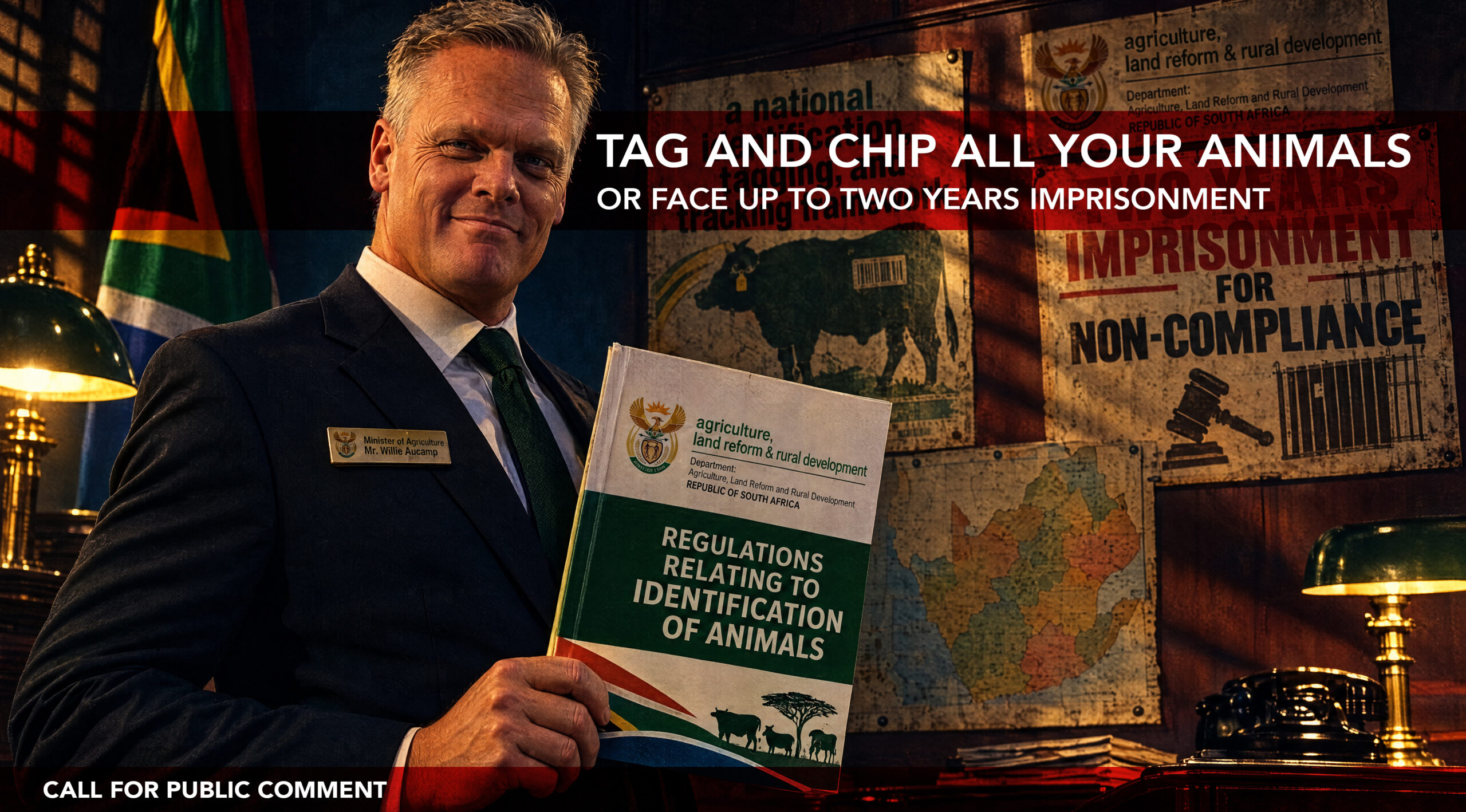
The Minister of Agriculture has gazetted proposed Regulations Relating to Identification of Animals under Section 28 of the Animal Improvement Act, 1998 (Act No. 62 of 1998).
The draft establishes a national identification, tagging, and tracking framework requiring declared animals and livestock to be marked with approved analogue and digital devices, captured on the Integrated Registration and Genetic Information System (INTERGIS), and tracked across every movement, ownership transfer, and disposal.
While the red meat and livestock industry recognises that national animal traceability is critical to contain disease outbreaks (such as Foot-and-Mouth Disease) and combat stock theft, the draft framework introduces severe administrative, technical, and constitutional concerns.
click the link for more info, or scroll down to have your say
Where Do You Stand?
🔴 I OBJECT to the Draft Regulations Relating to Identification of Animals in their current form
(Rejects the unconstitutional 2-year prison penalty, statutory conflict with Act 6 of 2002, exclusion of domestic pets, and the punitive, unfunded compliance burden placed on smallholder and communal farmers.)
🟡 I AMEND / NOT FULLY
(Supports the urgent need for a National Livestock Identification and Traceability System to curb stock theft and biosecurity threats, but demands excising companion animals, capping penalties to the legal 6-month limit, deleting the 90-day tag deactivation rule, and introducing a phased, subsidised transition for communal farmers.)
🟢 I SUPPORT the Draft Regulations Relating to Identification of Animals as published
(Supports universal mandatory animal identification, double ear-tagging, strict movement controls, and central INTERGIS recording to protect national biosecurity and reopen international meat export markets.)
Have your say – shape the regulations.

Top concerns
-
- The Regulatory Clause:
Regulation 19 prescribes a fine or imprisonment for a period not exceeding two years for any contravention of the regulations. - The Core Risk & Impact:
Subordinate regulations cannot exceed the statutory authority granted by Parliament. Section 25 and Section 28 of the enabling Animal Improvement Act 62 of 1998 cap penalties at six months’ imprisonment. Imposing a 2-year criminal sentence via regulation is ultra vires (exceeding legal powers), unconstitutional, and administratively defective. Threatening farmers and citizens with excessive prison sentences over administrative tagging procedures violates administrative justice.
- The Regulatory Clause:
-
- The Regulatory Clause:
Enacted under Section 28 of the Animal Improvement Act 62 of 1998. The - Core Risk & Impact:
Act 62 of 1998 was legislated to govern stud breeding, genetic material (semen and ova), and livestock pedigree improvement. Universal livestock identification, branding, and ownership marks are specifically governed by the Animal Identification Act 6 of 2002. Attempting to enforce a national Livestock Identification and Traceability System (LITS) through the genetic improvement statute bypasses the correct legal framework, creating confusion, institutional overlap, and regulatory vulnerability.
- The Regulatory Clause:
-
- The Regulatory Clause:
Regulations 2, 3, 4, 5, and 6 require every owner to purchase approved digital/analogue devices, maintain on-farm registers, report tag losses within 7 days, and interface with the INTERGIS database. - The Core Risk & Impact:
South Africa’s communal and subsistence livestock owners manage millions of cattle and goats in areas lacking internet access, electricity, and veterinary extension services. Without state-subsidised tags, handheld RFID readers, and physical support infrastructure, these rules will disenfranchise rural farmers, criminalise customary livestock keepers, and exclude them from legal livestock trade.
- The Regulatory Clause:
-
- The Regulatory Clause:
Regulation 6(9) deactivates unused tags after 90 days; Regulation 9(3) mandates tagging lambs within 3 weeks; Regulation 10(3) requires tagging piglets within 1 week; Regulation 20 brings the law into operation immediately upon final gazetting. - The Core Risk & Impact:
Bulk purchasing of ear tags is standard farm practice; automatically deactivating unused tags after 90 days causes severe financial losses and supply chain gridlock. Tagging piglets at 7 days or moving lambs at 3 weeks is biologically and logistically impractical in extensive grazing environments. Promulgating these rules without a multi-year transitional runway ignores the reality of tagging tens of millions of existing national livestock.
- The Regulatory Clause:
-
- The Regulatory Clause:
Regulation 15 includes dogs (requiring identification devices, tattoos, or microchips), while Regulation 14 includes rabbits. - The Core Risk & Impact:
Conflating domestic household pets with agricultural livestock under an animal improvement statute designed for livestock breeds has caused panic. The Department must explicitly clarify that companion animals and non-agricultural domestic pets are completely excluded from agricultural herd registers, INTERGIS compliance, and commercial movement bans.
- The Regulatory Clause:
-
- The Regulatory Clause:
Regulations 2, 5, and 6 establishing double-tagging (visual and RFID) and colour coding for disease surveillance. - The Core Rationale:
A credible, functioning national animal identification and traceability system (LITS) is urgently needed to safeguard South Africa against catastrophic disease outbreaks (such as Foot-and-Mouth Disease), protect national biosecurity, deter stock theft, and reopen critical international export markets for South African red meat producers.
- The Regulatory Clause:
Perspectives: What is the debate?
-
- Biosecurity & Disease Traceability
Double tagging (visual and RFID) and disease-zone colour coding allow veterinary authorities to trace animal movements instantly during Foot-and-Mouth Disease (FMD) outbreaks, preventing nationwide export bans. - Stock Theft Mitigation
Requiring unique identification devices linked directly to registered brand marks and registered holding cards provides law enforcement with definitive proof of ownership to curb rampant stock theft. - Smallholder & Rural Impact
A single national database ensures that all livestock in South Africa—regardless of farm size—meets phytosanitary standards, integrating communal farmers into the formal commercial value chain. - Statutory & Legal Soundness
Section 28 of Act 62 of 1998 gives the Minister broad executive powers to regulate the identification of declared breeds to ensure genetic purity and herd standards. - Domestic Pet Inclusion
Standardising microchips and registration databases protects companion animals, aids recovery, and aligns with international companion animal welfare practices.
- Biosecurity & Disease Traceability
-
- Biosecurity & Disease Traceability
Traceability is vital, but centralising it on the cumbersome INTERGIS system without mobile-first, offline-capable field technology will collapse under rural administrative constraints. - Stock Theft Mitigation
Criminal syndicates routinely obliterate tags and falsify papers; penalising legitimate farmers with two years in prison for clerical errors does not stop organised livestock crime syndicates. - Smallholder & Rural Impact
Unfunded compliance mandates (costing R150–R275 per head for tags, readers, and registrations) will wipe out profit margins for subsistence and small-scale livestock owners. - Statutory & Legal Soundness
Act 62 is a breeding and genetics statute. Applying it universally to all livestock creates an unlawful statutory conflict with the Animal Identification Act 6 of 2002, and the 2-year prison penalty is strictly ultra vires. - Domestic Pet Inclusion
Regulating domestic pet dogs and rabbits under an agricultural livestock breeding act is legislative overreach that creates unnecessary public fear of criminal prosecution.
- Biosecurity & Disease Traceability