

- No I do not support the government's plans 182
- Yes I do 1
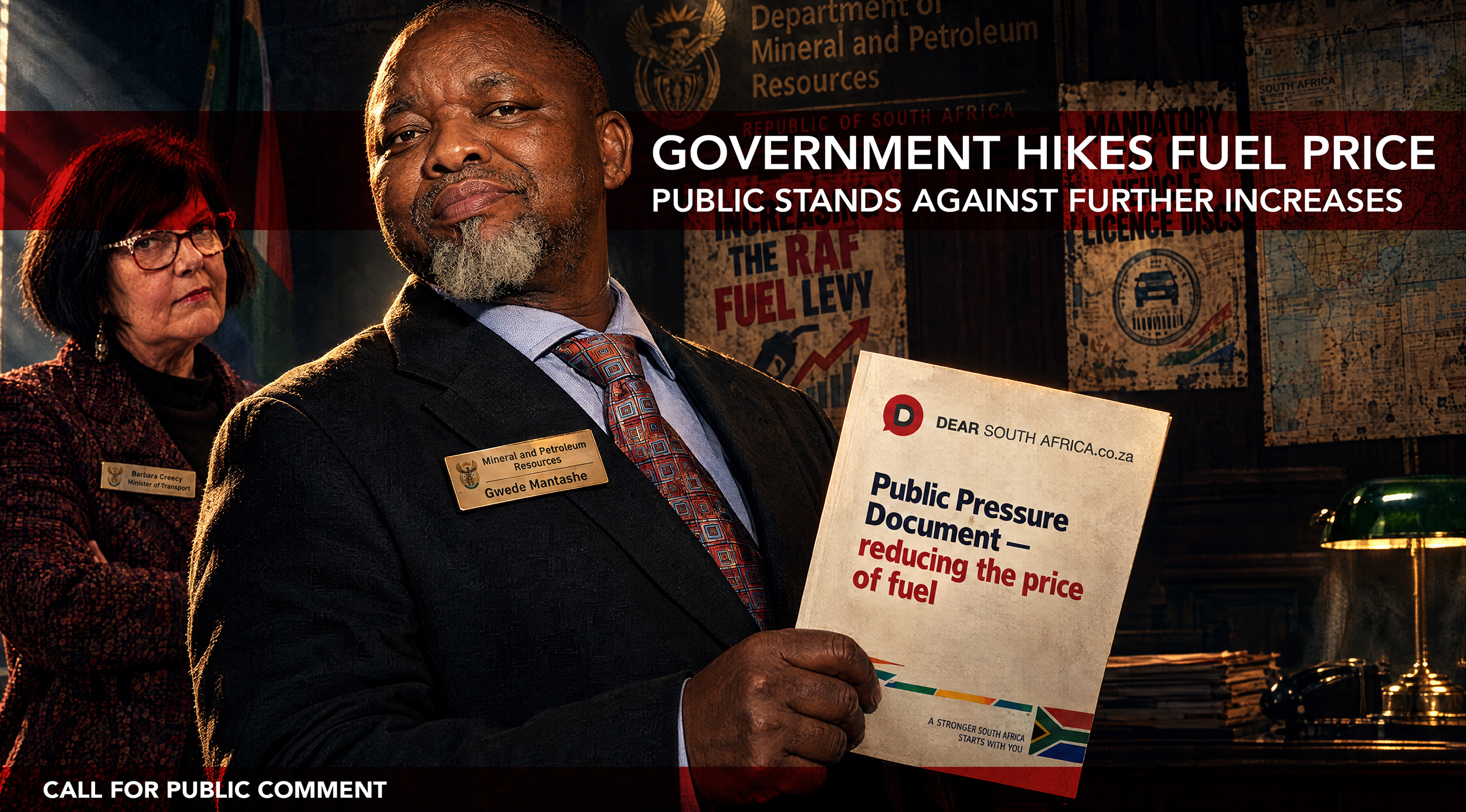
South Africans face an unprecedented cost-of-living crisis as November brings a historic fuel spike—projected at +R4.58/litre on petrol and nearly +R3.00/litre on diesel.
Instead of intervening, the state is engineering an aggressive double-tax:
-
- Refusing Proven Relief: Between April and 30 June 2026, National Treasury proved fuel tax cuts work by slashing petrol levies by R3.00/l and diesel to R0. Levies snapped back on 1 July, and Treasury now refuses to reinstate relief despite record price shocks.
- The RAF Pump Squeeze: The Road Accident Fund has formally asked Treasury to hike its fuel levy to R3.00 per litre—a 33% increase.
- The Licence Disc Surcharge: The Department of Transport is drafting a mandatory annual licence disc renewal tax, ostensibly for electric vehicles but penalising every vehicle owner nationwide.
You are invited to comment.
click the link for more info, or scroll down to have your say
Where Do You Stand?
🔴 NO, I OBJECT to the R3.00/litre RAF hike and the licence disc tax, and DEMAND the reinstatement of fuel levy relief
(Rejects double-taxing motorists at both the pump and the annual renewal counter; demands that National Treasury immediately reinstate the emergency General Fuel Levy relief measures that expired on 30 June 2026 to neutralise projected record price shocks; opposes bailing out RAF administrative waste and multi-billion-rand legal fee leakages; and calls for retail petrol price deregulation into a maximum price cap.)
🟡 I AMEND / NOT FULLY
(Supports financial solvency for road accident victims and addressing electric vehicle road-use parity, but demands the immediate reinstatement of the GFL relief measures ended in June 2026; insists on strict legislative caps on RAF litigation fees; requires any new transport fees to be strictly ring-fenced to non-combustion electric vehicles; and demands maximum price caps on retail petrol to unlock station competition.)
🟢 YES, I SUPPORT the proposed revenue measures as published by government
(Backs allowing the mid-2026 fuel levy relief to remain permanently retired; supports increasing the RAF fuel levy to R3.00/litre to stabilise accident victim compensation; agrees with introducing a mandatory licence disc renewal surcharge to secure road revenue as fuel consumption declines; and maintains the existing regulated pricing model.)
Have your say – shape the regulations.

Top concerns
-
- The 2026 Precedent:
Between April and 30 June 2026, National Treasury proved that temporary fuel tax cuts are legally, procedurally, and fiscally viable. Treasury lowered the General Fuel Levy (GFL) by up to R3.00/l on petrol and waived the diesel levy entirely to R0.00/l before phasing it out on 30 June 2026. - The Current Failure:
The expiration of that relief on 30 June 2026 snapped fuel taxes back to R4.10/l on petrol and R3.93/l on diesel. In the face of a projected November increase of R4.58/l, sitting idle while extracting full statutory taxes is economically destructive.
- The 2026 Precedent:
Points for Your Submission:
-
- Demand that the Minister of Finance immediately reinstate the emergency General Fuel Levy reduction measures that were terminated on 30 June 2026.
- Require National Treasury to institute a permanent, statutory counter-cyclical buffer: whenever landed Basic Fuel Price (BFP) under-recoveries exceed extraordinary levels, the GFL must automatically scale down.
-
- The Proposal:
The Department of Transport is drafting regulations to attach a mandatory annual levy to motor vehicle licence disc renewals, while the RAF is simultaneously lobbying to raise the fuel levy to R3.00 per litre. - The Underlying Issue:
Motorists already contribute over R6.00/litre in combined statutory taxes every time they fill their tanks. Adding a secondary surcharge onto annual licence discs forces vehicle owners to pay twice for the same basic mandate. For commercial fleets, logistics operators, and low-income motorists, this fixed overhead will lead to widespread non-compliance, swelling the number of unlicensed, unroadworthy vehicles on public roads.
- The Proposal:
Points for Your Submission:
-
- Object to converting provincial and municipal vehicle licence renewals into an unaccountable bailout mechanism for state entities.
- Highlight that adding fixed annual renewal surcharges during a cost-of-living crisis will penalize compliance and harm fleet businesses.
-
- The Underlying Issue:
The Road Accident Fund’s financial insolvency is not caused by inadequate fuel levy collections—Treasury already transfers over R48 billion annually to the Fund. The deficit is driven by procedural backlogs, billions lost to private attorney litigation fees, administrative waste, and duplicate medical claims. - The Risk:
Raising the fuel levy to R3.00/litre and adding a licence disc tax simply pours capital into an unreformed institution without resolving the systemic liabilities that caused the deficit.
- The Underlying Issue:
Points for Your Submission:
-
- Demand that Parliament and Treasury reject any levy increase until the Road Accident Fund Act is fundamentally reformed to cap legal fees and transition to a no-fault, statutory benefit model.
- Require full forensic accountability regarding the Fund’s internal litigation expenditure before any additional taxpayer revenue is granted.
-
- The Proposal:
The Department of Transport claims the licence disc tax is necessary because electric and new-energy vehicles consume zero fuel and therefore contribute R0 to the RAF via the fuel levy. - The Underlying Issue:
Instead of designing an equitable, ring-fenced road-user charge strictly applicable to registered electric vehicles, the Department is preparing a blanket tax that penalises millions of internal combustion engine (ICE) motorists who are already paying the fuel levy every week.
- The Proposal:
Points for Your Submission:
-
- Reject using EV adoption as an excuse to impose broad taxes on conventional motorists.
- Insist that any alternative road-use charges apply strictly to non-fuel-burning vehicles and never duplicate existing fuel taxes.
-
- The Underlying Issue:
Under the Petroleum Products Act, retail petrol prices remain legally fixed by the state down to the cent. While diesel retailers can discount margins to compete for consumer volume, petrol stations face criminal penalties if they offer retail discounts.
- The Underlying Issue:
Points for Your Submission:
-
- Call on the Minister of Mineral and Petroleum Resources to amend retail petrol price regulations from a fixed price to a maximum price cap.
- Enable service stations and independent retailers to discount margins at the pump, passing commercial competition savings directly to road users.
Perspectives: What is the debate?
-
- Securing Third-Party Accident Support: The Road Accident Fund provides an essential constitutional and social safety net for vulnerable road users, pedestrians, and low-income accident victims who cannot afford private medical insurance. Without financial solvency, the Fund faces collapse.
- Adapting to New Technology: As the automotive fleet gradually transitions toward hybrid and electric vehicles, traditional fuel levy collections will decline. Introducing alternative funding streams ensures all road users contribute equitably to the compensation system.
- Revenue Predictability: Relying solely on volumetric fuel sales exposes statutory bodies to volatile global oil markets and fuel demand destruction. A fixed annual licence disc charge provides steady, predictable income to settle medical claims.
-
- The Reality of Double Taxation: Charging motorists over R6.00/litre in fuel taxes while simultaneously adding a secondary surcharge onto annual licence discs punishes vehicle owners twice for the same basic public service.
- Refusing to Deploy Proven Relief: Earlier in 2026, government proved it could slash the General Fuel Levy (even cutting diesel tax to zero) to shield consumers. Refusing to reinstate that relief during a projected R4.58/l surge while plotting new taxes is indefensible.
- A Blank Check for Legal Inefficiency: The RAF’s deficit is not caused by inadequate taxpayer support, but by systemic mismanagement, billions lost to attorney contingency fees, and procedural backlogs. Granting extra levies without fixing internal governance disincentivizes genuine reform.
- Economic Shocks and Food Inflation: Fuel is the primary operational input for agriculture and freight transport. When combined with impending international fuel price shocks, state-induced tax hikes directly accelerate grocery inflation, taxi fares, and small business closures.