

-
-
- No I do not support the draft Bill 689
- Yes I do 4668
- Not fully 431
-
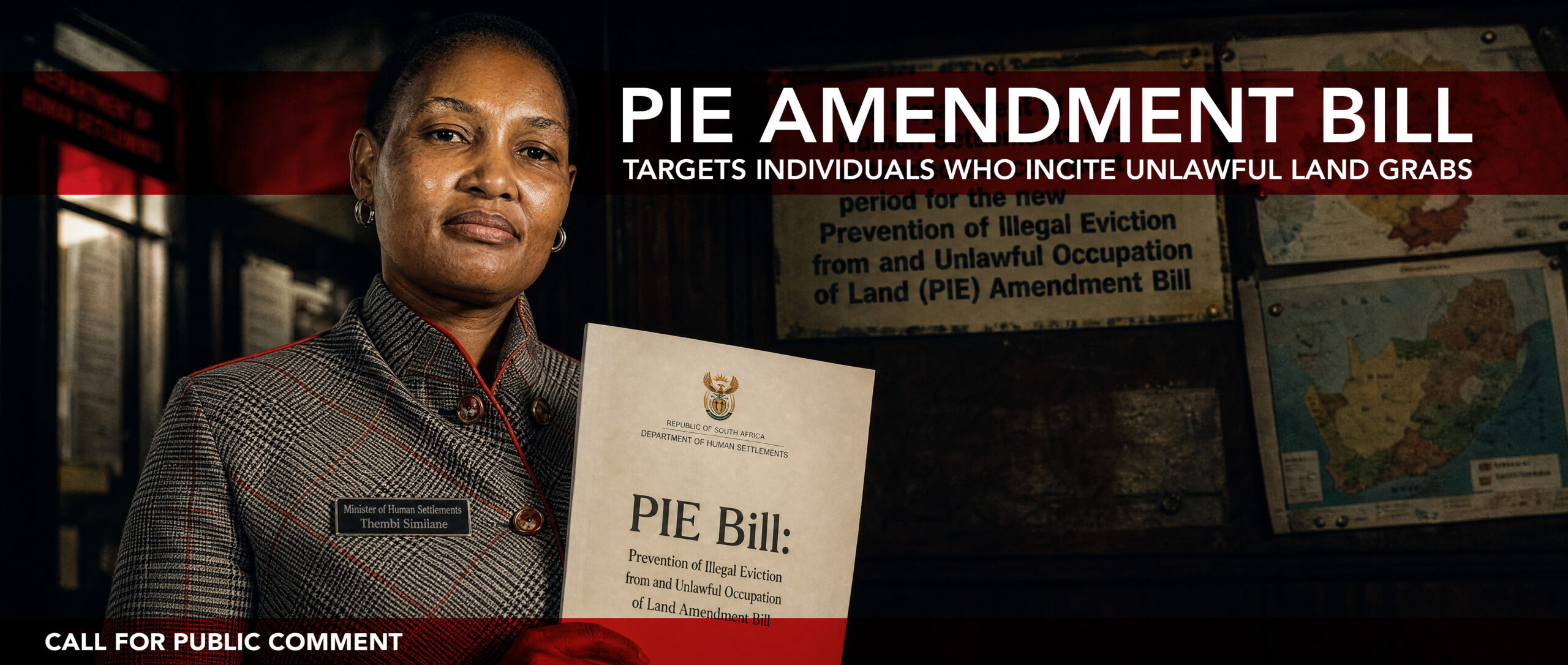
The Department of Human Settlements officially released the Draft Prevention of Illegal Eviction from and Unlawful Occupation of Land Amendment Bill, 2026 for public comment.
This draft Bill proposes significant overhauls to the existing PIE Act of 1998, introducing strict criminal penalties for property invasions and re-shaping how evictions and alternative accommodation are handled across South Africa.
The Minister of Human Settlements, Thembisile Simelane, has invited citizens to have their say. The public has 60 days from the publication date of 16 April 2026 to submit written comments.
Why this matters: The government notes that South Africa is facing an unprecedented surge in unlawful land occupations and high-rise building hijackings. While these amendments aim to protect property owners and relieve heavily burdened municipalities, they also introduce critical changes affecting the rights of vulnerable groups and the provision of temporary shelter.
click the link for more info
Have your say – shape the Bill. [CLOSED]

Top Public & Legal Concerns: PIE Amendment Bill, 2026
The proposed amendments represent one of the most radical overhauls of South Africa’s property and eviction laws since 1998. While property owners and developers generally welcome stricter measures against land invasions, human rights organisations and legal experts have flagged serious constitutional concerns.
-
- Constitutionality & Homelessness: Concern that allowing evictions without alternative housing violates the Constitution and spikes street homelessness.
- Property Rights & Investment Protection: Support for stricter, faster eviction procedures to protect private property and restore developer confidence.
- Broad Criminal Definitions: Concern that the R2 million fine and incitement definitions could penalize NGOs and community leaders instead of just criminal syndicates.
- Administrative Clogging: Concern that forcing provincial and municipal departments into every court case will delay justice for property owners.
- Loss of Long-Term Occupier Protection: Objection to treating long-term residents the same as fresh land invasions by removing time-period distinctions.
The main areas of contention are divided below into the key pillars of the debate:
Eviction Without Alternative Housing (Section 4(14)):
-
- The Text: The Bill gives courts explicit permission to grant an eviction order without requiring a municipality or the state to provide alternative land or shelter.
- The Concern: Human rights advocates argue this directly violates Section 26(3) of the South African Constitution, which protects citizens against evictions that lead to immediate homelessness. Opponents fear this will cause a severe humanitarian crisis, pushing families onto the streets.
- The Counter-Perspective: Property owners and developers argue this clause is a vital lifeline. Under the current law, private owners are forced to carry the financial burden of unlawful occupiers for years simply because heavily burdened municipalities fail to provide alternative accommodation.
Fixed Expiration Dates on Emergency Shelter (Section 4(13)(b)):
-
- The Text: Where a court orders temporary alternative accommodation, it must stipulate a strict expiration date for how long that shelter remains available.
- The Concern: Critics question what happens to vulnerable families when that timer runs out. Without a long-term housing plan, this clause may simply delay homelessness by a few months rather than solving the underlying socio-economic issue.
The Definition of “Incitement” (Section 3(1)(b)):
-
- The Text: It creates a major criminal offence for anyone who incites, arranges, or organises a land occupation, regardless of whether they received money. Conviction carries a fine of up to R2,000,000.00, two years in prison, or both.
- The Concern: Legal aid clinics and community activists worry the text is written too broadly. There is concern that an NGO worker, community leader, or human rights advocate offering basic advice or assistance to a desperate community could be accused of “arranging” or “permitting” an unlawful occupation, exposing them to catastrophic fines.
- The Counter-Perspective: Proponents emphasize that massive criminal syndicates (often called “shack lords”) systematically orchestrate land invasions and building hijackings for profit. Strict penalties are viewed as the only effective way to dismantle these organized operations.
Scrapping the 6-Month Rule (Section 4(6) & 4(7)):
-
- The Text: The Bill deletes the historical legal distinction between someone who has occupied land for under six months versus over six months.
- The Concern: Previously, if someone occupied land for more than six months, the court had to heavily scrutinize whether alternative land was available before granting an eviction. Removing this timeframe means established communities who have lived on a piece of land for years are procedurally treated with the same urgency as someone who arrived days ago, stripping long-term residents of a crucial legal shield.
Judging Individuals on Neighborhood Trends (Section 5(1)(bA)):
-
- The Text: In urgent eviction cases, the court must now consider the general “pace, scale, and frequency” of land occupations in that specific area.
- The Concern: Legal scholars argue that an individual’s or family’s constitutional rights should be judged strictly on the merits of their specific case. Factoring in the broader neighborhood’s “frequency” of land invasions means a court could fast-track an eviction simply to make an example out of an area, punishing individuals for the independent actions of others.
Mandatory Joinder of Two Tiers of Government (Section 4(2A) & 5(2A)):
-
- The Text: It is now a mandatory requirement that both the local municipality AND the provincial department of human settlements are formally joined as legal parties to every single eviction case.
- The Concern: Private property owners fear this will create a massive bureaucratic bottleneck. Provincial departments and local municipalities are already notorious for delayed legal responses. Forcing both tiers of government into every eviction application could cause simple court cases to drag on for months or years, driving up legal expenses for landowners.
Perspectives: What is the debate?
The Draft PIE Amendment Bill, 2026, represents a fundamental clash between two core constitutional principles: the protection of private property rights (Section 25) and the right to access adequate housing and protection from arbitrary eviction (Section 26).
Here is what the different sides are saying to help you weigh your stance.
Private Owners Cannot Carry the State’s Housing Burden:
Supporters argue that under the current 1998 PIE Act, private landowners and developers are practically forced to accommodate unlawful occupiers for years. This happens because heavily burdened municipalities lack alternative shelter, draining the financial resources of law-abiding owners.
Dismantling Organized Crime and Syndicates:
Proponents point out that land invasions and high-rise building hijackings are rarely organic acts of desperation; they are increasingly run by highly organized criminal syndicates (“shack lords”) who unlawfully extract rent from the poor. Extreme penalties—like the R2 million fine, asset forfeiture, and prison sentences—are necessary to break these syndicates.
Relieving Municipal Financial Stress:
Forcing local governments to provide emergency shelter indefinitely is financially breaking South African cities. Giving courts the power to issue eviction orders without mandatory alternative housing, and placing strict expiration dates on emergency shelters, will safeguard municipal budgets for basic service delivery.
Managing Equally Regardless of Time:
Scrapping the 6-month rule closes a loophole where occupiers intentionally try to delay legal actions just long enough to secure enhanced legal protections, allowing landowners to act efficiently to recover their property.
A Direct Violation of the Constitution:
Opponents argue that Section 4(14) of the Bill—which allows evictions to occur without requiring alternative housing—directly violates Section 26(3) of the South African Constitution, which explicitly protects citizens against evictions that result in immediate homelessness.
Spur a Massive Humanitarian and Homelessness Crisis:
Human rights organizations warn that removing the obligation to provide alternative shelter and putting “timers” on emergency accommodation will not solve the housing shortage. Instead, it will simply displace thousands of vulnerable families, leading to a catastrophic spike in street homelessness.
Criminalizing Human Rights and Poverty Support:
Critics flag that the text defining “incitement” and “organizing” is dangerously broad. There is serious concern that an NGO worker, community leader, or human rights lawyer offering basic legal advice or emergency relief to an informal settlement could be accused of “permitting” or “arranging” an invasion, exposing them to ruinous fines.
Stripping Protections From Established Communities:
Deleting the distinction between short-term and long-term occupiers strips historic protections from long-standing informal settlements. Established, multigenerational communities could find themselves procedurally fast-tracked for eviction in the exact same manner as a fresh land invasion.