

- No I do not support the development 3977
- Yes I do 29
- Not fully 101
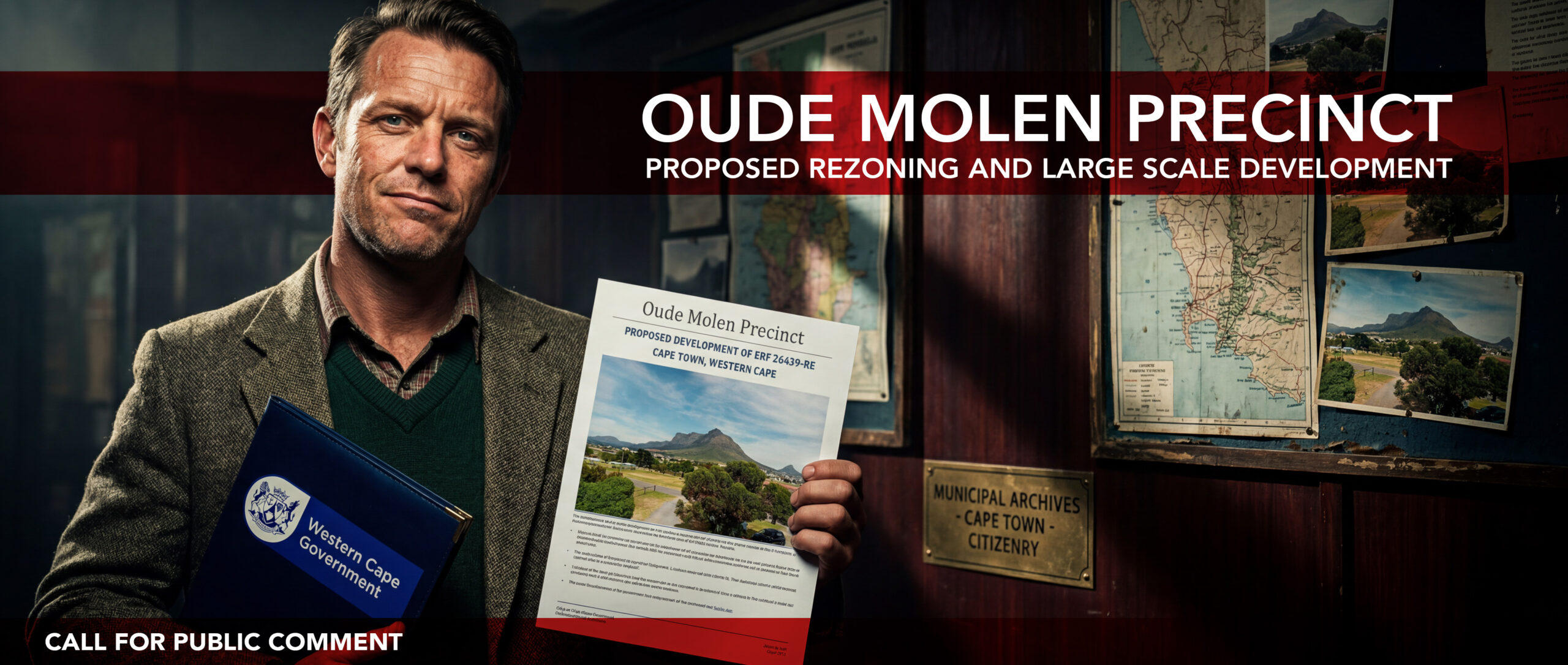
The Western Cape Government applied to rezone and redevelop the 13-hectare, publicly owned Oude Molen Precinct in Pinelands.
The current proposal intends to replace a long-established, low-density green space with a high-density, eight-storey mixed-use development introducing roughly 1,364 residential units, extensive commercial office spaces, and retail infrastructure.
The Statutory Roadblock: On 10 June 2026, Heritage Western Cape’s Appeals Committee officially dismissed the applicant’s appeal and upheld the outright refusal of the Heritage Impact Assessment (HIA), confirming it fails to comply with Section 38(3) of the National Heritage Resources Act (NHRA). Despite the heritage authorization standing rejected, the City of Cape Town is pushing forward with the land-use application anyway. Public comments close on 30 June 2026.
click the link for more info
Have your say – shape your city. [CLOSED]

Top concerns
The City cannot lawfully approve a development framework while the underlying statutory heritage assessment stands rejected under Section 38(3) of the NHRA. The applicant’s HIA misapplied the statutory framework by using a restrictive, “vertical” definition of heritage transmission to dismiss living heritage as defined in Section 2(xxi). The River Club litigation firmly foregrounded intangible heritage and First Nations consultation as substantive considerations—obligations this application flouts. Wide-ranging formal objections from multiple recognised Khoe and San houses expose early claims of indigenous endorsement as false, confirming that the proposal destroys a contiguous cultural landscape.
The existing community at Oude Molen provides essential care, educational, therapeutic, and cultural services that depend entirely on the tranquil, semi-rural character of the site. These activities are a direct continuation of the 130-year-old institutional “continuity of purpose” belonging to the surrounding Valkenberg therapeutic landscape, which historically utilized land-based care and agricultural rehabilitation. Displacing the Robin Trust, the holistic schools, the eco-gardens, and the equestrian therapy facilities destroys a functioning social ecosystem that delivers immense public value. These living heritage resources have been completely excluded from the project’s social impact considerations.
The public participation process is fundamentally flawed because the models and illustrations published for public feedback do not depict the maximum limits for height, bulk, and density quietly established within the legal framework. This creates a highly inaccurate impression of the project’s true physical scale. Crucially, once the City approves this framework, all subsequent planning phases are legally constrained to implement within those maximum parameters, leaving the public with severely limited scope to influence or alter the scale of development at later stages.
There is clear, document-backed evidence that this administrative process is not being conducted in good faith. Official Western Cape Government materials presented to international financiers at the Western Cape Investment Summit in November 2025 explicitly misrepresented the project as a fully cleared, “derisked” opportunity with completed heritage authorizations and finalized public participation. In reality, the HIA had already been found non-compliant by Heritage Western Cape in June 2025, a revised assessment had not been submitted, and public feedback windows remained open. Forcing a land-use approval through while ignoring active legal rejections confirms that the outcome has been completely predetermined.
This is a high-value parcel of public land. It currently delivers substantial, measurable social and environmental value to the citizens of Cape Town at zero cost to the municipality. Any disposal, rezoning, or high-density development of public land must serve the genuine public interest, rather than being alienated for private commercial exploitation under a loose framework.
An area-wide Heritage Impact Assessment for the broader, deeply historic Two Rivers Urban Park landscape was never completed. The overarching heritage process was abruptly suspended, and the Local Spatial Development Framework was pushed through regardless. By deferring heritage impacts to individual sites and then choosing to ignore site-level rejections, the City is systematically fragmenting a contiguous cultural landscape without evaluating cumulative, landscape-scale damage.
This application cannot be viewed in isolation. It is part of a wave of concurrent mega-developments along the same corridor, including Riverlands, Conradie Park, and the redevelopment of the King David Mowbray Golf Course. The cumulative strain on infrastructure has never been independently audited. Local schools are already over-capacity following the Conradie Park rollout, traffic gridlock is expanding, and the transport framework relies on a new train station for which no confirmed budget or commitment has been made by PRASA.
The applicant’s marketing relies heavily on claims that one-third of the development will consist of social and affordable housing. However, the framework documents explicitly state that the inclusion of these units is non-binding and entirely contingent on future “financial feasibility” assessments. There is no enforceable legal mechanism in this application to guarantee that affordable housing will ever materialise. The City should not grant permanent, high-density development rights based on voluntary targets that a private developer can easily abandon later.
The 13-hectare site directly borders the sensitive Black River corridor and wetland system. Despite the intense scale and density of a five-storey proposal, no independent Environmental Impact Assessment (EIA) has been conducted. The site is a documented habitat for protected species, including the endangered Western Leopard Toad. Pushing this rezoning through without evaluating the cumulative ecological impacts alongside neighboring mega-developments violates basic environmental sustainability principles.
Perspectives: What is the debate?
To help you make an informed decision, here is a summary of the core arguments being advanced by supporters and opponents of the redevelopment proposal:
Undoing Spatial Apartheid: Proponents argue that Oude Molen represents a key opportunity to utilize well-located public land to bring working-class families closer to the city center.
Housing Delivery: Pushing forward with mixed-use spaces provides a 34% allocation for social and affordable housing units to address Cape Town’s acute housing backlog.
Claimed Job Creation: Section 6.6.1 of the Motivation Report claims the development will generate 900 full-time equivalent employment opportunities across construction and operational phases.
Transit-Oriented Development (TOD): Planners argue that maximizing density next to major transport and medical corridors builds a compact, sustainable city.
Unlawful Heritage Procedural Bypassing: Pushing land-use approvals through while the HIA stands officially rejected under Section 38(3) of the NHRA is premature and legally non-compliant. Wide-ranging formal objections from multiple recognised Khoe and San houses expose early claims of First Nations endorsement as false.
Calculated Net Loss of Jobs: While the state promises 900 jobs, they hide the baseline reality. Robin Trust alone employs 410 people on-site. Combined with the schools, stables, food gardens, and small enterprises, the site already supports hundreds of secure, local operational jobs. The proposal represents a net employment loss, not a gain.
The Private School Bait-and-Switch: Early public engagement used the promise of new educational facilities. However, Section 5.2 of the April 2026 Motivation Report explicitly reveals that the proposed school will be private, noting that the Department of Education confirmed there is no planned public school provision for the site.
Threat to Level 1 Trauma Emergency Access: The Traffic Impact Assessment admits that capacity on Alexandra Road is already critically constrained at the Berkley and Raapenberg Road intersections. Pushing thousands of new daily vehicle trips onto this bottleneck directly threatens emergency vehicle response times to the neighboring Vincent Pallotti Level 1 trauma unit.
Security & Operational Strains on Valkenberg Hospital: The proposal demolishes the historic secure buffer zone for Valkenberg Psychiatric Hospital, placing vulnerable psychiatric patients at risk and severing long-standing land-based therapeutic and occupational therapy integrations.
Erasure of Living Heritage: Critics point out that the developers use a narrow, outdated definition of heritage that ignores “horizontal” community transmission and mistakes “archival silence” (the colonial omission of marginalized group records) for an absence of living culture and First Nations history.
Destruction of a Fragile Social Ecosystem: Pushing high-density concrete blocks will permanently displace a 30-year-old self-sustaining village of tenants providing invaluable services of high public value, much of it free or low cost, including the Robin Trust medical care, two holistic schools, eco-gardens, and equestrian therapy facilities for disabled children.
Unenforceable Affordable Housing Claims: Financial fine print within the framework indicates that the “one-third affordable housing” pledge is non-binding and completely contingent on future private developer financial feasibility study outcomes.
Misleading Master Plans & Constrained Oversight: While the development framework fixes maximum height and bulk parameters, the illustrations provided to the public fail to depict these maximums, masking the true density. Once these land-use parameters are approved, subsequent processes are entirely constrained within those maxima, leaving the public with severely limited scope to influence or alter the scale of development at later stages.