
Advert
Advert – scroll down
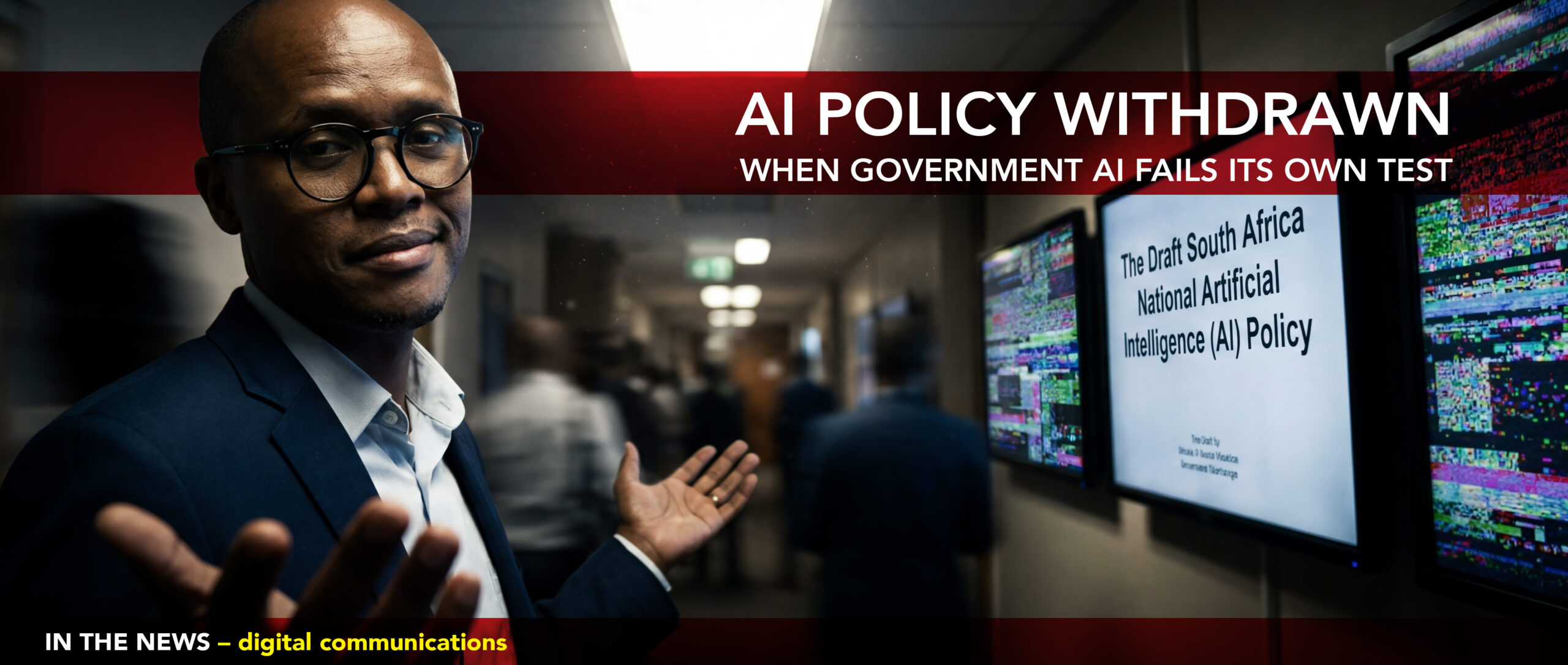
THE HALLUCINATED POLICY: WHEN GOVERNMENT AI FAILS ITS OWN TEST
There is a profound, almost poetic irony in watching the very custodians of our national technology policy get tripped up by the exact tools they are attempting to regulate.
On 10 April 2026, the Department of Communications and Digital Technologies (DCDT) published the highly anticipated Draft National Artificial Intelligence (AI) Policy in Government Gazette No. 54477. It was intended to establish a structured, 60-day public comment window to guide South Africa’s approach to an AI-driven future. Instead, just over two weeks later on 26 April 2026, the entire policy was abruptly withdrawn by Minister Solly Malatsi.
The reason? A catastrophic failure of human oversight. The foundational 86-page document, meant to serve as a strategic blueprint for the country, was exposed for containing a reference list packed with completely fabricated, AI-generated citations. In the tech world, this is a classic “AI hallucination”—where large language models confidently invent facts, sources, and links that do not exist. In a government gazette, however, it is a national embarrassment.
What makes this blunder truly remarkable is how directly it violates the explicit directives contained within the draft policy itself. The document spent pages outlining the critical importance of safety, professional accountability, and human control over automated systems.
Consider the stark disconnect between the department’s words and their actions:
-
- The “Human-in-the-Loop” Failure: Section 9.6.1 of the policy heavily advocated for a Human-in-the-Loop (HITL) approach, declaring that “critical AI decisions involve human oversight… ensuring oversight at all development stages”. Yet, it is painfully obvious that no qualified human official bothered to verify the accuracy of the source material before appending the Minister’s name and pushing it to the Government Printer.
- Neglecting Professional Responsibility: The policy mandated the development of a strict code of conduct for AI professionals, noting that standards must be created to help developers and organisations meet “ethical issues arising from their work”. By publishing automated text without fundamental fact-checking, the DCDT demonstrated the exact type of professional negligence they claim to oppose.
- Traceable Accountability: The text noted that “Organisations must take responsibility for the outcomes of their AI systems… This accountability must ultimately point to an attributable official or entity”. Minister Malatsi took heed of this specific principle in his withdrawal statement, acknowledging that the lapse compromised the state’s credibility and promising strict consequence management for those responsible for drafting and quality assurance.
Integrity Requires Research. At Dear South Africa, our core mission is to facilitate public participation—shaping policy by delivering citizen speech directly to government decision-makers. Naturally, when a policy as sweeping as the National AI Strategy drops, the public deserves a platform to dissect it.
However, we did not run a campaign for this draft document.
This situation is a fantastic, real-time display of why we refuse to blindly release a campaign the moment a gazette hits the press. Constructing a meaningful public participation campaign demands rigorous internal research, meticulous analysis, and deep consultation before anything is published on our platform.
Maintaining institutional integrity is everything to us. We cannot ask citizens to dedicate their valuable time, energy, and intelligence to critiquing a policy frame built on synthetic hallucinations and administrative laziness. Had we rushed to launch a campaign without doing our homework first, we would have validated a ghost document and compromised the credibility of the entire public participation process.
By holding back and executing our standard due diligence, we allowed the structural flaws of the draft to expose themselves. The fact that the document was pulled within 16 days proves that rushed, unverified policy formulation cannot withstand basic scrutiny—and it vindicates our careful, research-first approach.
The Real Danger: A Digital Competency Crisis
Minister Malatsi stated with humility that the unacceptable lapse proves why vigilant human oversight over the use of artificial intelligence is critical. While his quick decision to withdraw the document and enforce internal accountability is commendable, the broader implications are deeply worrying.
The DCDT is the apex department entrusted to lead South Africa’s digital policy environment. If the individuals tasked with crafting the rules for advanced machine learning tools cannot safely navigate using those exact tools to compile a reliable reference list, how can we trust them to regulate high-risk use cases in financial systems, healthcare, or national infrastructure?
This incident is a warning shot. AI holds massive potential for inclusive economic growth and public sector efficiency in South Africa. But technology is only as good as the human guardrails governing it.
South Africans do deserve better. We deserve a digital policy framework written by human minds, backed by verified research, and processed with absolute professional integrity. When the DCDT is ready to present a legitimate, robust, and human-verified AI policy, DearSouthAfrica’s thoroughly researched platform will be ready to let the country shape it. Until then, let this serve as a lesson: if you let AI do your homework, expect to get caught.