
Advert
Advert – scroll down
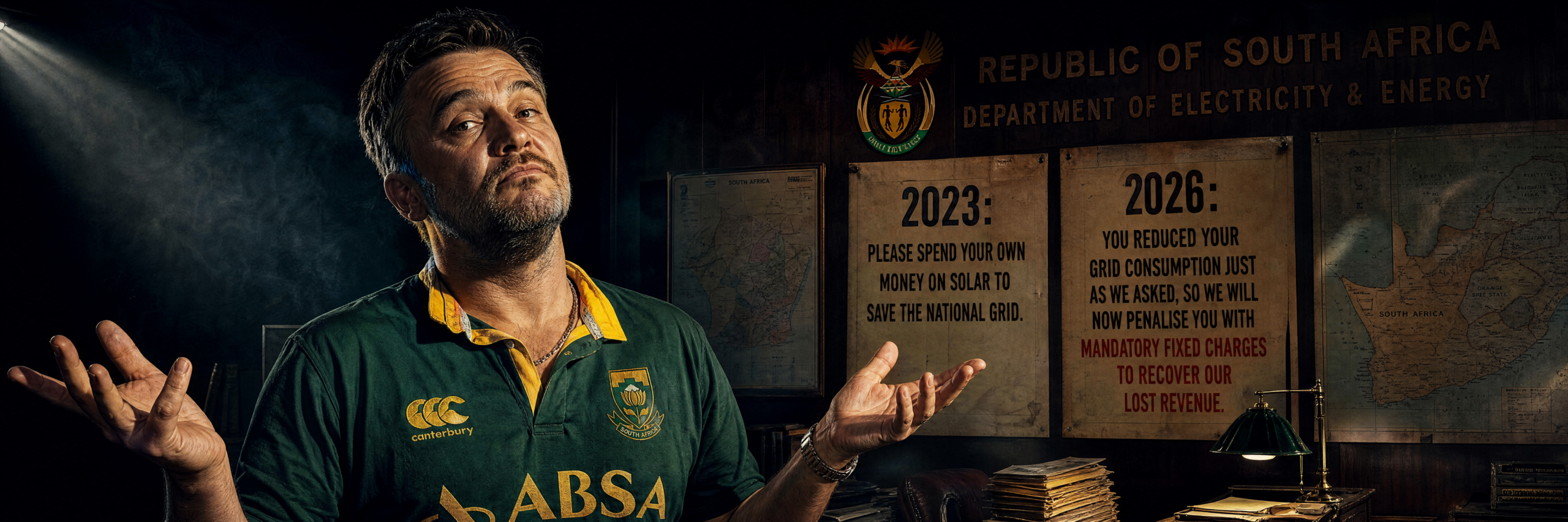
THE GREAT SOLAR BAIT-AND-SWITCH: HOW THE STATE RECRUITS CITIZENS TO SAVE THE GRID, THEN PENALISES THEM FOR DOING SO
By Rob Hutchinson
There is a distinct regulatory cynicism in watching a government plead with its citizens to spend their own life savings to resolve a national crisis, only to brand those very same citizens as economic freeloaders the moment the crisis abates.
Between 2022 and 2024, when rolling blackouts crippled the South African economy, the national government issued an urgent, unequivocal plea to the private sector and ordinary households: generate your own power, install rooftop solar, and take the pressure off an overburdened national grid.
To accelerate that private bailout, the state deployed explicit statutory incentives. In the 2023 Budget, National Treasury introduced the Section 6C solar tax rebate, offering individuals up to R15,000 (a 25% tax rebate) to purchase rooftop photovoltaic panels. Simultaneously, Eskom stepped forward to waive registration and connection-related costs for residential Small-Scale Embedded Generation (SSEG) systems up to 50 kVA, even rolling out smart meters at no charge—a programme so critical to system stability that its fee waiver remains extended through to 30 September 2026.
South Africans responded in droves. Across suburbs, industrial parks, and farms, households and small business owners invested tens of billions of Rands in solar panels, inverters, and battery banks. Together, private citizens quietly added thousands of megawatts of rooftop capacity, carrying the country through its darkest economic hour and single-handedly shaving peak daytime demand off Eskom’s collapsing coal fleet.
Now, enter August 2026.
With load shedding temporarily suspended and daytime electricity sales dropping, the Department of Electricity and Energy published its Electricity Sector Market Transformation Position Paper (Government Gazette No. 55226).
Tucked neatly inside its technical market design is a foundational guiding principle titled “Discourage free riding.”
In a staggering display of regulatory whiplash, the state’s position paper argues that because solar-equipped households consume fewer kilowatt-hours from the grid while remaining connected for backup, they are no longer paying their “fair share” of fixed infrastructure costs. The proposed remedy is a sweeping structural overhaul: shifting retail billing away from volumetric consumption (paying for the electricity you actually use) toward mandatory, high fixed monthly capacity and network charges for every grid-connected property.
The message from the state has completed a full 180-degree pivot:
-
- 2023: “Please spend your own money on solar to save the national grid.”
- 2026: “You reduced your grid consumption just as we asked, so we will now penalise you with mandatory fixed charges to recover our lost revenue.”
The Legal Doctrine of “Legitimate Expectation”
This policy contradiction is not merely bad economics; it represents an egregious violation of administrative rationality under South African constitutional law.
Under Section 33 of the Constitution and the Promotion of Administrative Justice Act (PAJA), state action must be lawful, reasonable, and procedurally fair. Within our jurisprudence lies the established doctrine of substantive and procedural legitimate expectation.
When organs of state actively induce private citizens to alter their financial position—through statutory tax incentives, ministerial speeches, and formal utility connection waivers—the state creates a legally binding representation. Citizens acted in good faith on the premise that reducing grid reliance was an officially sanctioned public good that would deliver long-term operational savings.
For the Department to turn around while Eskom’s SSEG connection fee waivers are still legally active and gazette a policy designed to claw back those household savings via unavoidable fixed fees is the textbook definition of an administrative bait-and-switch. You cannot invite citizens to invest under one set of rules and then retrospectively change the tariff architecture to neutralise the return on that investment.
Protecting Inefficiency at the Expense of Innovation
The economic logic underpinning this “anti-free-riding” levy is as flawed as its legal standing.
By penalising households that invested in solar, the government is treating the national electricity grid not as an enabling platform for a modern, decentralised economy, but as an extractive monopoly whose historical debt must be serviced at all costs.
Worse still, the Position Paper establishes a deeply inequitable, two-tiered system:
-
- The Corporate Open Market: Large industrial power users exceeding 1 MW will be designated as “Eligible Customers,” free to bypass municipal lines and contract directly with private renewable traders or buy cheaper wholesale electricity on the new South African Wholesale Electricity Market (SAWEM).
- The Captive Residential Class: Ordinary households and small businesses will remain “Captive Customers,” legally trapped inside municipal distribution boundaries.
If high-volume corporate clients leave municipal supply while rooftop solar households are hit with punitive fixed charges, who carries the burden of municipal revenue shortfalls and failing local infrastructure? The captive ratepayer.
The Power of the Administrative Record
Policy white papers and government gazettes are often treated by the public as foregone conclusions, but they are not. The publication of the Market Transformation Position Paper triggered a mandatory 30-day statutory public comment window under PAJA, closing on Sunday, 20 September 2026.
When citizens sign generic online petitions, government consideration committees routinely bundle them together and count them as a single collective submission. But when you lodge a substantive, individualized legal comment detailing policy irrationality, statutory contradictions, and financial prejudice, the Department of Electricity and Energy is legally mandated to read, catalog, and evaluate that input on the official administrative record.
If the government attempts to enact mandatory fixed solar fees without addressing this glaring policy contradiction, an unassailable record of public objections becomes the primary evidence required to challenge the policy in the High Court.
The state asked South Africans to step up and keep the lights on. South Africans delivered. We must now ensure that our reward for solving the national power crisis is not a permanent, state-mandated penalty on self-reliance.
Public comments on the Electricity Sector Market Transformation Position Paper close on 20 September 2026. Citizens, solar owners, and business operators can lodge their formal, PAJA-enforceable submissions directly to the Department of Electricity and Energy via the Dear South Africa platform at dearsouthafrica.co.za.