ROLLING THE DICE IN THE DARK:

SOUTH AFRICA’S PATCHWORK APPROACH TO GAMBLING REGULATION

South Africa is in the midst of a gambling boom. Driven by widespread smartphone adoption and an aggressive surge in marketing, the industry saw an estimated R1.5 trillion wagered in the 2024/2025 financial year alone. Yet, while the digital betting landscape evolves at breakneck speed, our regulatory framework is hopelessly stuck in the analog age.

Rather than implementing a cohesive national strategy to protect consumers and the economy, lawmakers are currently applying a disjointed patchwork of band-aids.

Take, for instance, the recently gazetted Draft National Gambling Amendment Regulations. The Department of Trade, Industry and Competition (DTIC) is proposing strict new rules, including a centralised national database to track excluded problem gamblers. On paper, this sounds like a necessary safeguard. In reality, these regulations apply almost exclusively to physical, brick-and-mortar casinos. They focus heavily on security guards visually identifying problem gamblers at the door, completely ignoring the digital elephant in the room: the millions of South Africans carrying a casino in their pocket.

Why is the government ignoring the online space? The tragic irony is that they aren’t—they just haven’t finalised the paperwork.

Comprehensive legislation designed to modernise our industry and nationally regulate interactive online gambling was actually drafted and passed by Parliament back in 2008. But for over 15 years, the National Gambling Amendment Act of 2008 has been gathering dust, sitting unsigned on the President’s desk due to endless political wrangling over provincial revenue sharing.

Because this national legislation remains in limbo, we are left with a fractured system where the internet is borderless, but our gambling laws are strictly provincial. Currently, an online sports betting operator can secure a license from just one Provincial Licensing Authority—say, the Western Cape or Mpumalanga—and legally operate nationwide. That single licensing province reaps all the tax revenue, while the other eight provinces are left to deal with the localised social fallout of problem gambling without seeing a cent of the financial benefit.

Recognising this imbalance, National Treasury recently stepped in with a blunt instrument. They have proposed a sweeping 20% national tax on gross gambling revenue from all online betting. Framed as a “sin tax” to internalise the societal costs of problem gambling, the proposal is an attempt to bypass the provincial licensing monopoly and funnel cash directly into the national fiscus. However, attempting to tax a digital industry that remains largely unlegislated at a national level is putting the cart before the horse. Industry experts warn that slapping a punitive tax on top of existing provincial levies could simply drive operators and punters straight into the hands of unregulated, offshore black markets.

Meanwhile, civil society has had enough. In response to mounting pressure over the “scourge” of betting logos dominating sports jerseys, television screens, and billboards, the DTIC is now scrambling to finalise stringent new gambling advertising regulations by July 2026. The Advertising Regulatory Board is simultaneously pushing for strict new codes to keep gambling ads away from minors and limit the use of influencers.

We are currently witnessing a regulatory scramble: Treasury is trying to tax the digital space, the DTIC is trying to censor its marketing, and provincial boards are hoarding its revenues—all while the actual law meant to govern interactive gambling remains unsigned.

Treating the symptoms without curing the disease is unsustainable. South Africa does not need more piecemeal amendments targeting physical slot machines while the digital world burns. We need a unified, modernised national framework that acknowledges the reality of borderless internet gambling, protects vulnerable citizens, and creates a fair, transparent economic environment.

With deadlines for public comment on Treasury’s 20% tax proposal and the Draft National Gambling Amendment Regulations closing soon, the window for citizens to weigh in on this legislative mess is open. It is time for the public to demand a sensible, comprehensive approach before the government gambles away any chance of effective regulation.

Sincerely,

Rob Hutchinson, founder DearSouthAfrica.co.za
MY BUDGET TIP FOR THE MINISTER OF FINANCE

Proposal: Adjustment of the VAT Registration Threshold from R1 million to R2 million

1.⁠ ⁠Historical Context and Inflationary Correction

The compulsory VAT registration threshold has remained stagnant at R1 million since 2009. Over the past 17 years, the purchasing power of the Rand has diminished significantly. When adjusted for cumulative inflation, R1 million in 2009 is equivalent to over R2.3 million in today’s terms. By maintaining the status quo, the Treasury is effectively lowering the barrier for entry into the VAT system every year, capturing smaller and more vulnerable businesses that the original 2009 legislation intended to protect. A shift to R2 million is a vital correction to reflect current economic realities.

2.⁠ ⁠Protecting Thin Profit Margins

Small businesses operate in a highly competitive landscape where profit margins are often razor-thin. For a business turning over R1 million to R2 million annually, the administrative and financial weight of VAT compliance is disproportionately high. When these businesses are forced to register, they face a “lose-lose” scenario: raise prices and lose customers to informal competitors, or absorb the 15% cost and face insolvency. Lifting the threshold allows these SMMEs to remain price-competitive while they stabilise.

3.⁠ ⁠Reducing the Administrative and Compliance Burden

VAT compliance is not just a financial cost; it is a massive productivity drain. Small business owners are typically the primary operators, accountants, and administrators. The complexity of VAT filing—and the severe penalties for clerical errors—diverts essential focus away from growth and job creation. Increasing the threshold provides a “regulatory breathing room,” allowing businesses to scale their internal systems before taking on the complexities of the VAT net.

4.⁠ ⁠Preventing Business Failure and Supporting Job Creation

The “missing middle” of the South African economy—businesses attempting to transition from micro-enterprises to sustainable firms—frequently collapse at the current R1 million turnover mark. The sudden jump in compliance requirements is often the primary catalyst for failure. SMMEs are the backbone of employment in South Africa; by providing this relief, the Treasury incentivises formalisation without the immediate threat of administrative strangulation.

Conclusion:

In light of the high failure rate of small businesses and the nearly two decades of inflationary erosion, I urge the Minister to adjust the VAT threshold to R2 million. This is a practical, high-impact intervention that will safeguard the backbone of our economy and encourage sustainable growth.

Sincerely,

Robert Hutchinson, founder, DearSouthAfrica.co.za

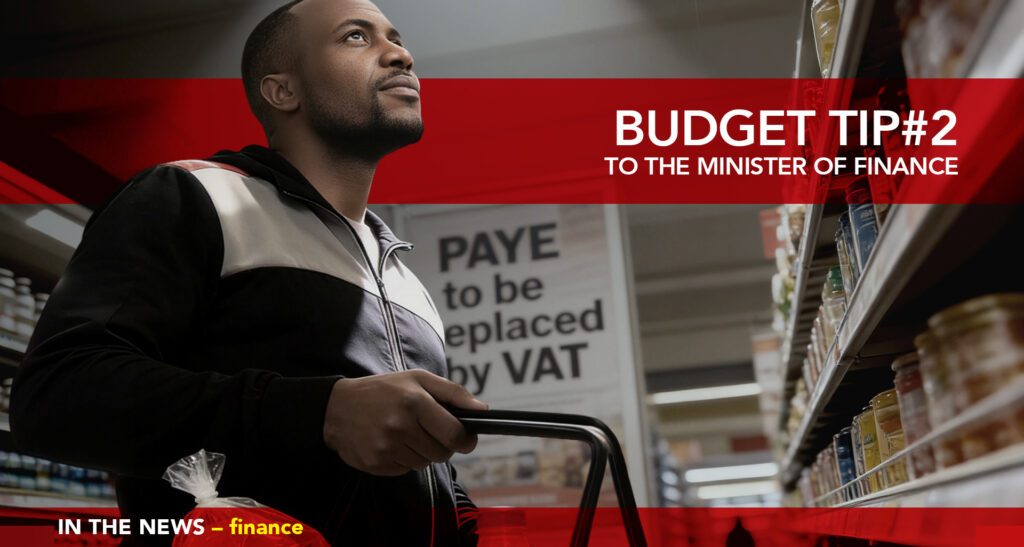
MY BUDGET TIP #2 FOR THE MINISTER OF FINANCE

Proposal: Scrap Personal Income Tax (PAYE) — replace with a Consumption-Based Tax System (VAT)

1.⁠ ⁠Historical Context and the Need for Change

South Africa’s reliance on a narrow base of Personal Income Tax (PAYE) is unsustainable. A small percentage of the population carries the national budget, leading to high emigration rates and tax fatigue. By shifting to a consumption-based model, we broaden the tax base to include everyone participating in the economy—including tourists and the informal sector—while rewarding productivity and work.

2.⁠ ⁠Immediate Economic Stimulus

Scrapping PAYE would provide an immediate, substantial increase in take-home pay for every formal worker. This “instant raise” would flow directly back into the economy, driving demand and growth. By removing the “tax on work,” South Africa becomes an incredibly attractive destination for global talent and investment, encouraging businesses to hire without the massive overhead of payroll tax compliance.

3.⁠ ⁠Progressive Protection via Zero-Rating

The primary argument against a VAT-centric system is its impact on the poor. However, South Africa already zero-rates 19 basic food items. To implement this fairly, I suggest an expanded “dignity basket” of goods (basic hygiene, essential medicines, and entry-level digital access). This ensures that while luxury and discretionary spending are taxed, the cost of survival remains shielded for lower-income households.

4.⁠ ⁠The Luxury VAT: Taxing the High Spenders

To maintain progressivity, I propose a multi-tiered VAT system. While standard goods might attract a 20% rate to offset the loss of PAYE, “luxury goods” (e.g., luxury vehicles, jewellery, and high-end electronics) should attract a “Luxury VAT” of 25-30%. This ensures that high-income earners—the primary drivers of luxury consumption—contribute proportionately to the fiscus. This model is more effective than traditional wealth taxes because it is harder to evade and scales directly with a person’s lifestyle.

5.⁠ ⁠Inflationary Realities and Fairness

The tax system must reflect the current value of the Rand. Since the VAT threshold and tax brackets have often failed to keep pace with inflation, we have seen “bracket creep” stifle the middle class. A consumption tax is inherently more honest; you are taxed on what you choose to take out of the economy, not what you put in through your labor. Combining the abolition of PAYE with this model creates a “growth-first” environment where workers are rewarded for their effort.

Conclusion: Moving to a consumption-centric model simplifies the tax code, reduces the administrative burden on SARS, and creates a pro-growth environment. By taxing spending rather than earning, we encourage a culture of savings and investment while ensuring that everyone—especially those living a luxury lifestyle—contributes their fair share to the development of our nation.

Sincerely,

Rob Hutchinson, founder DearSouthAfrica.co.za
THE R2.3 MILLION VICTORY: WHAT THE NEW VAT THRESHOLD MEANS FOR YOUR SMALL BUSINESS

In the 2026 Budget Speech, Finance Minister Enoch Godongwana announced a long-overdue correction: the compulsory VAT registration threshold will increase from R1 million to R2.3 million, effective 1 April 2026. For those of us who have been championing the “missing middle” of South African business, this is a watershed moment.

Since 2009, the R1 million ceiling has acted as a “tax on growth,” pulling micro-enterprises into a complex administrative net long before they reached a sustainable scale. By adjusting this threshold to align with nearly two decades of inflation, the Treasury has finally acknowledged that a R1 million business in 2026 is significantly smaller and more vulnerable than it was in 2009.

Why This Matters: Beyond the Numbers

For the average SMME, VAT registration isn’t just about the 15% tax; it’s about the compliance cost.

• Cash Flow: Businesses often pay VAT to SARS before their clients have actually paid the invoice.

• Complexity: Monthly or bi-monthly filings require specialised accounting software or external tax practitioners, eating into razor-thin margins.

• Competitive Edge: Small firms serving the public can now keep their prices lower without the mandatory 15% markup, allowing them to compete more effectively with larger entities.

The “Interim Trap”: What if you exceed R1 million today?

This is the most pressing question for business owners right now. If your turnover hit R1.1 million this month, do you register now or wait for April?

Because the current law (R1 million) remains in force until 31 March 2026, the official position is that you are still legally required to register within 21 days of exceeding the threshold. However, we are in a unique “grey zone.”

Our Suggestions for Businesses in the Middle:

1. Don’t Just “Take a Chance”: SARS’s AI-enabled “Project AmaBillions” is more efficient than ever at spotting non-compliance. Ignoring a current legal obligation can lead to backdated penalties and interest that could wipe out your business.

2. Submit, then Deregister: If you hit the R1 million mark before April, the safest legal route is to apply for registration. Once the new law kicks in on 1 April, and if your turnover is safely below R2.3 million, you can apply for voluntary deregistration.

3. Wait for the “Clarification Note”: We expect SARS to issue a Binding General Ruling or a Practice Note shortly. It is highly likely they will offer a “grace period” or a simplified transition for those caught in this five-week window to avoid the administrative nightmare of registering a business only to deregister it 30 days later.

4. Consult Your Accountant on the “Payments Basis”: If you must register now, ensure you apply to be on the Payments Basis (if you qualify). This ensures you only pay VAT to SARS once you’ve actually received cash from your customers, easing the liquidity crunch.

Will SARS “Write it Off”?

Historically, SARS does not “write off” obligations. However, the Commissioner has the power to remit penalties and interest if a taxpayer can show they acted in good faith during a period of legislative transition.

The Bottom Line

This win proves that public participation works. We provided the math, we highlighted the struggle, and the Treasury listened. This R2.3 million threshold is a lifeline for the backbone of our economy—the small business owner.

As we wait for the final gazetted regulations, keep your records meticulous. The burden is lifting, but we must cross the finish line legally.

Rob Hutchinson, DearSouthAfrica.co.za

PROVINCIAL RENAMING IS MORE THAN JUST A MAP CHANGE

South Africa is currently witnessing a quiet but profound tug-of-war over its identity. On one side of the Drakensberg, King Misuzulu kaZwelithini has issued a royal call to strike “Natal” from the provincial lexicon, leaving us simply with KwaZulu. On the other side of the Hex River, the drumbeat for Cape Independence—the so-called “CapeXit”—has moved from the fringes of social media into the formal halls of Parliament.

At first glance, these are two separate regional issues. But look closer, and you’ll see they are symptoms of the same national ailment: a growing disillusionment with the “1994 Compromise” and a desire to redefine the boundaries of our belonging.

The King’s argument for “KwaZulu” is rooted in the restoration of dignity. “Natal,” a Portuguese word for “Christmas,” is a colonial timestamp. To many, the hyphen in KwaZulu-Natal is a scar—a forced marriage between a proud, indigenous kingdom and a colonial administrative block.

However, as those of us in the public participation space know, symbols carry weight. Renaming the province isn’t just a matter of changing stationery; it’s a jurisdictional statement. The Ingonyama Trust already holds 30% of the province’s land in a unique legal structure. By moving the name from “KZN” to “KwaZulu,” the monarchy is signaling a return to a pre-1994 identity—one where traditional authority holds a more central place in the modern state.

While KZN looks backward to reclaim a name, the Western Cape is looking outward to escape a system. The push for Cape Independence is fuelled by a different fire: the belief that the “one, sovereign, indivisible state” promised by our Constitution has failed to deliver on safety, infrastructure, and economic growth.

President Ramaphosa’s recent, firm rejection of a secession referendum in January 2026 highlights the constitutional wall. The law says we are one. The people in the streets of Cape Town and the hills of Zululand are increasingly asking: At what cost?

Whether we are debating a name change in the east or a border change in the west, the missing ingredient is the same: meaningful public participation. A provincial name change is not a royal decree, nor is secession a simple poll. Both require a fundamental shift in our “Social Contract.” According to our current standards, a name change requires a two-thirds majority in Parliament and a constitutional amendment. It requires every voice—from the AmaBhaca in uMzimkhulu who fear Zulu hegemony, to the suburbanites in Durban worried about the R100-million rebranding bill—to be heard.

If we allow these movements to become purely ethnic or purely secessionist, we risk the “Recrimination Nation” scenario—a country of fractured enclaves blaming one another for a collective decline.

The call to rename KZN and the call for Cape autonomy are both demands for recognition. They are a signal that the centralised, “one-size-fits-all” model of 1994 is straining under the weight of 2026. We don’t need to fear these debates, but we must demand that they happen within the light of transparent, rigorous public engagement.

If we are to drop the hyphen in our province names or rewrite the rules of our provinces, let it be because we found a better way to live together, not because we’ve finally given up on the idea of South Africa.

Robert Hutchinson, founder, Dear South Africa.

DearSA opposes the nationalisation of C-19 vaccines – allowing freedom of choice

Earlier this month DearSA noted with great concern the national government’s purported prohibition on private and provincial procurement of any COVID-19 vaccines.

DearSA-vaccination

From 15 January 2021 until 28 February 2021, DearSA ran a public participation campaign regarding the national government’s COVID-19 vaccine rollout strategy. Over 17 000 South Africans participated in the process and exercised their constitutional rights within our participative constitutional democracy.

DearSA applied to be a friend of the court in the ongoing litigation regarding COVID-19 vaccine procurement in light of the participants’ comments. On 1 March 2021, DearSA’s legal team filed court papers and brought the submissions of 17 000 participants before the court, enabling their voices to be heard.

“The rollout of COVID-19 vaccines is an important issue for all South Africans insisting on a choice. We ensured that their voices are formally heard in this ground-breaking court case. DearSA will continue to ensure the voices of all South Africans are heard through our public participation platform and campaigns.” said Rob Hutchinson, executive director of DearSA.

In the government’s court papers, the Department of Health’s Director-General acknowledged that the government could not have total control over the purchase, rollout, and administering of vaccines. As a result, the private procurement of COVID-19 vaccines is not prohibited.

South Africans who participated on DearSA’s platform voiced the following major concerns regarding the government’s vaccine rollout plan:

Firstly, the government acted outside of its constitutional mandate and without an empowering provision when it prohibited the private and provincial procurement of COVID-19 vaccines. This conduct by the government was consequently ultra vires.

Secondly, centralising the procurement process creates an administrative burden for the government, slowing the rollout of vaccines and, as a consequence leaving the most vulnerable South Africans behind in vaccine distribution.

Thirdly, that allowing for the parallel procurement of vaccines in cooperation with the private sector would ensure safeguards and freedom of choice, to the benefit of all South Africans.

Lastly, a decentralised approach to vaccine procurement is the most efficient, most rapid, and allows less room for corruption.

DearSA will continue to monitor the government’s rollout plan.

Government wants to track you from cradle to grave

By Ciaran Ryan

The government’s draft official Identity Management Policy was released on 22 December, just before Christmas.

DearSA-ID-trace

Publishing something just before Christmas is a tried and trusted tactic in the news business if you want to bury a potentially acrid story.

The Department of Home Affairs wants a new randomised ID that allows for sex alterations, links you to your parents, captures your biometric information at birth and then later in life, and all this in the interests of serving you better as a governing body.

Is it just me, or is this a tyrant’s wet dream

Reading the sales pitch for this policy document, you might think “fine, okay, I don’t really see how this will help me, but I’ll go with it.”

The document is freighted with roseate buzz words like “international best practice”, “respect for privacy” and “interoperability”.

Let’s pause right there. What is meant by “interoperability”? Essentially, gathering every bit of information possible on everyone in the country and sharing this “between identity subsystems” and other domestic and international jurisdictions.

SA’s ID system is not currently integrated and interoperable with those of other African countries and the EU, and that’s about to be rectified. Even the most venal of sins committed in SA will be shared with other jurisdictions. It’s already happened in the tax sphere, where jurisdictions share information through what is called Common Reporting Standards. In other words, South African expatriates under new rules to be introduced in March 2021 can be hunted down anywhere in the world for taxes owing.

The sharing of data between “jurisdictions” is about to get a lot more fluid. One of the justifications for this is combatting organised crime. The new draft proposal wants to capture facial and other biometrics, like fingerprints – which should make capturing criminals a doddle, right? How’s that worked out so far?

This begins to take on the vague outlines of China’s Social Credit System, where eating or playing loud music on public transit systems earn you demerit points on your social credit score, as do traffic violations, failure to sort your waste, cheating in exams, jaywalking, and cheating in online video games. Making blood donations and volunteering work hours can earn you back points. The list of potential ways to earn demerit points is too long to list here, but you can take a look yourself. It’s pretty frightening. Snitching on religious minorities is encouraged, and there’s an app to track “deadbeat debtors” – those who owe money.

Viewed through this prism, your conduct in life determines the extent to which you are declared a person or a non-person. Consider that as of June 2019, nearly 27 million Chinese citizens were denied high-speed rail tickets based on their social credit score, and by July 2019 2.56 million were denied flight tickets.

Is this what’s in store for us?

There’s been little discussion around this draft ID system – which is in itself a worry. Any proposed change in the law must be subject to rigorous cross-examination from the viewpoint of socio-economic impacts.

Anyone watching the farce of the US election – and the ability of people with no ID to vote and potentially skew an election – may be wondering what’s wrong with our system of national IDs. Americans have resisted the idea of a national ID for decades on the basis this is an infringement of privacy and Constitutional rights, though they have something approximating this in the form of a Social Security Number. Then, of course, they have state drivers’ licences. There are multiple ways to track US citizens, with or without a national ID.

It seems our elections are far more trustworthy, if only because you have to have a national ID and then register to vote.

South Africans long ago accepted the national ID as a fact of life. ID numbers were introduced under the 1950 Population Registration Act as a way of keeping tabs on different racial groups. What was an apartheid contrivance has served the ANC well, which introduced the Identification Act in 1997. The original aim of racial profiling is still very much alive today, but this new ID system will expand it well beyond that.

What’s wrong with the current system?

So, what’s wrong with the current ID system that it needs a complete overhaul?

And what kind of an overhaul is contemplated by the Department of Home Affairs (DHA), the government entity responsible for ID management?

To find this out, we go to “Problem Analysis” in the draft policy document. The Identification Act is now more than 20 years old, needs modernising, will help deliver e-government and e-commerce services to those in need, and all the other motivations that typically accompanies a proposal such as this.

The Identification Act of 1997 was enacted for the purposes of maintaining a population register and to enable government to issue ID cards. Section 7 of the Act obligates the Director-General to issue ID numbers in a way that details date of birth, gender and whether a citizen of resident.

The current ID system and how it works

Here’s how it works. The existing national ID comprises a 13-digit code as follows: YYMMDDSSSSCAZ.

The first six digits represent the date of birth, and the next four digits (SSSS) are based on gender. The next digit “C” shows if you are a South African citizen – 0 being a citizen, 1 being a permanent resident.

The last digit (Z) is what is called a “checksum” which is a statistical check that the number sequence is correct.

Here’s how it will change under the proposed new system

ID numbers will be based on parents: the ID number of a child must be processed on the basis of biographic information and linked to their parents’ ID numbers and mother’s biometric data.

Recognition of other sex/gender categories – The new legislation and population register must make a provision that enables the establishment of a category that is neither male nor female.

Random unique identity number – Another option is to issue a random unique identity number that is not linked to or founded on a person’s sex/gender, date of birth, place of birth or any other marker.

Records of persons throughout their lifespan – Every birth that takes place in the country must be registered. If possible, the biometrics of children must be captured at birth. Where impossible, the biometrics of a parent must be linked to the birth certificate of a child.

Re-registration – Children must be reregistered when they reach age five with 10 fingerprints and iris and facial photographs. A combination of different biometric data for children should be considered with options such as the photograph of the ear.

The capturing and management of this data will fall under the National Identity System, or NIS, which will link with both government and non-government databases, such as banks and retailers. On the government side, health and education data will round off a near full picture of the citizen.

It’s not hard to see how the Chinese credit scoring system is but a hop, skip and a jump away for South Africans. Also linked to the NIS data are the issue of passports, immigration and refugee data. As some have remarked, it’s almost as if the Chinese government wrote the policy document for us.

The government plans to hoover up every bit of data it can on you and your children yet to be born. What’s also clear from the document is that government plans to monetise (sell) this data. This should concern us on several front: state security agencies have been implicated in extrajudicial surveillance against SA citizens, while law enforcement bodies appear to have an extremely wide interpretation of their powers under the Criminal Procedure Act to gather up cell phone subscriber records (having obtained 70,000 such records, according to Right to Know).

Where does privacy fit into this?

Section 14 of the Constitutes guarantees the right to privacy, which includes the right not to have your person or home searched; your property searched; possessions seized; or privacy of communications infringed.

Though the draft ID document makes multiple mentions of privacy, most of these relate to data privacy – but even that must be regarded with suspicion, as we have seen a number of devastating breaches of data security (and privacy) at the hands of companies like Experian. There may be severe penalties for mishandling of private data under the Protection of Personal Information (POPI) Act, but that’s no guarantee of anything placed in the custody of a new, and massive, government bureaucracy.

All this is being sold to us as a way to afford rights to non-traditional gender groups, and to accelerate transformation and government services to those in need. It ticks all the right boxes. But we had better know what we are signing on to.

Have your say

Have your say on this police document here.

Disaster Management Act – new regulations download

President Cyril Ramaphosa has moved South Africa back to Lockdown Level 3.

“We are at an extremely dangerous point in our fight against the pandemic.”
Ramaphosa said on Monday, Cabinet has decided to put the country on an adjusted Level 3 from Level 1 with immediate effect.

Under the adjusted level 3 regulations:

  • All indoor and outdoor gatherings will be prohibited for 14 days from the date hereof, except for funerals
  • Funerals may not be attended by more than 50 people with social distancing.
  • Every business premises must determine the maximum number of staff and customers permitted at any one time based on our social-distancing guidelines and may not exceed that limit.
  • The nationwide curfew will be extended from 9pm to 6am. Apart from permitted workers and for medical and security emergencies, nobody is allowed outside their place of residence during curfew.
  • Non-essential establishments – including shops, restaurants, bars and all cultural venues – must close at 8pm. The list of these establishments will be released shortly.
  • From now on it is compulsory for every person to wear a mask in a public space. A person who does not wear a cloth mask covering over the nose and mouth in a public place will be committing an offence.
  • A person who does not wear a mask could be arrested and prosecuted. On conviction, they will be liable to a fine or to imprisonment for a period not exceeding six months or to both a fine and imprisonment.

Under the strengthened regulations:

  • The sale of alcohol from retail outlets and the on-site consumption of alcohol will not be permitted.
  • The prohibition on consuming alcohol in public spaces like parks and beaches remains.
  • Distribution and transportation will be prohibited with exceptions that will be explained by the minister.
  • These regulations may be reviewed within the next few weeks if we see a sustained decline in infections and hospital admissions.
  • In effect, the adjusted Level 3 regulations will keep the economy open while strengthening measures to reduce transmission.
  • With a few exceptions, businesses may continue to operate as long as all relevant health protocols and social distancing measures are adhered to.
  • Night clubs and businesses engaged in the sale and transportation of liquor will not be allowed to operate.

The Level 3 restrictions will remain in place until 15 January 2021.

DearSA campaign helps avert a potentially disruptive change in voting methods

Thanks largely to a robust campaign by participative democracy group DearSA, the government has decided to ditch two clauses in the Electoral Laws Amendment Bill – which would have allowed a change in voting methods.

DearSA-electronic-vote

These clauses would have allowed a switch from the current paper ballots to electronic voting – potentially sparking the kind of controversy and allegations of fraud now surrounding the recent US Presidential election.

Cybersecurity experts and lawyers have warned of the potential for hacking such electronic systems, and many have cautioned against adopting systems prone to abuse by malign actors.

On Wednesday, 2 December 2020, the Portfolio Committee on Home Affairs approved the Electoral Laws Amendment Bill and said will recommend to the National Assembly to adopt it – but without the disputed clauses 14 and 21 which would have empowered the Electoral Commission of South Africa (IEC) to prescribe a different voting method.

“The committee agreed that voting method is a policy matter that cannot be left to the IEC alone to decide, even though the IEC had mentioned that the intention was to only allow for testing of such alternatives,” says a press release issued by Parliament this week.

Parliament acknowledges the role played by DearSA in having these clauses removed from the Bill. It notes the concerns raised by members of the public in the 12,305 submissions received.

The Electoral Laws Amendment Bill seeks to amend three pieces of legislation:
· the Electoral Commission Act, 1996;
· the Electoral Act, 1998; and,
· the Local Government: Municipal Electoral Act, 2000.

These amendments were deemed necessary to prepare for the forthcoming general local government elections in 2021.

DearSA director Rob Hutchinson says removal of the concerning clauses is as a direct result of the work done by DearSA and the IRR – who brought attention to potentially disruptive changes that could lead to future disputes in election outcomes.

“The last thing we want in SA is to have election results disputed, such as we are currently seeing in the US. There are grave concerns over electronic voting methods”.

While all voting methods have potential for fraud and error, the view comments on the DearSA platform around this campaign, is the existing paper ballot method is the most reliable method we have, since it leaves a paper trail and auditing the results is therefore easier.

“This is a great victory for participative democracy in SA, and we want to thank the thousands of people who took the time to understand and comment on the proposed changes to the law.”

New ‘Internet censorship bill’ open for comment until mid October 2020

Stella Ndabeni-Abrahams, Minister of Communications and Digital Technologies,  recently extended the period for comment on the Draft Film and Publications Amendment Regulations, which align with the Films and Publications Amendment Act (FPAA).

DearSA-internet censorship

Anti-censorship groups have dubbed this the “internet censorship bill” for seeking to regulate what it deems “harmful content” and to corral online content providers under its wing. Many commentators have pointed out the regulations contravene Constitutional rights to freedom of expression.

A campaign by Dear SA attracted nearly 14,000 comments, the overwhelming majority expressing their opinion against the Bill as it stands.

“I did not sign up for fascist, communist tyranny,” says one commentator.

“Gross overreach,” says another.

Yet another: “Freedom of speech should be a basic right and any law that has as its aim the removal of this right should be viewed with great reservation and suspicion, it is one step away from a police state.”

President Cyril Ramaphosa signed the Bill into law on 4 October 2019, though it has yet to come into effect. Defenders of the bill argue that though the clumsily worded document extends itself to everybody distributing content online, in practical terms little will change for most people, if only because regulators are simply unable to deal with the volume of content produced daily. Others. However, have pointed out that this is always a dangerous assumption – that government will not attempt to extend its reach to the literal limit of the law.

It is therefore almost certain this Bill will be challenged in the Constitutional Court should it proceed in its present form.

In practical terms, all online distributors of content – whether they intend to make money from it or not – will have to register with the Film and Publications Board (FPB) and submit content for review prior to publication, or apply to the FPB Council for self-classification accreditation. Another alternative is to seek approval for the use of classification ratings issued by a foreign international classifications authority.

Previously, the Film Publications Act limited itself to the regulation of films and games, and only where these were made available for hire or sale. Now its reach extends to all online content.

Once the FPB issues a registration certificate, it can then impose any conditions it deems necessary to achieve its objectives, which are:

“To regulate the creation, production, possession and distribution of certain publications and certain films by means of classification, the imposition of age restrictions and the giving of consumer advice, due regard being had in particular to the protection of children against sexual exploitation or degradation in publications, films and on the Internet; and to

“Make the exploitative use of children in pornographic publications, films or on the Internet, punishable.”

While few people would disagree with the need to have strict laws against the sexual exploitation of children, the reach of the new Regulations goes well beyond this. The state, in the form of the FPB, will now have a say over every piece of online content distributed via the internet.

It seems inconceivable that the drafters of the Bill gave much consideration to the Constitutional protections to freedom of expression, nor to the practical effects of issuing registration certificates to tens of thousands of content producers and each item of content published. Every bit of ‘film” – which means a “sequence of visual images” – is covered by the bill, and will require an age classification from the FPB.

Interestingly, those who are members of the Press Council of SA get a free pass. Those who are not and intend to publish online content “shall submit the publication to the FPB together with the relevant form provided by the FPB, and the prescribed fee, for examination and classification, before it may be distributed or exhibited within the Republic (of SA).”

In other words, the state will now decide who is fit to distribute content (in effect designating who is a journalist) and will require everyone to submit to the registration and classification process.

You will have to apply to the FPB for classification of a film or trailer, and once that film or trailer is reviewed, each member of the classification committee will be expected to express their “opinion” with reference to the Classification Guidelines of the FPB.

A majority decision by the classification members will carry the day.

Similarly, if you are a broadcaster falling under ICASA (Independent Communications Authority of South Africa)

The amended Films and Publications Act makes it a criminal offence to distribute a film as defined above without first registering with the FPB and getting your “sequence of visual images” classified with an age restriction.

Many commentators have expressed alarm at the draconian nature of this regulation and its echoes of the darkest days of apartheid censorship. Though the Bill does not on its face appear to infringe political discourse, it is broad enough to conceivably be used in such a manner under a less benign regime. In other respects, this Bill goes beyond the wildest dreams of apartheid’s information police because of its attempt to extend the arm of the law to virtually anyone expressing an opinion or providing entertainment online.

If you are convicted under this Bill, you face a fine of up to R150,000 and imprisonment for up to eight months.

You have until the end of October to comment on this bill, and you probably should.