
Advert
Advert – scroll down

-
-
- No I do not support the regulations 1527
- Yes I do 465
- Not fully 634
-
The Department of Justice and Constitutional Development invited written comments on the draft Regulations under the Cannabis for Private Purposes Act.
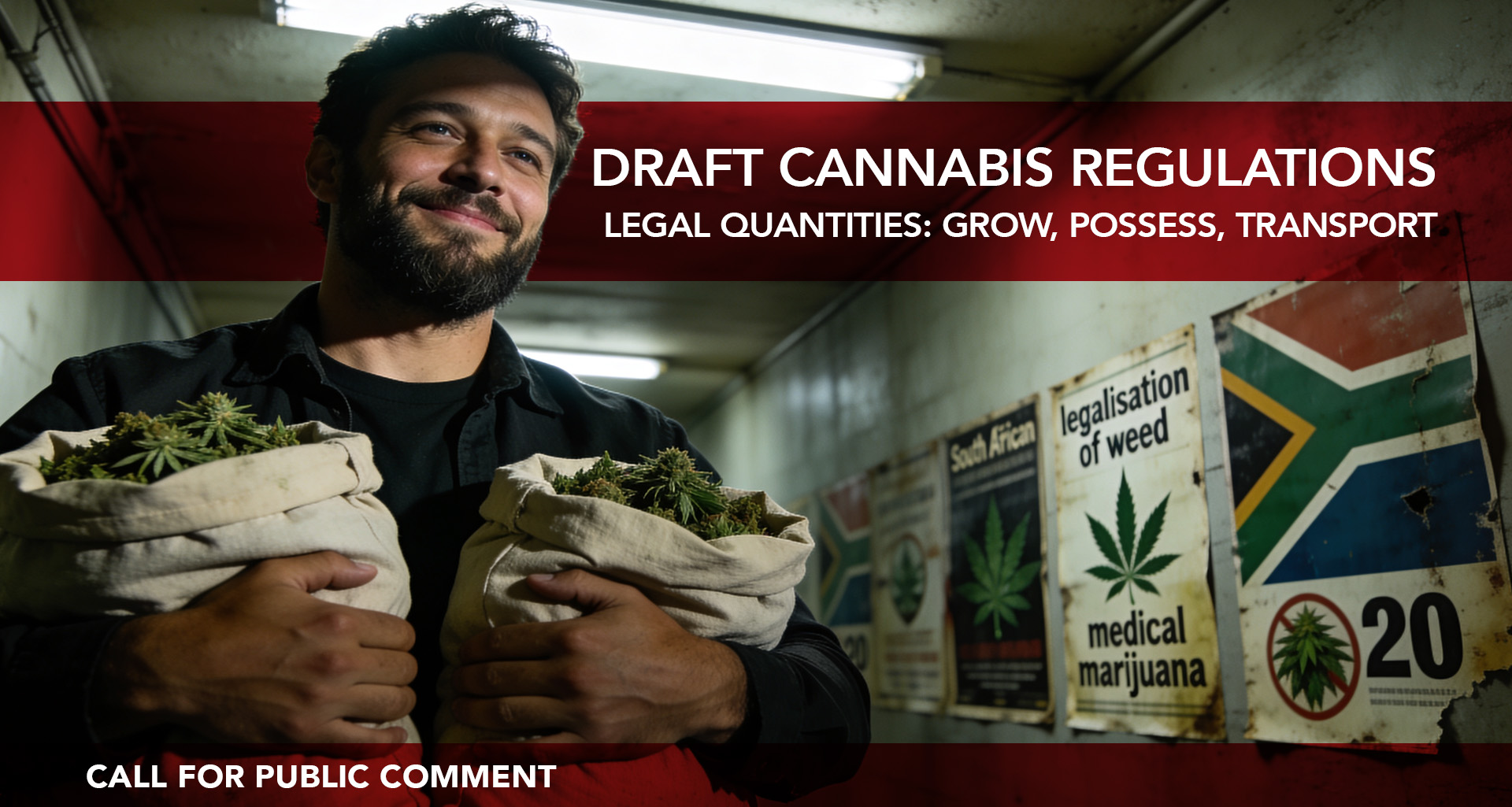
The Department of Justice and Constitutional Development has officially published the long-awaited draft regulations to enforce the Cannabis for Private Purposes Act, 2024. Following the landmark 2018 Constitutional Court ruling that decriminalised the private use of cannabis by adults, these new regulations finally set the specific legal boundaries for how much cannabis South Africans can grow, possess, and transport.
Have your say – shape the paper. [CLOSED]

Perspectives: What is the Debate?
The publication of these draft regulations has sparked a fierce debate between the government, legal professionals, and civil society.
On one side, the government and some industry bodies argue that these regulations are a necessary, internationally benchmarked step to finally bring the Cannabis Act into enforceable law. They believe setting firm numerical limits is the only way to end the legal “grey area” and provide clarity for both citizens and the police.
On the other side, cannabis activists, human rights groups, and civil society organisations argue that the Department of Justice is overstepping its bounds. They argue that the regulations are actually stricter than the Act itself, re-criminalising private behaviour through technicalities, arbitrary limits, and severe privacy violations, particularly regarding the rules of transportation.
Those who support the draft regulations as they stand argue the following:
-
- Legal Certainty and Protection: For years, the lack of defined limits meant that arrests were left to the subjective discretion of individual police officers. Supporters argue that setting firm limits (750g and 5 plants) provides absolute legal certainty, protecting citizens from arbitrary arrest as long as they stay within the thresholds.
- A Vital Step Toward Promulgation: Without these regulations, the Cannabis for Private Purposes Act remains largely theoretical. Supporters point out that finalising these rules is the mandatory final step required to remove THC from the strict narcotics schedule under the Drugs Act.
- International Benchmarking: The Department of Justice notes that the limits were developed by considering what reasonably constitutes private use, looking at the yields of cannabis plants, and aligning with international benchmarks for public safety.
- A Clear Path for Expungement: The regulations finally create a formal, timeline-driven administrative process to expunge the criminal records of thousands of South Africans who were historically marginalized and prosecuted for minor cannabis offences.
Civil society groups, advocates, and opponents of the draft regulations raise several serious concerns:
-
- Arbitrary Limits: Critics argue that the 5-plant and 750g limits are entirely arbitrary and lack scientific or agricultural backing. A blanket 5-plant limit fails to account for the massive difference between a small indoor plant and a large outdoor plant, or the fact that an annual outdoor harvest can easily yield more than 750g, instantly turning a legal home-grower into a criminal.
- Regulatory Overreach: Opponents argue that the regulations are legally flawed because they contradict and go further than the Act passed by Parliament. By removing rights or adding restrictions that Parliament did not approve, critics argue the regulations are unconstitutional.
- Privacy Violations & “Police Drivers”: The transport rules—which force drivers and passengers to declare their cannabis to each other and grant drivers the power to inspect a passenger’s belongings—are viewed as a massive infringement on adult privacy. Critics argue it forces ordinary citizens to act like police officers.
- Vague Wording Invites Abuse: The regulations use vague terms regarding how cannabis must be “concealed” or prohibiting anyone from “revealing” it. Opponents fear this ambiguous language will be used as a loophole for law enforcement to continue harassing citizens and executing unwarranted vehicle searches.
- Disproportionate Impact on the Poor: The strict requirement to conceal cannabis in a vehicle’s boot or enclosed compartment disproportionately harms poorer citizens or rural residents who rely on public transport, communal living spaces, or who do not own vehicles with lockable boots.