
Advert
Advert – scroll down
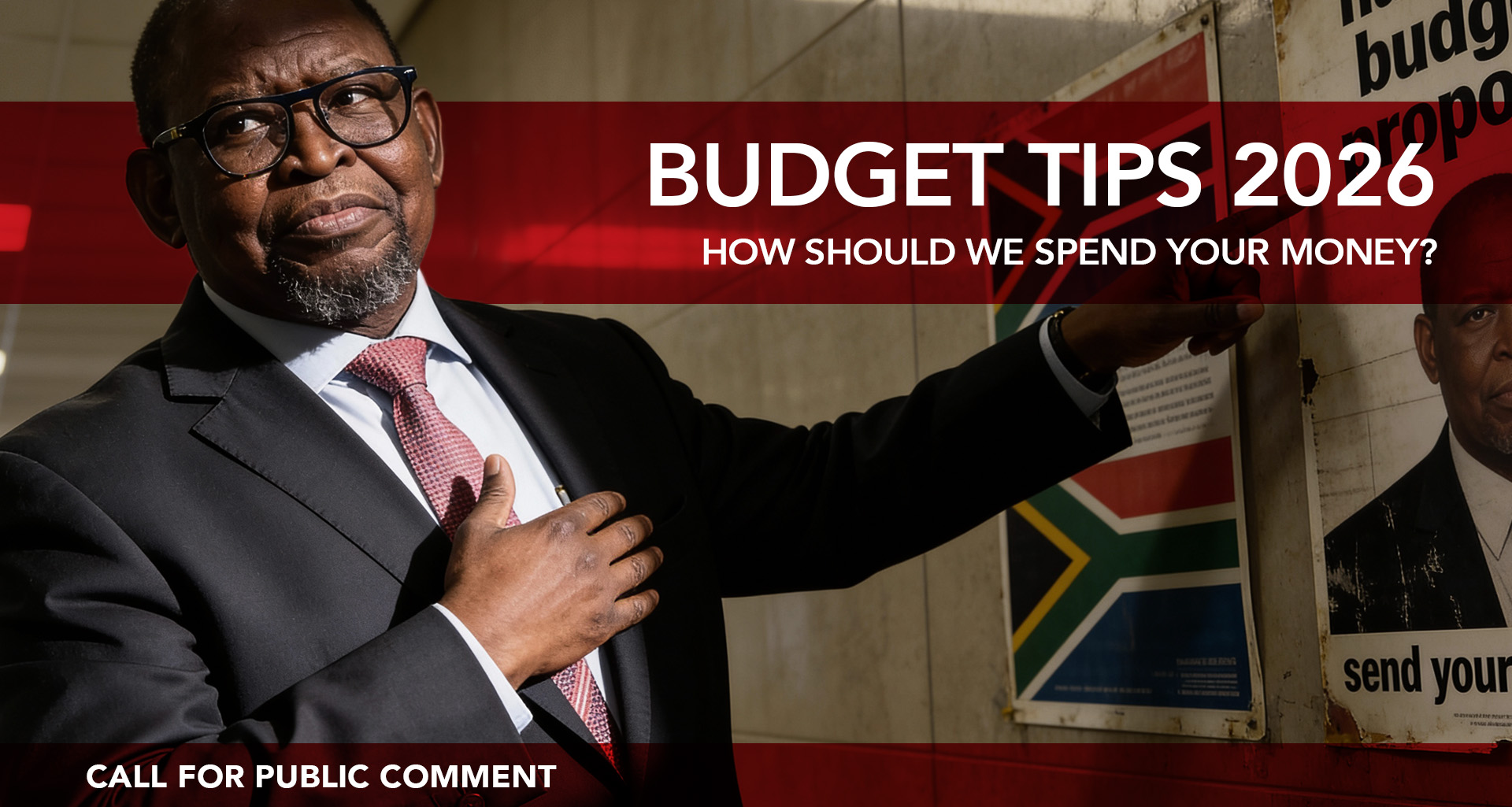

The Minister of Finance, Mr Enoch Godongwana, invited South Africans to share their suggestions on the 2026 Budget.
Minister Godongwana will deliver the National Budget Speech on 25 February 2026. The budget allocation aims to strike a balance between growing the economy and supporting the vulnerable amid limited resources. People submitted views on:
-
- the economy and fiscus 94
- government spending 815
- addressing a large budget defecit 64
- stabilising SOE finances 75
- energy and water investments 125
- tax revenues 68
- debt sustainability 38
- municipal finances 98
- all of the above 2453
- other 189
- no concern 4
Have your say – shape the budget [CLOSED]

Top concerns
Context: Growth is currently projected at 1.6% for 2026. Economists generally agree we need 5%+ to significantly slash unemployment.
Survey Question: Given the current low growth rate, which single policy change would most effectively encourage businesses to invest and create jobs in South Africa?
Context: Over 60% of non-interest spending goes toward the “Social Wage” (Education, Health, Social Grants). However, the public often highlights “wasteful expenditure” (VIP security, bloated cabinets).
Survey Question: If you had to reallocate 5% of the current budget from one department to another, where would you take it from, and where should it go?
Context: We are spending more than we earn, filling the gap with loans. The deficit is roughly 4.6% of GDP.
Survey Question: To bridge the budget gap, should the government focus more on cutting current expenditure or finding new ways to grow revenue without raising taxes?
Context: Bailouts for entities like Eskom and Transnet have cost taxpayers hundreds of billions.
Survey Question: Should the government continue to provide financial bailouts to struggling SOEs, or should these entities be required to find private-sector partners to stay afloat?
Context: This year, the focus has expanded to include water. Maintenance backlogs in water infrastructure are now considered a “tier-one” economic risk alongside energy.
Survey Question: What should be the priority for infrastructure funding: building new renewable energy projects or repairing existing municipal water and sanitation systems?
Context: Personal Income Tax is the largest revenue source. “Fiscal drag” (not adjusting tax brackets for inflation) often hits the middle class hardest.
Survey Question: Which tax adjustment would most help your household or business: a reduction in Personal Income Tax, a VAT holiday on more essential items, or corporate tax incentives for hiring?
Context: As we discussed, debt interest (R434.9bn) is one of the fastest-growing budget items.
Survey Question: As interest payments on debt now exceed the health budget, what is your ‘tip’ for the Minister to prevent the country from falling into a debt trap?
Context: Over half of SA’s municipalities are considered “in financial distress,” with billions in uncollected debt.
Survey Question: How can the National Budget better support municipalities: through more direct grants or by enforcing stricter consequences for financial mismanagement?