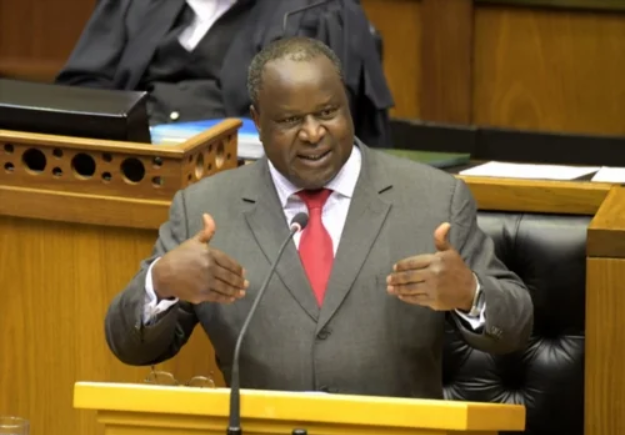
Eskom bailout will come at a huge cost to taxpayers: Mboweni

The South African government’s decision to increase support for the embattled state power utility is wreaking havoc on the nation’s finances and may force it to increase borrowing and raise the budget deficit.

Finance Minister Tito Mboweni told lawmakers in Cape Town on Tuesday that Eskom will get R26 billion ($1.9 billion) this financial year and R33 billion in 2020-21 to help it remain solvent.

The additional bailout comes just five months after he announced a three-year R69 billion cash injection for the utility. The rand and government bonds fell. We are facing an extremely serious financial situation,” Mboweni said.

In addition to the financial support for Eskom, there are also preliminary indications that tax revenue could be ‘significantly lower’ than forecast in the 2019-20 budget.

“This could substantially increase the government’s borrowing requirement,” he said.

Rand Weakens

The rand weakened after Mboweni’s comments, declining as much as 0.6% to 13.9499 against the dollar, while yields on government bonds due 2030 climbed the most in six weeks.

“Mboweni reminded investors that South Africa faces major fiscal challenges, mainly due to the substantial burden of Eskom which needs to be properly restructured,” said Piotr Matys, a currency strategist at Rabobank in London.

Eskom has accumulated R440 billion of debt and isn’t selling enough power to cover its costs, the legacy of years of mismanagement and cost overruns at its new plants. The utility provides about 95% of the nation’s power.

While the additional government aid will enable the utility to meet its financial obligations this financial year, it remains the biggest threat to the nation’s finances and its operating model needs to be overhauled, Mboweni said.

What comes next?

The National Assembly will today consider and make decisions on the on the 2019 Appropriation Bill and the highly anticipated special Eskom Appropriation Bill.

The Appropriation Bill proposes appropriating money from the National Revenue Fund for requirements of the State and prescribes conditions for the spending of the funds withdrawn.

Finance Minister Tito Mboweni tabled the 2019/2020 national budget in Parliament on 20 February, together with the 2019 Appropriation Bill.

In a statement, Parliament said the Bill lapsed after the last sitting of the National Assembly before the May general elections.

“However, the sixth Parliament’s National Assembly revived it in June. The Minister of Finance also tabled proposed amendments on 25 June,” said Parliament.

These amendments include the authorisation of expenditure of R17.652 billion to Eskom on 2 April, in terms of section 16 (1) of the Public Finance Management Act, which deals with use of funds in emergency situations.

If today’s National Assembly plenary sitting agrees to the Appropriation Bill, the Bill will be sent to the National Council of Provinces for consideration and decision.

Earlier this month, Public Enterprises Minister Pravin Gordhan said a special bill on Eskom — aimed at finding a roadmap of the power utility’s recovery – was being drafted.

Finance Minister Tito Mboweni, Gordhan said, will soon introduce a Special Appropriation Bill aimed at bolstering Eskom’s cash position soon.

Briefing reporters in Cape Town at the time, Gordhan said work on the paper had begun.

“We should have a draft very soon for government to look at,” said Gordhan.

The power utility is currently facing financial challenges.

4 Ways Expropriation Without Compensation Will Affect You

Article from the Rational Standard
By:Nicholas Woode-Smith

Expropriation without compensation (EWC) isn’t an abstract threat, always too far away to matter and only affecting the people you don’t care about. It is very, and most unfortunately, real and present.

With Parliament agreeing to review section 25 of the Constitution, we aren’t yet facing expropriation without compensation, but we are faced with the fact that our legislators are at least predisposed towards eliminating private property rights in South Africa. If or when section 25 is amended, the government will be allowed to seize private property without giving any compensation or being required to negotiate with the victims.

But even without amending the Constitution, plans have already been revealed of how the ANC will proceed with mass land-theft.

This disastrous policy has been pushed forward by the African National Congress (ANC), backed by the ANC-in-exile, the Economic Freedom Fighters (EFF). This is not just some idle support of a controversial policy, however. At the risk of sounding alarmist – you should be alarmed – the policy of expropriation without compensation is socially, politically and economically disastrous.

Yet, so many South Africans are apathetic. At best, they talk about expropriation without compensation in detached whispers, as if discussing Crimea. It isn’t something that one wants to acknowledge as happening to them. In fact, a lot of people, including land owners, have denied the threat of expropriation without compensation, thinking that it will only affect rural white farmers.

But society ripples. It won’t just affect white farmers. This policy will have dire consequences for all of South Africa. The following, to drive home the severity of EWC, are just a few:

1. Food prices will rise, if food doesn’t just run out

Many in the EFF and ANC have this romantic notion around small-scale, peasant style farming. A big part of the campaign to pass EWC is to, allegedly, redistribute farmland to create jobs for black people who were oppressed during Apartheid. EWC, they argue, is the fast-track to effective land reform that will bolster the wealth of the previously impoverished.

Yet, small-scale farming and even large-scale farming is not the path to prosperity. It is more often a money-sink, hardly seeing profits for decades. Farming is a skill and capital-intensive industry. Take it away from the current farmers, and you are left with farmers without the skill or capital to keep it going. And this isn’t racism. If a non-farming white person was given a farm, they would fail just as much as a non-farming black person.

We shouldn’t be playing around with food security. Already South Africa’s farming industry has suffered under threats of EWC and ever-increasing farm attacks. This is not something you merely read about in the news.

When farmers suffer, when the next harvest is uncertain, when the entire livelihoods and properties of the food producer is under threat, food security suffers. And at best, the price of food rises to exorbitant amounts, or we become completely reliant on foreign imports (which the government likes to restrict and heavily tax, making it expensive again). And at worst, we starve.

Venezuela and Zimbabwe are modern-day examples of the failures of socialism in achieving food security. The 20th century is rife with even more examples of how collectivisation, land reform and expropriation cause mass starvation. EWC will cause similar symptoms.

Succinctly: If you don’t want to starve or spend all your money on food, then oppose EWC.

2. No property will be safe

The proposed Expropriation Bill doesn’t only affect white-owned farms. It allows the state to seize anything. That means urban properties, holiday homes, apartment blocks. And not just landed property. EWC isn’t just about land reform. It is about instituting total collectivisation over the country. The Expropriation Bill allows the state to seize intellectual property, stocks, pensions… anything.

And there will be no negotiations. No compensation.

If you own stuff, and want to keep it, you need to oppose EWC.

3. Your wealth is at risk

If EWC is instated, the economy will crash. This doesn’t only affect the rich stockbrokers and business owners. This affects the poorest beggar, every professional, children in schools – everyone. World Wars have started over economic situations less dire than South Africa today. We have untold numbers of people living in poverty, without any opportunities. EWC will remove the few opportunities we have.

As trust in property rights deteriorates, investors will leave. Capital will flood out of the country. Banks will lose billions. And no, the “evil” banker doesn’t suffer. That’s your money they’re losing. Your savings. But it won’t be their fault. It will be yours for not doing everything within your power to stop EWC from happening.

macroeconomic impact assessment of EWC from the Gordon Institute of Business Science states:

“It makes no sense to attempt the implementation of land reform policies that have proven over and over again to exercise a destructive influence on the economy and threaten the livelihoods of the most vulnerable members of society — those that cannot sell their skills in other jurisdictions.”

And as EWC becomes another money-sink, the state will raise more taxes, enforce more regulations, and take more and more of your already-dwindling cash.

The economy will fail with EWC. This is not up for debate anymore. It is a certainty, and those arguing that it will not harm the economy are the worst kind of liars and useful idiots. When the economy fails, everyone will suffer.

4. Your favourite brands will disappear

If the loss of food, your stuff and your financial well-being aren’t convincing enough, then I must appeal to your consumerism. As EWC rips apart property rights and the economy, companies whose products you enjoy will leave the country. This goes for fast-food chains, restaurants, cell phone brands, access to designer gear, access to private security and all other forms of gadgets and conveniences.

Companies that can leave, will, because they don’t want to risk losing their stuff. And because they reasonably don’t want to share a huge part of their profit-pie with a government run by gangsters.

Conclusion

Most South Africans don’t support EWC. But they don’t need to. They just need to remain silent. Revolutions are won by stubborn and violent minorities. The pro-EWC factions in South Africa will stop at nothing to pass their bizarre pseudo-religious ideas – even at the expense of our hard-won rights, our freedom, our prosperity and our lives.

“The only thing necessary for the triumph of evil is for good men to do nothing.” This saying has been commonly attributed to Edmund Burke.

It is way past time for more South Africans to take a popular stand against an unacceptable policy. I am not calling for mass protest or picketing. I’ve never found those to be effective. But there are many ways you can help oppose EWC.

From writing to your legislators, holding your political party accountable, writing articles for the media, donating to civil society organisations like the Free Market FoundationInstitute of Race Relations, and AfriForum. Help get the word out about this policy that many South Africans aren’t aware of or care about. Share Rational Standard content on social media. Tell your friends and family.

Don’t be afraid to be vociferous. Facts are on the side of those who oppose EWC. And it is time we stop apologising for it. It is time we get busy and stop the oncoming destruction of South Africa.

Original article link:

4 Ways Expropriation Without Compensation Will Affect You

Mboweni confirms R59 billion Eskom bailout

The minister also said the debt and restructuring of Eskom will need to be addressed.

Finance Minister Tito Mboweni on Tuesday presented his plans to parliament to provide financial support to struggling energy utility Eskom.

Mboweni introduced the Special Appropriation Bill in the National Assembly, which will offer the parastatal a lifeline in the current and next financial year.

This will lead to a R59 billion bailout from government in two instalments: R26bn in the 2019/20 financial year followed by R33bn in the 2020/21 financial year.

“I stated in my budget vote 7 for the National Treasury that Eskom presents the biggest risk to the fiscal framework because of its financial problems and negative impact on the economy,” Mboweni said.

“Given the high risks of a systemic failure if Eskom were to collapse, government is urgently working on stabilising the utility, while developing a broad strategy for its future.

“Eskom faces serious financial and operational challenges, which to a large extent were caused by the governance challenges that the entity previously experienced which resulted in a decline in investor confidence.

The minister also said the debt and restructuring of Eskom would need to be addressed.

Mboweni said a team of officials had considered a number of options as a solution to the company’s debt challenges in order to ensure its sustainability.

He will be appointing a chief restructuring officer, who “will be mandated to test these options with the ratings agencies to establish what impact each will have on the fiscus and recommend the appropriate one for implementation”.

Article from The Citizen

Chance for public to comment on proposed by-law to protect Cape Town’s beaches

Article from IOL

Cape Town – The City of Cape Town will soon put out a draft by-law to protect its precious coastline from encroachment, poaching activities and other damaging actions.

In a statement, the City said it would soon publicise the draft Coastal By-law for public participation, with the intention being to “better protect and manage our coastline, which is one of Cape Town’s most important and valued assets”.

“Cape Town is synonymous with rolling waves, rocky shores, dolphins, whales, and sunsets on pristine beaches,” said the City of Cape Town’s Mayoral Committee Member for Spatial Planning and Environment, Marian Nieuwoudt.

“Our coastline draws millions of tourists and local visitors every year; it is central to our identity, and gives us a sense of place and pride.

“We also cannot overestimate the importance of the coast to our local economy. It is a public asset that must be preserved and protected for current and future generations.

“The draft by-law will assist us to better manage our coastline and enable law enforcement of activities that may have a damaging impact on the coastal environment.”

The draft by-law will be available for public comment from 1 August until 2 September, 2019. The City will, during this time, also host eight public hearings across Cape Town where residents can ask questions, and comment.

The draft by-law will be applicable to the coastal zone, which covers the seashore, the coastal waters and the environment on, in, under and above the coastal zone.

The proposed by-law addresses the following:

– poaching, or illegal fishing

–  harvesting, or removal of vegetation

– removal of sand, pebbles, rocks, shells, and kelp

–  removal of or damage to indigenous coastal vegetation

–  littering

– pollution and dumping

– encroachment of private property into the coastal environment

– measures to remove encroachments, and rehabilitate affected land

– possession or consumption of liquor or drugs

– hawking or doing business without authorisation

– launching of vessels

Vissuing of fines for contraventions

“One of the most important aspects of the proposed by-law is that it will give the City the legislative powers to enforce the public’s right to access and enjoy our beaches and sea.

“Some residents are claiming the beaches or parcels of land in front of their properties as their own private areas by either extending their homes or gardens, sinking swimming pools, or building walkways with ‘no-access’ signs on it. Our coastline belongs to all South Africans and the by-law will be used to entrench this right,” said Nieuwoudt.

The City added that the by-law will be a legislative tool to entrench and enforce the public’s right to freely access and enjoy the coastline; ensure the sustainable use and development of the coastal area; promote the protection of the natural environment of the coastal zone; manage and promote public access to beaches and beach areas; prevent anti-social behaviour on beaches and beach areas; and manage access to and the use of public amenities on the beach and beach areas.

It is also intended to enable better regulation, protection and governance of the coastline as a sensitive and economically valuable asset, and to ensure measures are taken to rehabilitate or correct actions that have a damaging impact on the coastal environment.

Outrage over Cape Town’s electricity tariff hike

Article from IOL

Cape Town – The City of Cape Town is facing a groundswell of opposition to its increase of the electricity tariff and surcharge, a move which has been labeled as unconstitutional.

The tariff increase and surcharge has sparked outrage from cash-strapped residents and has lead a civic group, a concerned resident and energy expert to take separate action to put pressure on the city and the National Energy Regulator of SA (Nersa) to decrease costs.

The recent increase in electricity tariffs and the levy has seen the cost of electricity rise astronomically, with some residents paying up to 30% more than the 8.8% intended.

Civic organisation STOP COCT, which is spearheading a demand for a public hearing by Nersa, said the recent evaluations of properties had seen some residents slapped with high electricity bills.

Spokesperson Sandra Dickson said: “STOP COCT has received many complaints. People are upset about this.”

Dickson accused the city of not being transparent in the way it set the tariffs, as required by the law.

In July last year, the city introduced a surcharge of R150 for properties with prepaid meters and valued at more than R1 million, as well as those properties worth more than R400 000 with no prepaid meters.

This year, the surcharge was increased to R163.50.

In addition to the surcharge, the city added another surcharge of a flat rate of 10% to the electricity tariffs.

Nersa is now investigating the surcharge.

The city also stopped giving free units of electricity to customers whose monthly usage surpassed 450 units over a period of 12 months.

During the past three years, residents rejected proposed electricity and water rate increases during public participation hearings, but their concerns were ignored as the city implemented increases.

In 2017, then mayor Patricia de Lille postponed the increase after residents raised concerns.

An “Electricity tariffs must fall” has campaign also been launched by a concerned resident to force Premier Alan Winde, the city and mayor Dan Plato to take action.

Two days after its launch, close to 1900 people had supported the petition.

Nersa said it approved the city’s tariff increase application for the period July 1, 2019-June 30, 2020.

The city, according to Nersa, had applied for an average tariff increase of 11.30%.

But the city was adamant that it had only received “provisional approval and had yet to receive a formal, signed letter.

Despite this, it went ahead and implemented the tariff increase.

In addition, it also added a surcharge of 10% and a CPI inflation rate, and claimed that the money derived would be transferred to the rates account.

“In essence, since 2016, the tariffs have been higher than those approved by Nersa. In 2018, the real increase was about 15 to 16%. and now with properties re-evaluated, some residents have found that their accounts have increased by up to 30%,” said Dickson.

The residents now want Nersa to intervene. The call for the public hearing follows a similar one Nersa had with Tshwane residents who were unhappy about the implementation of a surcharge which the regulator had not approved.

Energy expert Ted Blom was looking into taking up the matter on behalf of dissatisfied customers. He believed the requirement that customers should lodge a dispute with their supplier, who in turn would refer the matter to Nersa, would dissuade many from taking action against the city.

Blom said municipalities should provide electricity at cost and should not include mark-ups.

“Both Tshwane and the City of Cape Town increased the fixed cost, which is unfair to residents and to non-users. That’s unconstitutional and against the National Development Plan.” Deputy mayor and mayoral committee member for finance Ian Nielson said the city followed “all the necessary” legal processes, including public participation.

Some residents took to social media to vent their dissatisfaction with the surcharge and tariff increase, while others also questioned the deduction of monies to off-set rates arrears from electricity purchases.

We will not abandon B-BBEE – Ramaphosa

Article from FIN 24

President Cyril Ramaphosa told Members of Parliament on Thursday that government would not scrap the broad-based black economic empowerment, although he acknowledged that the policy had been slow in achieving the economic transformation it was intended to.

Ramaphosa was replying to the National Assembly’s debate on his budget vote, which he tabled on Wednesday afternoon. B-BBEE has long been criticised as ineffective in reshaping the economic structure of South Africa.

Ramaphosa told members that while the pace of investment and economic transformation has been slow, it has not been insignificant, and the African National Congress-led government will not be abandoning B-BBEE.

“We are not going to scrap B-BBEE, because it has brought real benefits to blacks, women and persons living with disabilities. It has contributed to the significant growth of a black middle class, boosted employment equity and it has enabled black people and women to become owners and managers of businesses,” said Ramaphosa.

Ramaphosa said the Presidency looked forward to working to mobilising all of society, business, labour, civil society, NGOs and political parties to grow the economy and to reduce poverty.

“Far from abolishing it (B-BBEE), now is actually the time to strengthen it, to make it more effective and make it more aligned with our goals of increasing investment and employment,” said Ramaphosa.

OPINION: New employment equity bill is progressive, must become law

Article from Business Report.

JOHANNESBURG – Employment and Labour Minister Thulas Nxesi has announced in his budget vote that the government is soon to table the long-awaited Employment Equity Amendment Bill in Parliament.

This is a crucial bill that seeks to strengthen the Employment Equity Act and support the nation’s efforts to eradicate the legacies of apartheid discrimination, and inequality in the workplace.

It is a powerful bill that employers, unions and workers should familiarise themselves with to ensure that when it becomes law, most likely in mid-2020, we all understand its rights and obligations.

Critics of the government’s efforts to achieve employment equity will complain that it is unnecessary 25 years into democracy, and that it would bully business.

However, the complaints are not based on fact.

In the public service, women constitute 45.3percent of employees, 39percent of senior management and 32.6percent of top management. The private sector fares far worse with women only making up 32.3percent of senior management and a mere 21.6percent of top management.

The statistics for persons with disabilities are a shocking indictment on employers. While they constitute at least 10percent of the nation, they make up less than 1percent of employees in the public and private sectors, despite the employment equity target of 2percent.

The EE Amendment Bill has six essential components:

Targets – It empowers the minister to set employment-equity targets for economic sectors, as well as regions. This is crucial as many sectors are significantly untransformed, eg they are still overwhelmingly white and/or male-dominated (such as the insurance, banks, and mining industries).

It allows the minister to set regional targets given that racial diversity in South Africa often has regional differences, such as the Western Cape and Northern Cape are provinces with coloured majorities or KwaZulu-Natal where 10percent is of Indian descent or Limpopo where minorities constitute less than 3percent of the population.

Plans – The bill requires employers with more than 50 employees to submit employment equity plans for their companies, spelling out how they will achieve these targets.

Employers are then required to submit annual reports to the department. Employers will complain about this, but the bill’s regulations have provided user-friendly forms to make it much easier to develop plans and submit annual reports. The point is to spur employment equity and not to bog companies down with paperwork.

Remuneration – The bill requires employers to pay workers equal pay for equal work. This is still a major problem facing millions of women as well as African, Coloured and Indian workers, 25 years into democracy.

The bill clarifies what is discrimination, as well as what workers can do to when facing such abuses such as lodging grievances with the CCMA or the Labour Courts.

This will empower the CCMA and the courts when making judgments on equal pay cases.

Testing – Increasingly job applicants are being subjected to very dubious psychological tests by employers. These are often irrelevant, unfair, unscientific, and unregulated.

Frequently, such tests have been used to discriminate against black or women applicants or to favour jobs for pals.

The bill now requires such tests to be fair and relevant to the job, not be discriminatory or biased and most importantly, that they must be approved by the Health Professions Council of South Africa (HPCSA).

An aggrieved employer can now refer dubious tests to the CCMA.

The employer will then be forced to provide proof why the tests are relevant and fair, and that they have been approved by the HPCSA.

Inspection – As part of ensuring the employment equity objectives become reality, the bill seeks to strengthen the hand of the labour inspectors.

The inspectors are compelled to inspect workplaces and empowered to issue employers with compliance orders.

Nxesi also announced that the number of labour inspectors are to be increased from 1400 to 1900, and that an additional 200 health and safety inspectors are to be employed. However, given a labour force of more than 12 million, this is still far too few.

The department will be establishing a toll-free hotline where workers can SMS the names and addresses of employers who are in violation of any labour laws.

This information will be given to the labour inspectors who will then raid, fine, and issue compliance orders to offending employers.

Tenders – Companies seeking to do business with the state will be compelled to submit a certificate from the department confirming that they are in compliance with the Employment Equity Act and its objectives, and that they do not pay their employees less than the national minimum wage. This will ensure that recalcitrant employers abide by the progressive labour laws.

Cosatu has engaged extensively on this bill with other stakeholders at the National Economic Department and Labour Council (Nedlac). While employers complain about filling in forms, these have been made simple and user-friendly.

Some will object to being made to comply but it is crucial that we do so, if we are serious about building a non-racial and non-sexist society.

To do nothing means that we are happy to see women, persons with disabilities and African, Coloured and Indian workers remaining in low-paying jobs.

If we want to be a humane, modern and productive economy, we must accept the responsibilities that come with it.

As trade unions, we have to ensure all our shop stewards, members and workers know their rights, and challenge and report employers who break the laws.

Cosatu looks forward to seeing this progressive bill become a reality, and will ensure its speedy passage through Parliament and its signing by President Cyril Ramaphosa.

Expropriation without compensation?

Article from EWN

Minister Thoko Didiza on Tuesday tabled the department’s budget and one for the Department of Fisheries and Forestry, which is also under her leadership.

CAPE TOWN – Land expropriation without expropriation would happen whether those opposed to it like it or not.

That was the word from Agriculture and Land Reform Minister Thoko Didiza and her deputy Mcebisi Skwatsha.

Didiza on Tuesday tabled the department’s budget and one for the Department of Fisheries and Forestry, which is also under her leadership.

Skwatsha said the sky would not cave in when legislation to expropriate land without compensation was finally passed.

“To expropriate land without compensation sooner than later will be a reality. All this will happen in an orderly and constitutional fashion,” he said.

Skwatsha’s comments followed those of Didiza who said land expropriation was inevitable.

“For me this is, and it must be, a new conversation among South Africans. We don’t need to fear the inevitable but we can shape that future of an inclusive South Africa.”

Didiza said it would ultimately be up to the national legislature and how it crafted and worded the legislation to make land expropriation a reality.

Laws to criminalise racism and hate crimes a priority: Ronald Lamola

Article from the Sunday Times

Justice and constitutional development minister Ronald Lamola wants the new parliament to prioritise a proposed piece of legislation aimed at criminalising racism and other hate crimes.

Presenting his first budget vote in the National Assembly on Tuesday, Lamola detailed his legislative agenda for the 2019-2020 financial year, including the revival of the Hate Crimes and Hate Speech Bill which the fifth parliament failed to finalise before the expiry of its term before the elections in May.

The bill sparked controversy when it was first tabled in parliament in 2018, with its detractors describing it as a threat to freedom of speech.

But Lamola said he would soon be reviving the bill in parliament so that the justice portfolio committee could start processing it afresh.

He said the controversial Traditional Courts Bill would also be back on the agenda.

As part of its legislative programme, the department intends to promote the following bills this financial year:

• The Prevention and Combating of Hate Crimes and Hate Speech Bill, which has already been introduced into parliament and was being considered by the justice and correctional services portfolio committee.

• The Traditional Courts Bill, which was passed by the National Assembly of the fifth parliament and is awaiting consideration by the National Council of Provinces (NCOP).

• A bill providing for the establishment of a Land Court aimed at promoting land justice and the democratisation of land ownership. The bill would aim to address some of the challenges experienced with the current Land Claims Court dispensation.

• The Recognition of Customary Marriages Amendment Bill would be introduced to ensure compliance with court judgments.

Turning to the scourge of crime and corruption, Lamola said he would lobby the national Treasury to lift a freeze on the hiring of staff at the National Prosecuting Authority (NPA) from 2015, which he said had resulted in almost 700 vacant prosecutor posts.

Lamola said he would also discuss with the Treasury the implications of accepting private-donor funding to bolster the capacity of the NPA.

“However, much more needs to be done to resource the NPA to enable it to meet the demands for its services. For example, the fiscally induced freeze on all hiring of staff since 2015, resulting in 685 vacant prosecutor posts as at the end of June, needs to be reconsidered so that the NPA can recruit much-needed middle-to-senior level positions as a matter of urgency, especially in the specialised units,” he said.

“While recognising the current fiscal constraints, the department will need to engage with the national Treasury regarding measures to enable the adequate capacitation of the NPA.”

Lamola said the department would discuss with the NPA and the Treasury the implications of private-donor funding “because as we leave no stone unturned to ensure all criminal cases are prosecuted, we will nonetheless endeavour to do nothing that will undermine the independence and integrity of the prosecution”.

MEDIA STATEMENT BY DIGNITY SA

THE DRAFT NATIONAL HEALTH AMENDMENT BILL 2018

The Draft Bill is long overdue. In the late 1990s, President Mandela instructed the South African Law [Reform] Commission (SALC) to investigate, and make law reform recommendations regarding, end-of-life decision-making in all its forms. Among others, the SALC’s second or final report (1999) proposed that advance directives (a living will and a durable power of attorney for healthcare) be legalised.

For almost 20 years, Parliament failed to follow these recommendations despite advance directives being a legal instrument in many other jurisdictions, and despite medical decisions regarding withholding and withdrawal of life-sustaining treatment having to be made in conditions of uncertainty regarding criminal and civil liability. (Life-sustaining treatment would include a range of treatments, such as antibiotics, IV-tube feeding, dialysis or surgery.)

Quite simply, in carefully prescribed circumstances, South Africans’ right to make decisions about their own continued life should be explicitly and unambiguously recognised in law by affirming the legal status and force of advance directives.

Advance directives are decision-guiding instruments that come into operation when contemporaneous decision-making is no longer possible due to incapacity brought on by an accident, trauma or disease.

First, a living will is an instrument that enables a patient to refuse unwanted life-sustaining treatment – by withholding or withdrawing it – when they are no longer able to do so contemporaneously due to irreversible decision-making incompetence.

Second, a durable power of attorney for healthcare is an instrument that enables a patient to transfer their healthcare (including medical) decision-making to another person – a proxy or substitute – when they are no longer competent to do so contemporaneously, including decision-making about continued life and thus withholding and withdrawal of life-sustaining treatment.

There are several persuasive considerations – ethical, legal and professional – why a living will and a durable power of attorney for healthcare should be explicitly recognised in our law.

These considerations demonstrate why the answer by the Minister of Health, in response to a question put to him in Parliament, is wrong – in ethics and law – when he said that “withholding or withdrawing life-sustaining treatment is a decision taken by the treating doctor and must only be based on his or her clinical evaluation and not on anybody’s request”.

On the contrary, a living will and durable power of attorney for healthcare:
1. Are instruments that give expression to widely-accepted, basic medical ethics principles, such as respect for autonomy (self-determination), beneficence (doing good), non-maleficence (refraining from doing harm) and justice (fair or even-handed treatment), as well as virtues such as compassion and solidarity;

2. Are expressions of constitutional rights in the Bill of Rights, such as the rights to dignity (incorporated in the right to life – former Constitutional Court Justice Kate O’Regan), to freedom of bodily integrity, and to privacy;

3. Were proposed by the SALC, in 1999, following a thorough investigation of international practice and after wide consultation with the South African public;

4. Are actually already embedded – without being named, and all too vaguely in respect of specifically life-sustaining treatment – in the National Health Act 2003

a. Section 7(1)(e) affirms informed consent as a prerequisite for providing healthcare services and recognises the right to refuse such services;

b. Section 7(1)(a) and (b) allow for the appointment of substitute or proxy healthcare decision-makers, explicitly or by way of natural succession by family members;

5. Were confirmed – albeit not directly or by name, but in respect of the underlying principles at stake – by the Supreme Court of Appeal (SCA) in its judgment of 6 December 2016 in the Stransham-Ford case, where a full bench of five SCA judges stated the following: “[31] A person may refuse treatment that would otherwise prolong life. This is an aspect of personal autonomy that is constitutionally protected and would not ordinarily be regarded as suicide. Medical treatment without the patient’s consent is regarded as an assault so that the patient is always entitled to refuse medical treatment. In refusing treatment the patient is allowing the natural processes of the disease to take their course” (my italics).

6. Would guide medical practice in an area of ignorance, uncertainty, and even unnecessary fear for adverse legal consequences, should practitioners act according to directives in a living will or durable power of attorney for healthcare.

We have a moral and constitutional right to life. But we do not have an obligation to live irrespective of the quality of our lives, or regardless of the circumstances.

Willem Landman
Professor Extraordinaire, Department of Philosophy, University of Stellenbosch
Executive Committee Member, Dignity SA
Founding CEO and Non-Executive Director, The Ethics Institute (TEI)

Stellenbosch
6 August 2018

Announcement
Dignity SA will be hosting the 22nd biennial conference of the World Federation of Right to Die Societies in September, with delegates from 23 countries attending and some of the world’s most distinguished thought leaders in the right to die movement – including ethicists, scientists, legal experts, and medical professionals – will grace the stage. The conference is open to the public (and the media) at the Cape Sun hotel on 7 and 8 September. The conference will end with what surely is to be a rigorous debate. For more information or to book (fewer than 30 seats left): www.assisteddying2018.com.