

- No I do not support the regulations 2168
- Yes I do 85
- Not fully 299
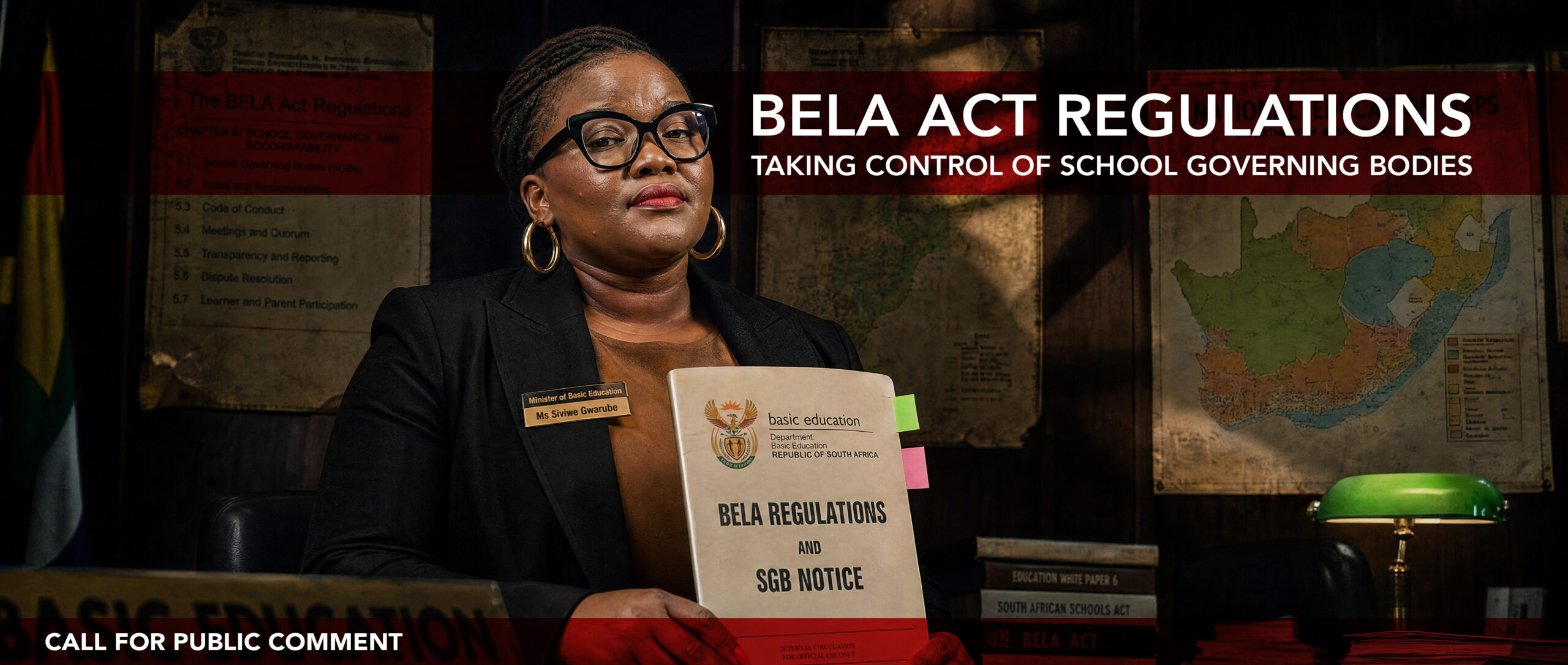
Following the enactment of the Basic Education Laws Amendment (BELA) framework, Basic Education Minister Siviwe Gwarube gazetted four key regulatory instruments for public commentary.
These draft regulations move the BELA Act from high-level law into daily, on-the-ground reality across South Africa’s 22,000+ public schools. They directly impact how School Governing Bodies (SGBs) are elected, whether SGBs can pay teachers for extra coaching or weekend classes, how underperforming SGBs are managed, and how teacher development centres are built and run.
click the link for more info
Have your say – shape the regulations. [CLOSED]

Top concerns
To help you choose the option that best reflects your concern, here is a detailed breakdown of each Primary Area of Concern in the Question 2 dropdown.
-
- What it means:
Focuses on state restrictions on the independent power of School Governing Bodies (SGBs) to compensate state-employed teachers or administrative staff for additional work (such as afternoon sports coaching, weekend extra classes, or cultural activities). - Key Draft Provisions:
Draft Notice 7796 (Section 38A Regulations) prohibits SGBs from paying any extra money, financial benefit, or benefit-in-kind to state employees without submitting a formal application (Form 1) and securing advance written permission from the provincial Head of Department (HoD).
- What it means:
Why choose this:
If you believe democratically elected parent bodies should retain the local autonomy and flexibility to reward dedicated staff for extra effort without state interference or bureaucratic vetoes.
-
- What it means:
Focuses on the logistical bottleneck caused by forcing SGBs to wait up to a quarter of a year for provincial departmental decisions before extra pay or programs can be authorized. - Key Draft Provisions:
Regulation 5(2) of Draft Notice 7796 grants the provincial HoD up to three (3) months from the date of application receipt to approve or reject a Section 38A extra pay request.
- What it means:
Why choose this:
If you are concerned that a 90-day waiting window will paralise school calendars, delay sports seasons and academic catch-up programs, and burden both schools and provincial departments with excessive red tape.
-
- What it means:
Focuses on the potential inequalities and technical vulnerabilities introduced by modernizing SGB elections through remote or digital voting platforms. - Key Draft Provisions:
Draft Notice 7797 (SGB Election Regulations) introduces the E-Election Method, allowing public schools with requisite technical capacity to conduct remote digital voting, subject to technological readiness assessments and POPIA data compliance.
- What it means:
Why choose this:
If you worry that parents in under-resourced or rural communities without reliable internet, smartphones, or data will be disenfranchised, or if you have concerns regarding cyber-security and secret ballot verification in online elections.
-
- What it means:
Focuses on the balance of power between elected parent representatives and provincial education officials regarding state intervention in school governance. - Key Draft Provisions:
Draft Notice 7797 outlines formal procedures authorizing the provincial HoD to dissolve an SGB that fails to perform its statutory duties, appoint interim managers, and assume temporary control over school governance.
- What it means:
Why choose this:
If you believe granting provincial officials broader powers to dissolve SGBs risks centralising control, politically interfering in local school governance, or overriding parent voting mandates without sufficient independent judicial checks.
-
- What it means:
Focuses on the policy shift toward establishing physical spatial norms for training institutes rather than providing immediate, in-classroom support to educators. - Key Draft Provisions:
Draft Notices 7795 & 7798 set binding spatial square-meterage norms, ICT lab requirements, alternative power specs (solar/generators), and perimeter fencing for Provincial Institutes (PTDIs) and District Centres (DTDCs).
- What it means:
Why choose this:
If you feel that establishing spatial standards for training facilities misses the primary mark—arguing that state funding and resources should go directly toward in-classroom teacher support, reducing class sizes, providing teaching materials, and relieving overworked educators.
-
- What it means:
Focuses on the positive benefits of national legal uniformity, corruption prevention, and modernized facility standards across the public schooling ecosystem. - Key Draft Provisions:
Covers the overarching principles across all four gazette notices (Notices 7795, 7796, 7797, 7798), creating single national standards for SGB elections, Section 38A financial disclosures, and dignified, pit-latrine-free educator training facilities.
- What it means:
Why choose this:
If you agree with the Minister’s objective to eliminate double-dipping, prevent wealthy schools from inflating state salary gaps, ensure tax compliance, boost election turnout, and guarantee modern, dignified spaces for teacher development.
Perspectives: What is the debate?
Supporters argue: These regulations bring much-needed financial integrity, stop salary inflation discrepancies between rich and poor public schools, modernise parent election turnouts via e-voting, and ensure teacher training facilities meet dignified standards.
Critics argue: Requiring a 3-month state approval process before an SGB can pay teachers for weekend tutoring or afternoon sports coaching creates administrative paralysis. Others express concern that e-voting could disenfranchise parents without data or smartphones, and that setting building norms does not address educator workload inside crowded classrooms.
-
- What Supporters Say
Closes corruption loopholes & stops double-dipping: Prevents wealthy schools from privately inflating state salaries, ensures tax compliance, and protects public funds from unauthorised bonuses. - What Opponents Say
Creates administrative paralysis: A 3-month HoD waiting period for sports or extra math classes stifles extracurriculars and penalizes dedicated teachers who go above and beyond.
- What Supporters Say
-
- What Supporters Say
Modernises participation: E-voting and flexible day polling increase parent voter turnout and standardise handover procedures between outgoing and incoming SGBs. - What Opponents Say
Exacerbates the Digital Divide: Rural or low-income parent communities risk digital exclusion due to data costs, poor connectivity, or lack of smartphone access.
- What Supporters Say
-
- What Supporters Say
Ensures functional accountability: Authorises the HoD to intervene and dissolve failing or dysfunctional SGBs while appointing interim management. - What Opponents Say
Infringes on local SGB autonomy: Concentrates power in provincial bureaucracies, potentially undermining community-led governance and parental rights.
- What Supporters Say
-
- What Supporters Say
Establishes dignified, modern spaces: Guarantees universal disability access, backup power, digital libraries, and eradicates pit toilets at training institutes. - What Opponents Say
Focuses on bricks rather than support: Building spatial norms does not solve educator burnout, excessive admin burdens, or large classroom sizes in real schools.
- What Supporters Say
Suggested Public Responses (For & Against)
I write to express my overall SUPPORT for the draft regulations published under the Basic Education Laws Amendment Act framework.
-
- Financial Accountability (Section 38A):
I support the strict regulation of additional remuneration paid by SGBs to state employees. Requiring prior HoD approval, hourly time logs, and clear Section 38A school policies prevents the unauthorized misapplication of school funds, ensures tax compliance, and eliminates unfair salary discrepancies between schools. - Modernized SGB Elections (Notice 7797):
I welcome the formalization of e-voting and flexible day polling methods, which will significantly improve parent participation and voter turnout. The mandatory handover templates protect institutional memory when new SGBs take office. - Dignified Educator Infrastructure (Notices 7795 & 7798):
Setting binding spatial standards, universal disability access, and explicitly banning pit latrines at teacher training facilities is an essential step toward professionalizing educator support in South Africa.
- Financial Accountability (Section 38A):
While I acknowledge the need for standardized school governance, I OBJECT to specific overreaching aspects of the draft regulations and urge the Minister to make the following critical amendments:
-
- Reduce the 3-Month Section 38A Approval Window:
The proposed 3-month waiting period for HoD authorization under Regulation 5(2) is completely unworkable. Requiring an SGB to wait up to a quarter of a year to pay educators for coaching sports, music lessons, or weekend academic catch-up sessions will paralyze extra-curricular programs.
Amendment Request: The approval window must be shortened to 30 calendar days, with a provision that failure by the HoD to respond within 30 days constitutes automatic temporary approval. - Protect SGB Autonomy & Avoid Centralization: The regulations grant excessive administrative oversight to provincial education departments over routine SGB functions. SGBs are elected by parents and must retain the operational flexibility to manage extra duties without excessive red tape.
- Safeguard Against Digital Exclusion in E-Voting: Notice 7797 must explicitly guarantee that schools adopting e-voting maintain accessible physical voting alternatives so that parents without internet access, data, or smartphones are not disenfranchised.
- Prioritise In-Classroom Educator Relief: Physical infrastructure norms for district training centres must be matched by immediate, practical support for educators inside overcrowded classrooms.
- Reduce the 3-Month Section 38A Approval Window: