

- No I do not support the plans 41
- Yes I do 7
- Not fully 1
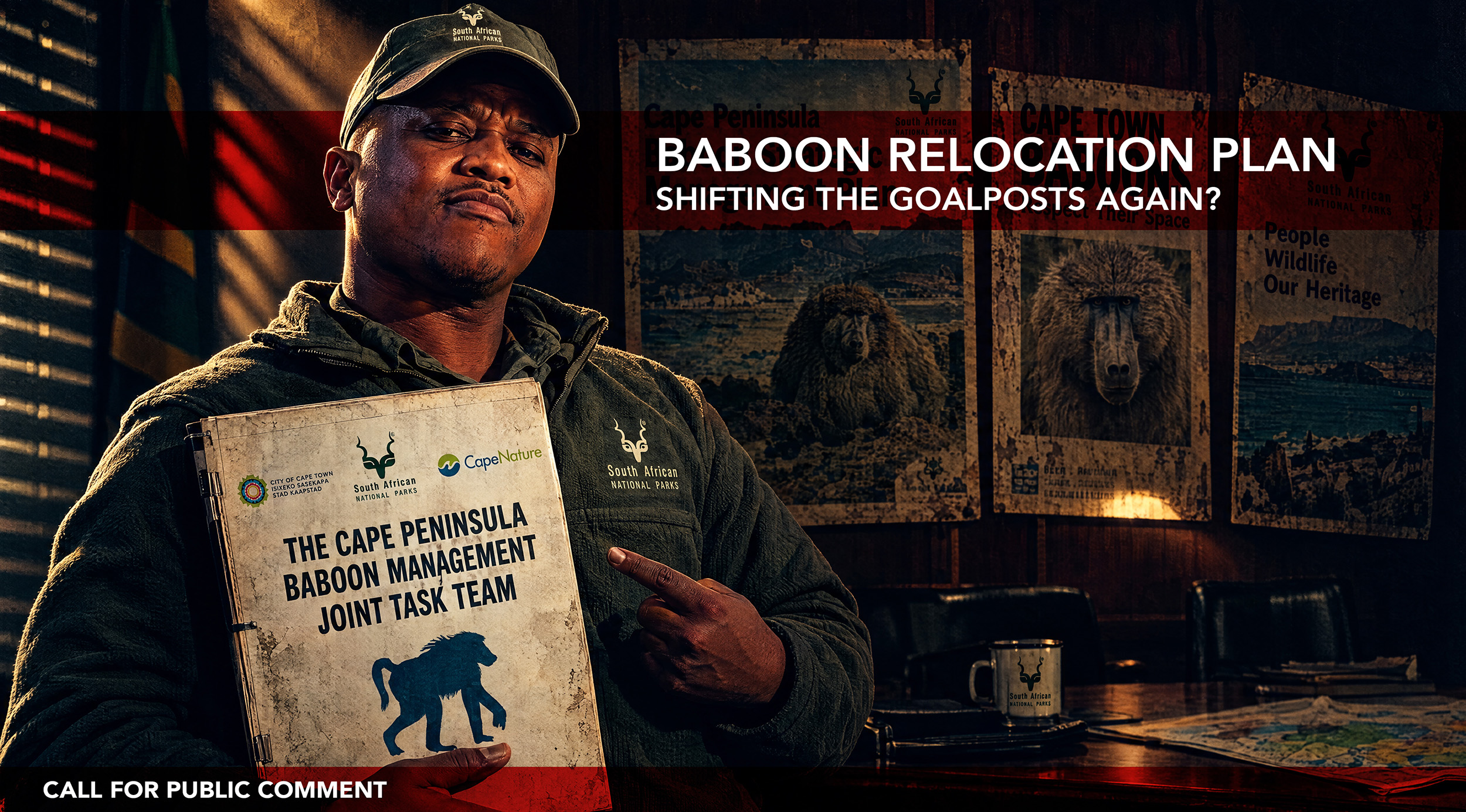
The Cape Peninsula Baboon Management Joint Task Team (CPBMJTT)—a tripartite collaboration comprising the City of Cape Town, CapeNature, and SANParks—is preparing to capture approximately 60 wild chacma baboons comprising the Seaforth and Waterfall troops and relocate them into permanent captive confinement at the Kogelfontein Urban Wildlife Centre near Scarborough.
The operation includes whole-troop trapping, veterinary health assessments, the surgical vasectomy of healthy males, and permanent containment behind fences.
While the overarching Cape Peninsula Baboon Strategic Management Plan underwent broad public comment in early 2023, the practical execution plan has undergone a drastic, unconsulted shift. In November 2025, the authorities publicly announced a phased trial model: Seaforth would move to a 1.5-hectare trial enclosure on private land along Plateau Road, followed by a mandatory six-month assessment and an Environmental Impact Assessment (EIA) before expanding or touching the Waterfall troop. By mid-2026, this staged private model was abandoned in favour of immediate, dual-troop permanent confinement at a R10 million municipal facility at Kogelfontein.
This campaign gives citizens a direct statutory channel to demand an administrative freeze on all capture operations until the complete regulatory authorisation chain is disclosed, a procedurally fair public participation process is conducted on the Kogelfontein model under Section 4 of PAJA, and viable free-ranging coexistence alternatives are formally assessed.
click the link for more info, or scroll down to have your say
Where Do You Stand?
🔴 I OBJECT to the permanent relocation and confinement at Kogelfontein (Rejects caging free-ranging baboons in an enclosure 292 times smaller than their range, halts premature capture operations while CapeNature confirms permit applications remain incomplete, and opposes abandoning the November 2025 Plateau Road trial model without lawful public participation).
🟡 I AMEND / NOT FULLY (Supports non-lethal baboon management and conflict reduction, but demands an immediate administrative freeze until CapeNature permit processes are finalised and disclosed, procedural fairness under PAJA is fulfilled, and funded free-ranging fencing and waste alternatives are formally assessed).
🟢 I SUPPORT the relocation to Kogelfontein as planned (Backs the Urban Wildlife Centre as a necessary non-lethal intervention to resolve chronic urban conflict in Simon’s Town, curb property incursions, and protect baboons from urban hazards including traffic, dog attacks, and human hostility).
Have your say – shape the plan.

Top concerns
-
- The Legal Fact:
Under Section 31 of the Nature Conservation Ordinance 19 of 1974, keeping any wild animal in captivity requires a formal captivity permit issued by CapeNature. Section 29 separately regulates trapping, capture methods, and transport. CapeNature’s official permit regulations state that incomplete applications will not be processed. - The Evidence:
On 29 September 2026, CapeNature confirmed under PAIA (Ref: PAIA/CWSMITH2026/11) that “a completed application is yet to be received” and the operational management plan before it “has not yet been finalised”.
- The Legal Fact:
Participant Submission Point:
The authorities cannot lawfully initiate capture, trapping, sedation, or transport without completed, processed, and approved provincial permits. Any operational step taken prior to lawful permit issuance is ultra vires and administratively unlawful.
-
- The Legal Fact:
Under Section 4 of the Promotion of Administrative Justice Act (Act 3 of 2000), administrative decisions that materially and adversely affect the rights of the public or the environment require a procedurally fair process, typically notice-and-comment. - The Evidence:
The 2023 Strategic Management Plan and November 2025 Final Action Plan committed to a 1.5-hectare trial on private Plateau Road land, subject to a six-month assessment and an Environmental Impact Assessment (EIA) for subsequent enclosures. Swapping this staged model for immediate, permanent confinement of two entire troops at the City-owned Kogelfontein facility represents a material departure implemented without public notice and comment.
- The Legal Fact:
Participant Submission Point:
The Kogelfontein relocation decision must be paused and subjected to a fresh, formal public participation process under Section 4 of PAJA before irreversible action is taken.
-
- The Empirical Fact:
Primatological tracking indicates that the Waterfall troop ranges across a natural home territory of 736.1 hectares. - The Evidence:
The proposed Kogelfontein camp provides approximately 2.52 hectares (with the JTT enclosure specified at 2.3 hectares). Confining 60 wild primates to an area 292 times smaller than their home range strips them of natural foraging ecology and group fission dynamics.
- The Empirical Fact:
Participant Submission Point:
Restricting free-ranging primates to a compressed enclosure violates basic welfare norms under the Animals Protection Act 71 of 1962 and aligns with the Cape of Good Hope SPCA’s formal position rejecting long-term captive holding of healthy wild troops.
-
- The Evidence:
Court correspondence and stakeholder records indicate capture operations were scheduled for on or about 12 September 2026.
- The Evidence:
Participant Submission Point:
The authorities must officially account for this timeline: who authorised an operational capture date for 12 September 2026 when CapeNature confirmed two weeks later (29 September) that a completed permit application had not even been received?
-
- The Governance Fact:
Managing anthropogenic food attractants is universally recognized as the primary prerequisite for mitigating baboon incursions. The City’s Action Plan incorporates a Baboon Waste Management Strategy. - The Evidence:
In September 2026, the City launched a rollout of 2,200 baboon-proof bins across high-conflict areas, but explicitly excluded Simon’s Town on the premise that Seaforth and Waterfall are earmarked for removal.
- The Governance Fact:
Participant Submission Point:
Excluding Simon’s Town from waste mitigation while citing urban foraging to justify caging creates an artificial administrative pretext. Waste management—particularly addressing naval facilities—must be fully implemented and evaluated prior to caging.
-
- The Evidence:
WAPFSA, supported by Dr David Gaynor, has advanced a funded coexistence proposal utilising targeted baboon-proof fencing, waste management, and dedicated monitoring to secure the urban fringe while keeping baboons in natural habitat. The City is simultaneously erecting a northern boundary fence for this exact purpose.
- The Evidence:
Participant Submission Point:
Decision-makers are legally bound to evaluate viable, less restrictive alternatives. The authorities have failed to produce any documented, rational evaluation rejecting the southern coexistence proposal.
Perspectives: What is the debate?
-
- Mitigating Severe Human-Wildlife Conflict:
The Joint Task Team maintains that the Waterfall and Seaforth troops have become chronically urbanised in Simon’s Town, creating substantial human-wildlife conflict, property damage, and safety risks that previous management methods have failed to resolve. - Non-Lethal Management Solution:
Authorities argue that permanent confinement in a purpose-built “semi-wild” Urban Wildlife Centre is preferable to euthanasia or leaving troops in urban environments where they face dog attacks, vehicle collisions, illegal pellet-gun shootings, and poisoning. - Protecting Regional Genetic Lines:
Proponents state that purpose-built enclosures provide shelter, water, and veterinary care while preventing troops from raiding residential waste and human food attractants. - Established Strategy:
The JTT asserts that baboon management has been continuously informed by extensive consultation, including the 2023 Strategic Management Plan public-participation process and review by an independent expert panel.
- Mitigating Severe Human-Wildlife Conflict:
-
- Regulatory Prematurity & Missing Permits:
CapeNature confirmed on 29 September 2026 that a completed captivity permit application has not been submitted and the operational management plan remains unfinalised. Capturing, transporting, and caging protected wildlife without completed statutory permits violates the Nature Conservation Ordinance 19 of 1974. - Severe Spatial Confinement:
Spatial tracking by primatologist Dr David Gaynor shows the Waterfall troop’s natural territory spans 736.1 hectares. Caging them in a 2.52-hectare enclosure (with the JTT enclosure specified at 2.3 hectares) reduces their living range by ~292 times, which experts warn constitutes a monument to management failure and an unviable welfare outcome. - Procedural Unfairness under PAJA:
The authorities substituted the announced November 2025 Plateau Road staged trial (which included a 6-month review and EIAs) with permanent confinement at Kogelfontein without conducting a specific notice-and-comment process under Section 4 of PAJA. - Refusal to Mitigate Waste Attractants: The City rolled out 2,200 baboon-proof bins across the Peninsula in September 2026 but intentionally excluded Simon’s Town on the grounds that the troops are earmarked for removal. Opponents argue the City is manufacturing a justification for removal by refusing to secure municipal waste.
- Viable Coexistence Alternatives Ignored:
A fully costed, funded alternative developed by WAPFSA and Dr Gaynor—incorporating strategic exclusion fencing, waste securement, and shepherding—has been bypassed without formal, transparent comparative assessment. - Animal Welfare Objections:
The Cape of Good Hope SPCA formally stated in July 2026 that it opposes placing healthy, free-roaming, wild-caught baboons into long-term captive sanctuaries.
- Regulatory Prematurity & Missing Permits: