
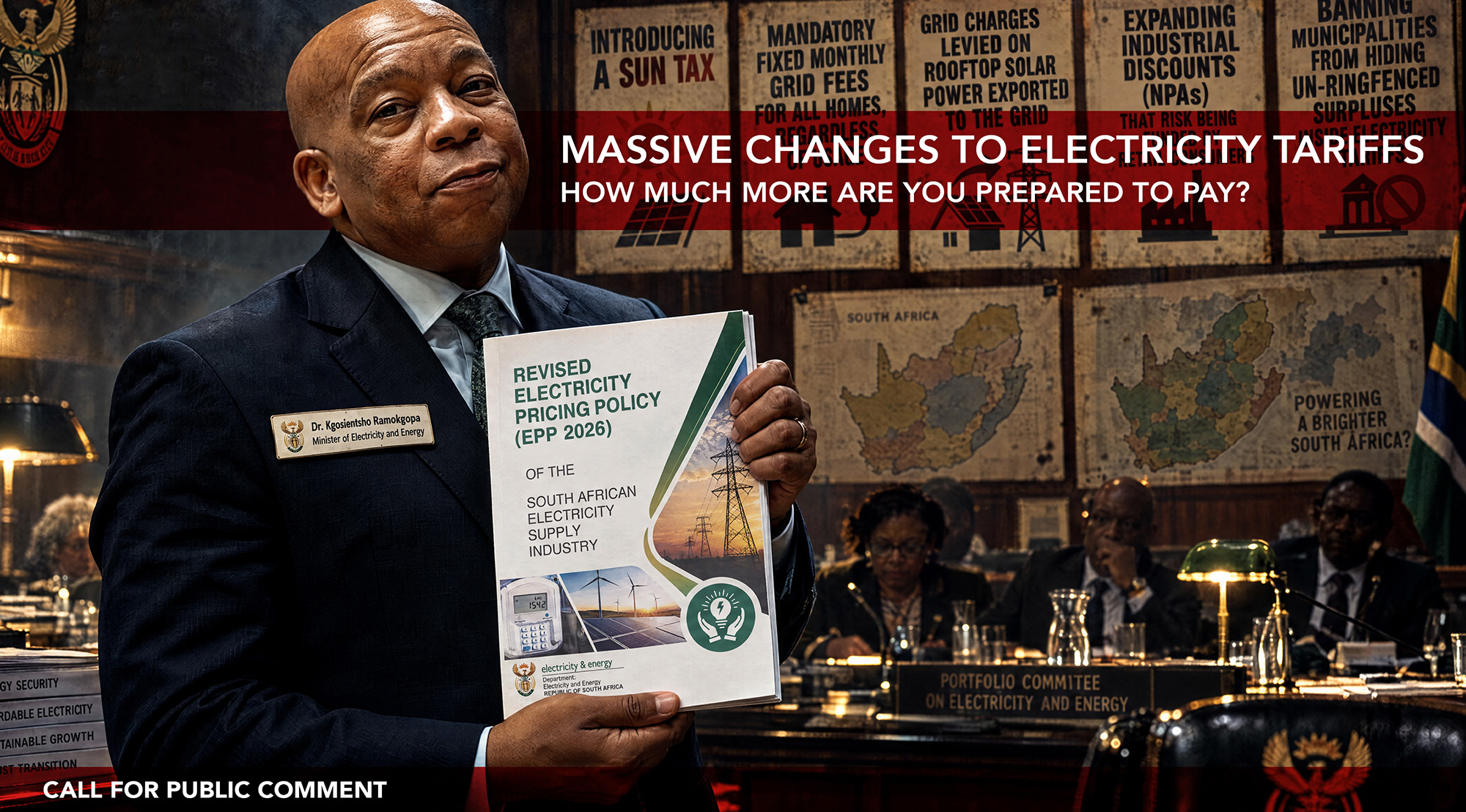

The Department of Electricity and Energy has gazetted the Revised Electricity Pricing Policy (EPP 2026), initiating the first complete structural overhaul of South Africa’s electricity tariff architecture since 2008.
Formulated to operationalise the Electricity Regulation Amendment Act, 2024 (ERAA), this policy marks the formal end of South Africa’s vertically integrated, single-buyer electricity monopoly. As Eskom unbundles into separate generation, transmission, and distribution entities, the state is introducing an open wholesale power market, multi-party trading, and competitive procurement.
To align with this evolving industry, the draft policy outlines 54 binding Policy Positions that overhaul how electricity tariffs are calculated, unbundled, and billed to every consumer in the country.
While the policy seeks to achieve transparent, cost-reflective pricing and long-term financial sustainability for grid infrastructure, it introduces significant financial shifts for households, small businesses, and private renewable energy investors.
click the link for more info, or scroll down to have your say
Have your say – shape the policy.

Top concerns
What the Draft Policy Proposes:
The policy shifts tariff design away from volumetric consumption (c/kWh) toward mandatory fixed network and capacity charges (R/kVA, R/kW, or R/Amp/month). To eliminate “volume risk” for distributors, utilities will bill customers for grid availability and network reservation regardless of whether electricity is consumed. In addition, Policy Position 15 introduces a universal generation standby charge applied at the wholesale level to recover the capital costs of keeping backup dispatchable generation on standby for grid-tied users.
The Core Civic / Household Risk:
Households and small businesses that invested private savings into rooftop solar, batteries, or energy-efficiency measures to survive load shedding will be hit with steep monthly fixed fees simply for remaining connected to the grid. Frugal, low-volume consumers can no longer lower their utility bills by conserving electricity, as fixed network fees create a high, unavoidable monthly billing floor.
What to Demand in Your Public Submission (PAJA-Enforceable Points):
-
- Demand that NERSA impose a strict statutory cap on fixed network and capacity charges, ensuring fixed availability fees cannot exceed 15% to 20% of an average domestic electricity bill.
- Insist that low-usage and energy-conserving households be protected from fixed capacity charges that disproportionately penalise lower-middle-income families.
- Require utilities to absorb fixed infrastructure costs through internal operational efficiencies rather than shifting revenue risk entirely onto captive consumers.
What the Draft Policy Proposes:
Grid-tied customers who generate and export renewable energy into the grid (prosumers) will be subjected to a highly restrictive net-billing framework:
-
- Mandatory Time-of-Use (TOU) tariffs.
- Prosumers must pay full Distribution Use of System (DUoS) and Transmission (TUoS) network charges on all imported energy and must also pay separate DUoS/TUoS charges on all energy exported into the grid.
- Exported power is credited only at the utility’s low “avoided purchase cost”.
- Network and retail charges cannot be credited or offset by exported energy credits, and an extra retail administration fee will be billed to handle net-billing meters.
The Core Civic / Household Risk:
By levying network charges on both energy imported and energy exported, the state effectively taxes private clean energy fed back into local communities. Prohibiting consumers from using export credits to offset fixed monthly network fees drastically erodes the financial return on private rooftop solar, disincentivising decarbonisation and pushing frustrated solar owners to defect from the grid entirely.
What to Demand in Your Public Submission (PAJA-Enforceable Points):
-
- Demand the complete removal of DUoS and TUoS network charges on exported electricity (Policy Position 33(d)), recognising that embedded solar reduces local line losses and daytime substation loading.
- Insist that solar export credits be eligible to offset the total monthly municipal utility bill, including fixed network and customer service charges.
- Require fair, cost-reflective feed-in credit rates that reflect the true economic value of daytime peak/standard clean power injected into local distribution networks.
What the Draft Policy Proposes:
The policy expands Negotiated Pricing Agreements (NPAs), allowing energy-intensive industrial consumers (such as ferrochrome smelters) to purchase electricity at deeply discounted, concessional rates to protect industrial competitiveness. Simultaneously, the Department is pursuing an expansion of Free Basic Electricity (FBE) from 50 kWh up to 200–300 kWh per month for indigent households. Under Policy Position 50, all network-connected users must contribute proportionately to tariff subsidies.
The Core Civic / Household Risk:
While industrial jobs and indigent support are vital, offering heavy industry discounted power (historically around 62 c/kWh) and expanding free power without an equivalent multi-billion-rand budget injection from National Treasury threatens paying consumers. If Eskom and municipal distributors suffer revenue shortfalls from these programmes, the deficit will inevitably be recovered through higher retail tariff charges on paying households and small businesses.
What to Demand in Your Public Submission (PAJA-Enforceable Points):
-
- Demand that any revenue shortfall arising from Negotiated Pricing Agreements (NPAs) with private commercial smelters be funded exclusively via the fiscus (Department of Trade, Industry and Competition or National Treasury) and legally ring-fenced from standard consumer tariffs.
- Insist that any expansion of Free Basic Electricity (FBE) above 50 kWh be fully backed by the National Treasury Equitable Share grant before implementation, with an explicit ban on funding social allocations through municipal electricity surcharges.
- Require full public disclosure and annual audited reporting of all NPA discounts and inter-tariff subsidy transfers on consumer invoices (Policy Position 50(j)).
What the Draft Policy Proposes:
Policy Position 38 eliminates Inclining Block Rate (IBR) tariffs for standard domestic customers, claiming that stepped usage tiers send poor economic signals and fail to reflect underlying capacity costs. Residential electricity supply is restructured into:
-
- Lifeline Tariffs: Single energy rate with zero basic charges, strictly reserved for indigent households with connections <60 Amps.
- Standard Domestic Tariffs: Unbundled charges consisting of an itemised monthly network capacity charge, a customer service charge, and a flat energy rate.
- Three-Phase Residential: Mandatory migration to unbundled Time-of-Use (TOU) tariffs.
The Core Civic / Household Risk:
The removal of IBRs strips middle-income families of the ability to manage their bills by staying within lower consumption tiers. Replacing stepped rates with flat energy rates plus substantial fixed monthly network fees will trigger immediate billing shocks for lower-to-middle-income ratepayers, retirees, and multi-family households that share a single electricity meter.
What to Demand in Your Public Submission (PAJA-Enforceable Points):
-
- Demand that NERSA retain an energy-conservation tariff tier for non-indigent, low-to-middle-income consumers that does not penalise modest energy usage with large monthly service fees.
- Insist that the migration from IBRs to unbundled domestic tariffs be phased in gradually over a minimum of five years, with mandatory local affordability impact assessments.
- Require that smart metering infrastructure and Time-of-Use domestic options be provided without upfront capital cost penalties to the end-user.
What the Draft Policy Proposes:
Policy Position 47 strictly forbids municipalities from introducing municipal electricity surcharges (MSOE) on top of existing non-transparent, un-ring-fenced municipal “surpluses”. NERSA is mandated to regulate base tariffs strictly to the audited Cost of Supply (CoS), while any municipal surcharge must be transparently itemised on bills and regulated separately by National Treasury under the Municipal Fiscal Powers and Functions Act.
The Core Civic / Household Risk:
For decades, local councils have used massive, hidden electricity markups (often 15% to 35% above Eskom bulk rates) as an unregulated cash cow to cross-subsidise operational salaries, administrative waste, and deficits in other departments. When councils fail to maintain their local electricity substations, cables, and transformers, power cuts multiply despite ratepayers paying exorbitant, un-ring-fenced tariffs.
What to Demand in Your Public Submission (PAJA-Enforceable Points):
-
- Demand that NERSA automatically reject any municipal tariff application that is not supported by a fully audited, publicly accessible Cost of Supply (CoS) study (Policy Position 25(a)).
- Insist on the immediate statutory ring-fencing of all municipal electricity revenues into dedicated maintenance accounts, legally prohibiting councils from diverting electricity revenue to fund unrelated municipal wage bills or deficits.
- Demand that National Treasury set a hard, uniform percentage cap on the Municipal Surcharge on Electricity (MSOE) to prevent local councils from using surcharges to circumvent NERSA tariff controls.
What the Draft Policy Proposes:
Non-technical losses (electricity theft, illegal connections, meter tampering) and bad debt have destabilised Eskom and municipal distributors. Policy Positions 42 and 43 mandate that NERSA establish data-based performance benchmarks for losses and bad debt. Any component of technical losses, non-technical losses, or uncollected debt that exceeds the approved regulatory standard must be deemed unacceptable and excised from the licensee’s allowed revenue base.
The Core Civic / Household Risk:
Historically, when municipalities fail to enforce bylaws, audit meters, or collect revenue from non-paying areas, they pass the financial deficit onto compliant, paying ratepayers through inflated annual tariff increases. Law-abiding citizens and businesses are effectively forced to pay double: once for their own consumed electricity, and a second time to subsidise utility incompetence, meter bypasses, and uncollected debt.
What to Demand in Your Public Submission (PAJA-Enforceable Points):
-
- Demand that NERSA immediately enforce Policy Position 43(b) by clawing back and disallowing any tariff requests where municipal distribution losses exceed national regulatory standards (typically 7%–10%).
- Insist that paying consumers be legally shielded from funding municipal arrears and Eskom debt defaults through local tariff markups or surcharge adjustments.
- Require licensees to implement strict, automated tamper detection, independent metering audits, and universal prepaid infrastructure in non-paying areas before requesting any tariff increases from compliant ratepayers.
Perspectives: What is the debate?
-
- Mandatory Fixed Charges (Policy Positions 11, 27, 30)
Ensures fair cost-recovery for grid maintenance and spinning reserves. Prevents grid-tied solar households from “free-riding” on wires maintained by non-solar and low-income users. - Prosumer Net-Billing Rules (Policy Position 33)
Treats the grid as an engineered machine requiring compensation for handling bi-directional energy flows and local voltage balancing. - Scrapping Inclining Block Tariffs (Policy Position 38)
IBRs send poor economic signals, do not reflect real capacity costs, and penalise large multi-family households that share a single connection - Municipal Surcharge Ring-Fencing (Policy Position 47)
Eliminates hidden municipal electricity markups, forcing councils to run efficient departments and ring-fence grid maintenance budgets. - Industrial Smelter NPAs (Policy Position 54)
Preserves strategic heavy industry (smelters, mining), prevents catastrophic de-industrialisation, and protects hundreds of thousands of jobs. - Prepaid Vending Caps (Policy Position 45)
Protects vulnerable and low-income prepaid consumers from price-gouging, hidden commissions, and predatory third-party vendors.
- Mandatory Fixed Charges (Policy Positions 11, 27, 30)
-
- Mandatory Fixed Charges (Policy Positions 11, 27, 30)
Functions as an arbitrary “sun tax” and availability penalty. Punishes energy efficiency and private capital invested to survive load shedding, extending solar payback periods. - Prosumer Net-Billing Rules (Policy Position 33)
Highly punitive: charging solar owners DUoS fees to export clean power while refusing to allow export credits to offset network fees creates an unviable investment model. - Scrapping Inclining Block Tariffs (Policy Position 38)
Removing IBRs in favour of flat energy rates plus heavy basic monthly connection fees will cause immediate sticker shock for low-to-middle-income ratepayers. - Municipal Surcharge Ring-Fencing (Policy Position 47)
Threatens local government fiscal collapse. If municipal electricity profits are stripped, councils will hike property rates or collapse basic community services. - Industrial Smelter NPAs (Policy Position 54)
If heavy industry receives electricity at 62 c/kWh (below cost), ordinary retail consumers and small businesses will be forced to shoulder the resulting revenue shortfall. - Prepaid Vending Caps (Policy Position 45)
Imposing tight commission caps without administrative support could cause independent retail vendors to shut down, stranding rural consumers without token access.
- Mandatory Fixed Charges (Policy Positions 11, 27, 30)