
Advert
Advert – scroll down
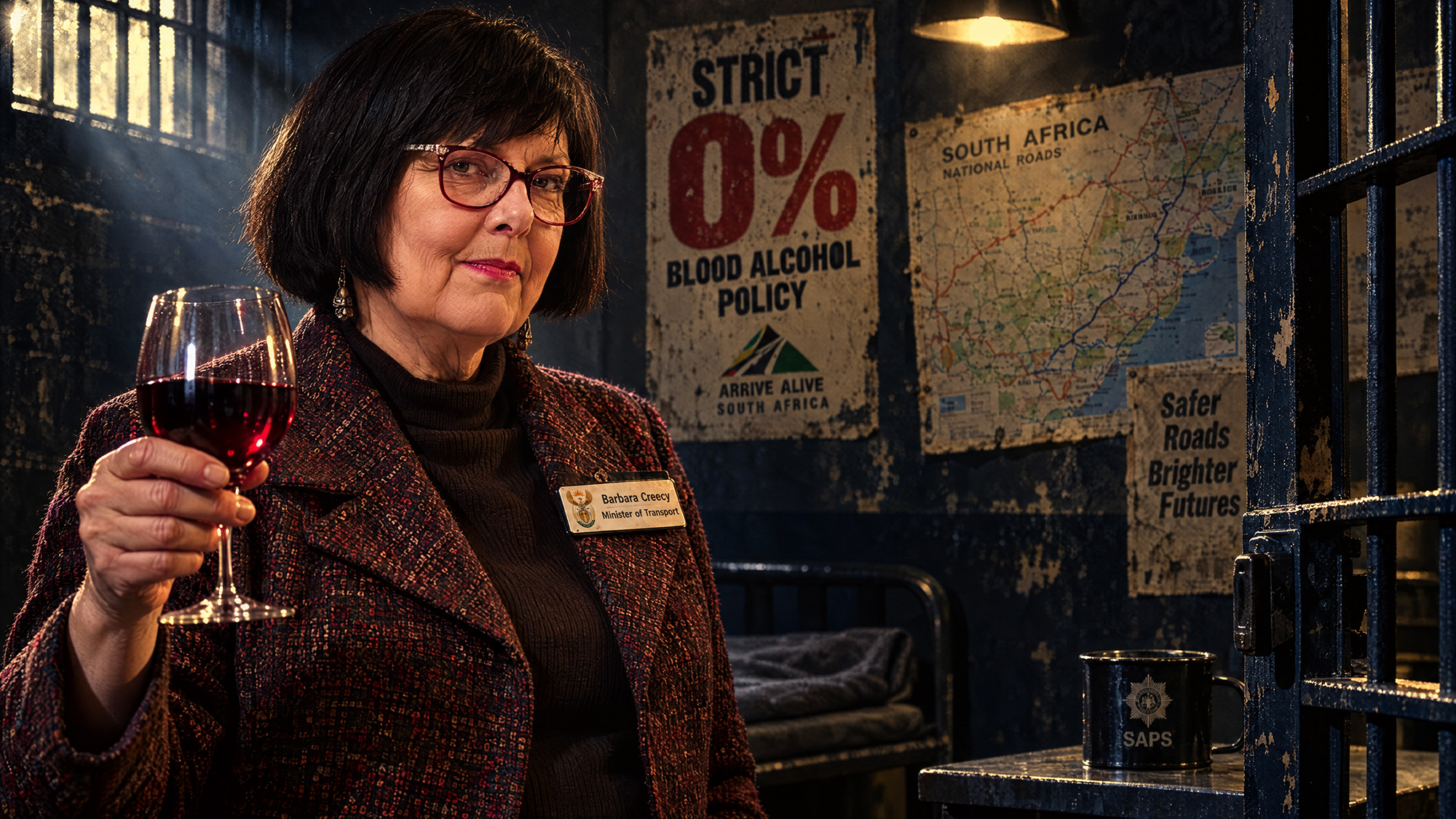
MINISTER CREECY’S 0% ALCOHOL LIMIT IS AN IRRATIONAL DISTRACTION
By Rob Hutchinson
Transport Minister Barbara Creecy’s ongoing push to amend Section 65 of the National Road Traffic Act and lower South Africa’s permissible blood alcohol concentration limit from 0.05g/100ml to an absolute zero is not just unworkable—it is an ill-informed and irrational idea. Instead of tackling the catastrophic failure of visible traffic policing and a broken justice system, the Minister is opting for a lazy legislative fix. It is the stroke of a pen that will turn ordinary, law-abiding citizens using mouthwash or cough medicine into criminals, while doing absolutely nothing to stop the actual carnage on our roads.
The reality is that the drivers causing the fatalities on our roads are not the ones hovering between 0.00% and 0.05%. They are the ones blowing three, four, or five times over the current legal limit. These drivers already ignore the current law. They will ignore the new one, too.
To understand how disconnected this proposal is from reality, we only need to look at the government’s own statistics regarding arrests versus actual convictions. Every festive season, the Department of Transport proudly announces massive arrest numbers. During the 2024/2025 festive season alone, nearly 10,000 motorists were arrested for drunk driving. Yet, the follow-through is a systemic failure.
According to organisations like South Africans Against Drunk Driving (SADD) and legal monitors, the actual conviction rate for drunk driving in South Africa hovers around a dismal 2% to 7.5%.
Why? Because our enforcement and judicial pipelines are fundamentally broken. Blood samples are botched or expire due to massive backlogs at forensic laboratories. Dockets routinely “disappear” from police stations. Cases are thrown out of court due to procedural errors or corrupted evidence. Lowering the legal limit to zero does not fix a single one of these structural failures. In fact, it will only overwhelm an already collapsing system by flooding it with false-positive arrests of people who consumed homeopathic remedies, further delaying the prosecution of the severely intoxicated drivers who are actually killing people.
Proponents of this zero-tolerance bill often attempt to justify it by citing “international best practice,” frequently pointing to nations like Norway, Japan, and Venezuela as success stories. This comparison is factually incorrect and deeply misleading. Norway operates with a 0.02% limit, Japan enforces a 0.03% limit, and Venezuela’s limit is set at 0.08%—which is significantly more lenient than South Africa’s current law. These nations recognise the biological necessity of a scientific buffer to account for common medications, natural endogenous ethanol production, and breathalyser calibration margins.
Are there any countries on this blue planet that actually enforce an absolute zero policy? Yes. A handful of nations—including the Czech Republic, Hungary, Romania, Slovakia, and Brazil—enforce a 0.00% limit, alongside certain Islamic states where alcohol consumption is strictly banned. However, the European and South American nations that enforce this limit pair it with constant, visible, corruption-free policing and comprehensive public transport infrastructure. South Africa is attempting to copy the most punitive aspects of these systems without possessing the basic enforcement capacity required to back them up.
We cannot legislate our way out of an enforcement crisis. Criminalising trace amounts of alcohol from homeopathic remedies will not save a single life. Fixing the forensic laboratories, eliminating bribery at roadblocks, and ensuring that the habitual offenders actually go to jail will. Minister Creecy must abandon this irrational legislative distraction and focus the state’s resources on the hard work of actual policing and prosecution.