
Advert
Advert – scroll down
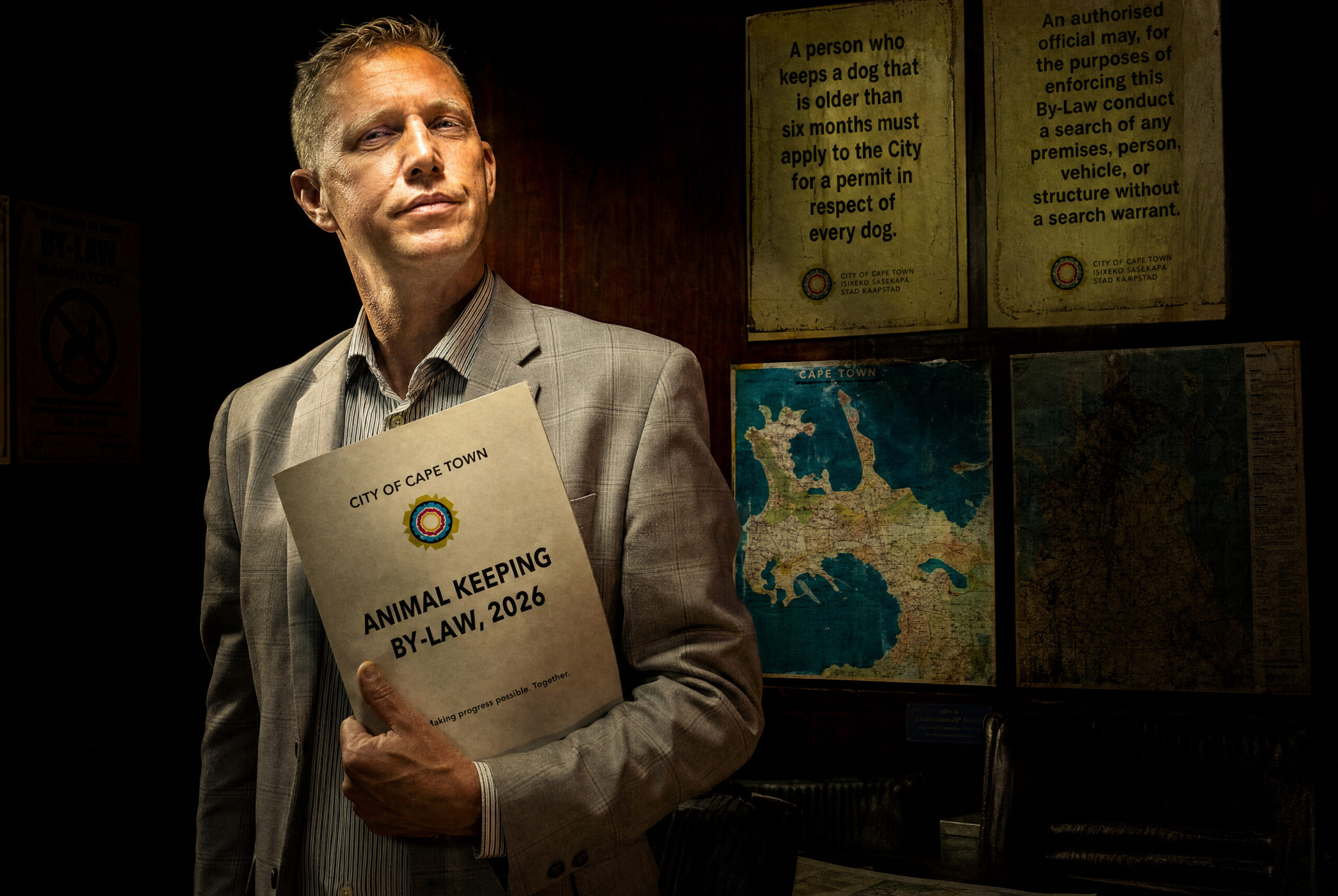
THE TROJAN HORSE IN YOUR BACKYARD: MUNICIPAL BY-LAWS, POLITICAL GASLIGHTING, AND THE COST OF SILENCE
When citizens think of government overreach, their minds naturally drift to Parliament: controversial national statutes, sweeping ministerial decrees, and contentious constitutional amendments. Yet the most pervasive, invasive erosion of personal liberty in South Africa rarely arrives through a presidential proclamation. It creeps in quietly through municipal gazettes, tucked inside mundane local by-laws that slip beneath the public radar until an enforcement officer knocks on the front door.
The City of Cape Town’s proposed Draft Animal Keeping By-law, 2026, is a masterclass in this quiet creep.
The draft contains long-overdue, widely celebrated anti-cruelty safeguards. Animal welfare advocates and civic organisations have rightly applauded clauses that restrict working cart horses from being driven in searing heat over 30°C, impose strict load limits, mandate hourly water breaks, ban the chaining and tethering of security dogs, and outlaw barbaric glue traps. These are progressive, humane measures that any civilised society ought to enforce.
Tucked behind this progressive shield lies an expansive machinery of bureaucratic control and municipal revenue extraction.
Under Sections 2 and 3, ordinary residents are told that keeping a family dog or cat older than six months requires an official municipal permit, accompanied by a prescribed municipal fee and vaccination records. Under Section 4, hard quotas are placed on companion animals—capping dogs to two in an apartment and three in a freestanding house, and cats to four—with excess pets requiring special permits, municipal property inspections, and written consent from adjacent neighbours. Backyard food producers are told they cannot keep more than five hens without approved building plans, while roosters and pigs are banned outright in suburbs. Section 42 empowers municipal officials to enter and search private homes, vehicles, and structures without a magistrate’s warrant if they believe obtaining one would cause a delay.
This is the silent danger of municipal overreach: legitimate, emotionally compelling causes—such as stopping animal abuse—are routinely weaponised as Trojan horses to normalise unprecedented intrusions into private homes, property rights, and domestic life.
The Politics of Denial: Why City Officials Mislead
When independent analysis brought these clauses into the public square, the reaction from the City’s political leadership followed a familiar administrative playbook: denial, deflection, and personal attack.
Alderman JP Smith, Mayoral Committee Member for Safety and Security, publicly took to social media to label commentators “misinformation merchants,” assuring the public that the draft by-law merely “encouraged voluntary registration,” that registration was “free,” that permits were only for excess animals, and that warrantless searches would never happen for ordinary by-laws.
Yet anyone who reads the gazetted draft legal text can see that these assurances directly contradict what Council published for public comment:
-
- The text does not say registration is “encouraged”; Section 2(5) states an owner must apply to the City for a permit in respect of every dog.
- It does not say it is “free”; Section 2(6) states the application must be accompanied by the prescribed permit fee as set out in the City’s tariff of charges.
- Section 42 does not limit warrantless searches to severe crimes like dog-fighting syndicates; it authorises warrantless entry across any private premises for the purposes of enforcing this By-law.
Why would seasoned politicians make statements so easily refuted by their own gazetted documents?
The answer lies in the intersection of fiscal anxiety, bureaucratic ambition, and political survival. South African municipalities are facing severe structural revenue pressures. In Cape Town, where recent judicial rulings have pushed back against unlawful valuation-linked tariffs and property-rate spikes, councils are under persistent institutional pressure to invent new administrative streams, fees, and compliance tariffs. Bureaucracies naturally seek to expand their jurisdictional footprint: more inspectors, more permitting registers, more discretionary approvals.
Officials recognise that the public is already fatigued by escalating rates and utility bills. The political fear of a middle-class ratepayer revolt is real.
When confronted with public outrage, the immediate political instinct is to soothe the public through broadcast soundbites and social media dismissals—hoping that citizens will accept the spoken PR rather than read the statutory print. It is a high-stakes bet that public engagement will remain passive, allowing the law to pass in its drafted form while public anger dissipates online.
The Watchdogs: Why Public Scrutiny Matters
This controversy highlights the indispensable role of independent political commentators, investigative analysts, and civic watchdogs.
Bureaucrats and legislative drafters often count on legal opacity. They write laws in dense, cross-referenced language and publish them in obscure municipal notices, betting that ordinary citizens will not read fifty pages of legal definitions.
When commentators like Willem Petzer open the gazetted PDF on a live screen, read the exact wording of Sections 2, 3, and 42, and place it directly alongside political spin, the informational monopoly is broken. It forces transparency into an arena designed for administrative convenience.
A vigilant public prevents governance from becoming a one-way monologue. It allows communities to make critical, surgical distinctions: to stand up and say, “We support the SPCA and we demand the protection of working cart horses and security guard dogs, but we reject municipal pet licensing fees, neighbour vetoes, and warrantless intrusions into our private living rooms”.
Without that scrutiny, the public is left with a false binary: either accept the entire 50-page bureaucratic apparatus or be accused of being against animal welfare.
The High Cost of Silence
The interim data on the Dear South Africa platform shows the closest split in the organisation’s history. Thousands of citizens are demanding action against dog attacks, barking nuisances, and animal abuse, while an equally vast number are drawing a hard line against municipal overreach.
Because the margins are razor-thin, civic complacency is dangerous.
In South African administrative law, under the Promotion of Administrative Justice Act (PAJA), public consultation is not an opinion poll. It is a formal statutory ledger. If affected citizens do not formally record their objections and proposed amendments, administrators and courts will legitimately conclude that the public consented to the text as written.
The repercussions extend far beyond the Cape Peninsula. Cape Town is South Africa’s municipal policy laboratory.
What begins as an experimental local by-law in Table Bay is routinely repackaged by the South African Local Government Association (SALGA) and exported to Johannesburg, Tshwane, eThekwini, and small local councils nationwide. If Cape Town succeeds in establishing universal permits for domestic pets, erf-based quotas, and warrantless home inspections, that framework becomes the administrative precedent for municipalities across the country.
Petitions signed on social media do not solve this; councils legally log them as a single collective submission.
Only individual, legally binding representations—lodged under PAJA—compel decision-makers to account for public input, address contradictions, and justify their legislative choices on the public record.
If you remain silent, the gazetted draft is the law you will live under. If you speak, the Council is legally bound to listen. The comment window closes on 29 September 2026; what happens to your home, your pets, and your constitutional rights depends entirely on whether you make your voice heard.