
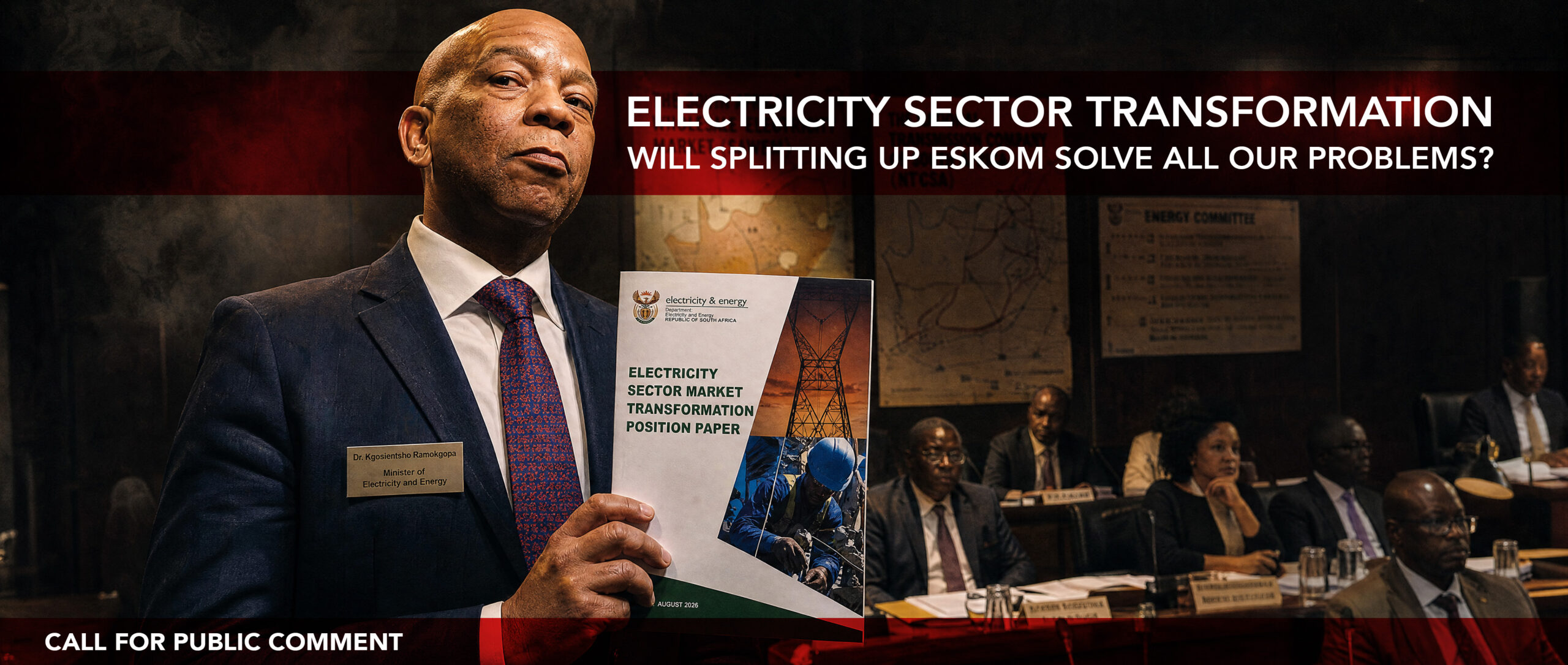

The Department of Electricity and Energy has published a structural roadmap to dismantle South Africa’s single-buyer electricity model and replace it with a competitive open market: the South African Wholesale Electricity Market (SAWEM).
While market competition aims to end Eskom’s generation monopoly and encourage private investment, the underlying policy introduces fundamental shifts that directly affect your monthly utility bills and private solar investments:
-
- Mandatory Fixed Grid Charges on Rooftop Solar: The policy explicitly targets grid-connected solar and partial-defection users under an “anti-free-riding” principle, shifting tariff structures from volumetric consumption (units used) to high, unavoidable fixed monthly connection fees.
- The “Captive Ratepayer” Risk: Large industrial and commercial users exceeding set thresholds (e.g., 1 MW) will be allowed to bypass municipal grids to buy cheaper power directly from private traders. Ordinary households and small businesses will remain “captive” to municipal distribution grids, risking higher tariffs to cover municipal revenue deficits and legacy cross-subsidies.
- Wholesale Price Volatility & Market Power: With Eskom Generation remaining the dominant producer, risks of market power, pricing manipulation, and trading speculation could translate into retail tariff volatility if regulatory protections are inadequate.
- Restructuring the Distribution Value Chain: Municipal and Eskom distributors must separate the physical grid (“wires”) from electricity sales (“retail/trading”), introducing separate fees for grid delivery and energy units.
click the link for more info, or scroll down to have your say
Where Do You Stand?
🟢 Support: Market competition, Eskom unbundling, and open wholesale trading are essential to solve South Africa’s energy crisis and attract private capital.
🔴 Object: Mandatory fixed solar charges, captive consumer price hikes, and municipal revenue losses will hurt ordinary households and small businesses.
🟡 Support with Amendments: Wholesale market reform should proceed only if strict caps are placed on fixed network fees, captive ratepayers are protected, and municipal cross-subsidies are safeguarded.
Have your say – shape the paper.

Top concerns
What the Policy Proposes:
The position paper establishes the principle to “discourage free riding,” arguing that modern electricity networks have high fixed infrastructure costs and low operational costs. Under this framework, tariffs will shift away from pure volumetric consumption charges (cents per kilowatt-hour) toward mandatory fixed capacity and network charges for all grid-connected customers, regardless of how little electricity they consume. Only consumers who disconnect completely from the national grid will be exempt from these fixed fees.
The Underlying Risk:
Households and small businesses that invested significant private capital into rooftop solar, batteries, and energy efficiency to protect themselves from load shedding will be forced to pay higher monthly baseline connection fees. This structural shift acts as a financial penalty on private decarbonisation, extending solar payback periods and increasing electricity bills for low-volume and frugal users.
Points to Demand in Your Public Submission:
-
- Demand that NERSA place strict statutory caps on fixed network and capacity charges to prevent utilities from penalising private renewable investments.
- Insist on a tiered tariff model that credits grid-tied rooftop solar owners for daytime energy injection, offsetting fixed network costs rather than imposing flat availability taxes.
- Require an independent socio-economic impact assessment on how fixed monthly fees affect low-income and energy-conserving households.
What the Policy Proposes:
The policy introduces a dual market structure dividing consumers into “Eligible Customers” and “Captive Customers.” Only large commercial and industrial consumers exceeding a specified demand threshold (e.g., 1 MW) will initially have the legal right to purchase directly on the open wholesale market or contract with private traders. All residential households and smaller commercial entities will remain “captive” to incumbent municipal or Eskom distribution retail tariffs.
The Underlying Risk:
Allowing the largest, highest-paying electricity users to exit municipal supply creates a two-tiered energy economy. As high-volume users migrate to competitive private contracts, the fixed costs of maintaining legacy municipal networks and state-owned infrastructure will be concentrated onto captive residential households, driving up standard retail tariffs.
Points to Demand in Your Public Submission:
-
- Demand a binding, published transition roadmap that progressively lowers the eligibility threshold, ensuring retail market choice is expanded to ordinary households and SMMEs rather than remaining an exclusive corporate privilege.
- Require NERSA to implement mandatory tariff-parity benchmarks ensuring captive customer tariffs do not exceed wholesale-plus-efficient-delivery benchmark prices.
- Oppose any mechanism that uses captive household tariffs to recover stranded costs or uncompetitive legacy contract premiums.
What the Policy Proposes:
Eskom Generation will participate in the South African Wholesale Electricity Market (SAWEM) as a legally separate commercial entity competing against independent power producers (IPPs). To prevent the abuse of market power—such as economic withholding (bidding at artificially inflated rates) or physical withholding (restricting supply to force price spikes)—the policy relies on transitional “vesting contracts,” NERSA bid oversight, and a Market Surveillance Unit (MSU).
The Underlying Risk:
Because Eskom Generation continues to control the vast majority of national baseload generating capacity, market surveillance alone may be inadequate to prevent pricing distortions. In unbundled spot markets worldwide, dominant generators and speculative trading desks have exploited dispatch rules to artificially inflate clearing prices, costs that are ultimately passed down to retail consumers.
Points to Demand in Your Public Submission:
-
- Demand mandatory cost-reflective bidding caps for any single generation entity that controls more than 20% of active dispatchable capacity in the market.
- Require full public transparency and real-time reporting of day-ahead and intra-day market bidding data to enable independent civil oversight.
- Mandate severe, legally enforceable financial penalties and license cancellations for participants found guilty of collusive bidding, capacity withholding, or market manipulation.
What the Policy Proposes:
The position paper mandates the unbundling of electricity distribution businesses into separate regulated network service providers (“wires”) and licensed retail trading businesses. It also enforces strict prudential (creditworthiness) requirements for wholesale market participation, while acknowledging that many municipal distributors currently fail to meet baseline financial viability criteria.
The Underlying Risk:
Local municipalities rely heavily on the profit margins generated from bulk electricity sales to industrial and commercial clients to cross-subsidise indigent households, free basic electricity (FBE), and municipal service delivery. If large customers bypass local councils to purchase from private traders, municipal distribution revenues could collapse, accelerating local government insolvency and worsening service delivery failures across towns and cities.
Points to Demand in Your Public Submission:
-
- Demand that the Department of Electricity and Energy, National Treasury, and SALGA establish a ring-fenced National Municipal Transition Mechanism before large commercial users are permitted to bypass municipal distribution accounts.
- Require municipal electricity distribution entities to ring-fence network maintenance budgets into dedicated accounts to prevent tariff revenue from being diverted into general municipal administrative expenses.
- Demand a transparent resolution framework for historical municipal bulk electricity debt that does not penalise paying ratepayers through inflated local tariffs.
What the Policy Proposes:
The National Transmission Company of South Africa (NTCSA) is designated to fulfill four critical, overlapping roles: Transmission Network Service Provider (TNSP), System Operator (SO), Market Operator (MO), and Central Purchasing Agency (CPA). While the Electricity Regulation Amendment Act provides for its transition into a fully independent entity within five years, the NTCSA will initially remain a subsidiary under Eskom Holdings.
The Underlying Risk:
Housing the market administrator (MO), grid controller (SO), wires builder (TNSP), and legacy contract holder (CPA) within a single corporate entity owned by Eskom Holdings creates severe structural conflicts of interest. The NTCSA could face internal pressure to prioritise Eskom Generation’s dispatch, protect legacy IPP off-take agreements, or delay third-party grid connections at the expense of private competitors and consumer choice.
Points to Demand in Your Public Submission:
-
- Demand that the five-year transition period for the full legal and operational independence of the NTCSA from Eskom Holdings be significantly shortened.
- Mandate strict statutory ring-fencing, independent board governance, and separate accounting between the Market Operator (MO) and the Central Purchasing Agency (CPA).
- Require an independent, external ombud mechanism to adjudicate grid access disputes, connection queue allocations, and dispatch fairness without regulatory delay.
What the Policy Proposes:
The paper recognises that transmission network congestion is a severe barrier to new generation capacity and proposes enabling private sector investment through Independent Transmission Projects (ITPs) alongside NTCSA infrastructure expansion. Grid congestion will be managed in the short term using “re-dispatching” strategies and constraint pricing mechanisms.
The Underlying Risk:
Grid capacity in the resource-rich Northern, Eastern, and Western Cape is already fully committed, preventing gigawatts of cheaper private renewable energy from coming online. Without a clear, bankable, and expedited regulatory framework for private transmission investment (ITPs), transmission bottlenecks will persist for years, causing market congestion costs and higher balancing fees to be passed onto end-users.
Points to Demand in Your Public Submission:
-
- Demand the immediate publication of a clear, standardized licensing and remuneration framework for Independent Transmission Projects (ITPs) to crowd in private capital for grid expansion.
- Require transparent, non-discriminatory grid allocation rules that prevent transmission capacity hoarding by non-performing projects.
- Insist that re-dispatching and congestion management costs caused by network delays be borne by network service providers rather than passed on to retail consumers through balancing surcharges.
Perspectives: What is the debate?
The proposed Electricity Sector Market Transformation Position Paper represents the most consequential restructuring of South Africa’s energy landscape in decades. At its core, the policy navigates a fundamental conflict: introducing free-market competition and cost-reflective tariffs versus protecting municipal financial viability, rooftop solar investments, and vulnerable captive consumers.
-
- Ending Monopolies and Unlocking Private Investment:
Decades of Eskom’s single-buyer monopoly led to catastrophic load shedding, debt bailouts, and stifled innovation. Establishing the South African Wholesale Electricity Market (SAWEM) allows private generators, renewable energy developers, and traders to compete directly, deploying private capital to build generation capacity without burdening national taxpayers. - Transparent Price Discovery and Long-Term Cost Reductions:
Open day-ahead and intra-day wholesale trading forces generators to bid at competitive, marginal costs. Over time, this market mechanism removes operational inefficiencies, penalises unreliable power stations, and drives down the baseline wholesale cost of electricity for the entire economy. - Fair System Cost Allocation (“Anti-Free Riding”):
The physical grid requires billions of Rands in fixed maintenance costs regardless of how much energy is consumed. Supporters argue that grid-tied rooftop solar owners still rely on the national grid for nighttime power and system stability. Shifting toward mandatory fixed capacity charges ensures that network costs are fairly shared across all connected users, rather than being disproportionately subsidised by poorer households without solar systems. - Level Playing Field via Network Unbundling:
Legally unbundling the National Transmission Company of South Africa (NTCSA) and forcing distribution companies to separate physical “wires” from electricity trading ensures non-discriminatory grid access for everyone. Independent power producers will finally compete on equal terms with Eskom Generation. - Professionalising Municipal Electricity Accounts:
Forcing municipalities to separate their retail trading businesses from network maintenance creates transparent accounting, prevents councils from diverting grid maintenance funds to cover unrelated administrative shortfalls, and establishes cost-reflective pricing models.
- Ending Monopolies and Unlocking Private Investment:
-
- A “Sun Tax” on Private Capital and Rooftop Solar:
Millions of households and businesses invested private savings into rooftop solar and batteries to keep their lights on when the state failed to do so. Replacing consumption-based billing with mandatory, high fixed monthly network charges penalises energy-conscious citizens, extends solar payback periods, and discourages private decarbonisation. - The “Captive Ratepayer Trap” and Municipal Insolvency:
Large industrial and commercial users exceeding demand thresholds (e.g., 1 MW) will be allowed to exit municipal supply to buy cheaper wholesale or private power. This strips municipalities of high-margin corporate revenue used to cross-subsidise indigent households and basic services, leaving captive residential ratepayers to shoulder skyrocketing local tariffs and degraded grid maintenance. - Wholesale Price Volatility and Market Power Manipulation:
Eskom Generation still controls the overwhelming majority of South Africa’s dispatchable baseload power. In unbundled spot markets worldwide, dominant suppliers have engaged in economic or physical withholding to artificially spike market clearing prices. Without hard statutory bid caps and aggressive oversight, wholesale price volatility will be passed directly down to retail consumers. - Severe Conflicts of Interest Within the NTCSA:
Consolidating transmission grid ownership (TNSP), system dispatch (SO), market clearing (MO), and legacy state off-take contracts (CPA) within a single entity under Eskom Holdings creates structural conflicts of interest. NTCSA could face internal commercial pressure to favour Eskom assets or delay third-party grid connections. - Premature Market Launch Amid Unresolved Municipal Debt:
Opening an advanced wholesale market with mandatory imbalance penalties in 2026/2027 while municipal distribution debt to Eskom remains unresolved is premature. Financially distressed municipalities that fail prudential credit requirements will be excluded from trading platforms, creating a divided nation of well-supplied metros and failing, power-starved rural councils.
- A “Sun Tax” on Private Capital and Rooftop Solar: