

- No I do not support the draft policy 4249
- Yes I do 56
- Not fully 316
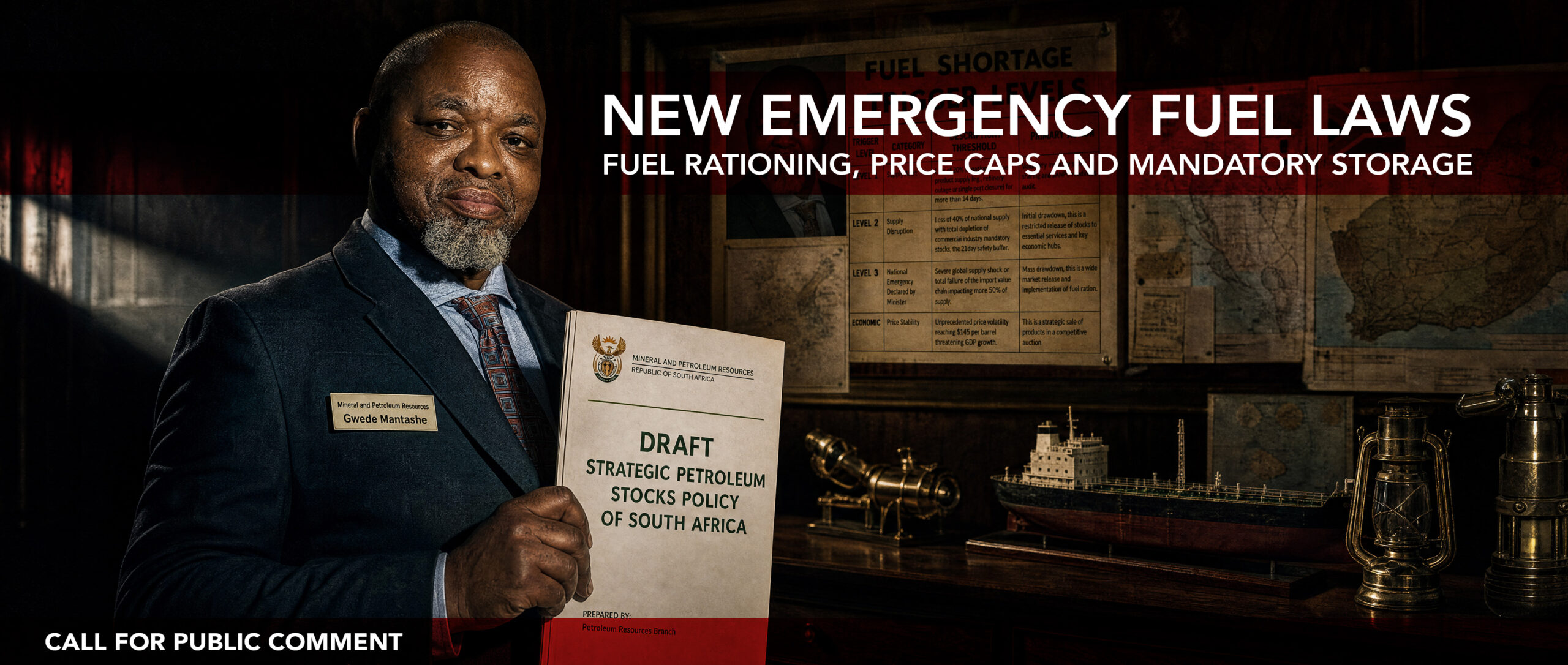
The Department of Mineral and Petroleum Resources officially published its draft Strategic Petroleum Stock Policy, 2026, for public comment.
South Africa’s energy sovereignty has fundamentally shifted. Following the permanent closure or conversion of major domestic crude refineries (like SAPREF and ENGEN), our nation has transitioned into being almost completely reliant on importing finished petroleum products (petrol and diesel) from overseas.
This total reliance on imports leaves our entire economy dangerously exposed to geopolitical global conflicts, maritime blockades, shipping delays, and massive currency fluctuations. Government data warns that a total nationwide unavailability of liquid fuel would choke our logistics lines, factories, and agricultural networks, costing the economy an estimated R1 Billion per day in lost GDP.
To build an emergency firewall, the state is moving away from a voluntary system to a strict, legally mandated regulatory regime. However, the choices made in this policy will directly dictate how much you pay at the pump, market competition, and your fundamental right to move freely during an energy crisis.
click the link for more info
Have your say – shape the regulations. [CLOSED]

Top concerns
To help you draft your official submission, we have unpacked the four most critical elements of the Draft Strategic Petroleum Stock Policy, 2026. Use these detailed explanations to guide your custom commentary.
What the Draft Policy Proposed:
The department mandates that all licensed private fuel wholesalers, manufacturers, and importers must maintain a 21-day reserve of net imports at their own commercial expense. This reserve must be physically split into 70% crude oil and 30% finished product, and must be rotated every three months to prevent degradation.
The Underlying Issue:
Forcing private companies to build or lease multi-million-litre storage tanks and tie up vast amounts of operational capital in “non-saleable” emergency stock is an immense financial burden. Because South Africa’s retail fuel prices are highly regulated and margin-controlled by the state, private oil firms will inevitably lobby the government for an expansion of the wholesale or retail margin to recover these multi-billion-rand infrastructure costs.
The Risk to You:
This well-intended security safety net could inadvertently act as a structural mechanism that permanently increases the price of petrol and diesel at the pump, passing the bill directly to the already strained South African consumer.
Points to consider for your comment:
-
- Should the private sector be forced to carry national security infrastructure costs?
- Do you object to any policy that risks introducing new levies or margin adjustments that increase consumer fuel costs?
- Are private wholesalers capable of executing a 3-month quality rotation without logistical bottlenecks?
What the Draft Policy Proposed:
Under a defined Level 3 National Emergency (a supply shock wiping out more than 50% of the country’s fuel inputs), the Minister of Mineral and Petroleum Resources is granted sole executive authority to declare a liquid fuels emergency and legally implement a nationwide fuel rationing framework.
The Underlying Issue:
While keeping emergency services operational during a catastrophic global blockade is crucial, historical precedents globally show that government-administered rationing systems are highly susceptible to systemic failure. Managing who gets fuel, how much they get, and when they get it requires a hyper-efficient administrative state mechanism that South Africa currently lacks.
The Risk to You:
Centralizing the power to ration fuel inside an executive department can lead to severe structural bottlenecks for businesses, critical food logistics lines, and public mobility. Furthermore, rationing regimes almost instantly give rise to corruption, distribution favoritism, and an incredibly lucrative, unchecked black market for fuel.
Points to consider for your comment:
-
- Do you agree with granting an executive minister the unchecked power to dictate fuel allocations to private businesses and individuals?
- What legal checks, balances, and judicial oversight must be added to prevent the abuse of a Level 3 emergency declaration?
- Should allocation priority be hardcoded in the policy to protect agriculture, food logistics, and medical transport over state consumption?
What the Draft Policy Proposed:
The policy creates an Economic/Price Stability Trigger. If global market volatility causes Brent Crude oil to spike or threaten to cross $145 per barrel, the state—via the South African National Petroleum Company (SANPC)—will release its strategic stocks to the market through competitive auctions to suppress and stabilize local retail fuel prices.
The Underlying Issue:
Artificially capping or manipulating market pricing using state reserves can yield short-term populist relief but frequently causes long-term structural harm. Strategic reserves are designed primarily to address physical scarcity (e.g., natural disasters, terminal failures, wars), not financial pricing fluctuations.
The Risk to You:
If the state uses up its physical backup reserves simply to buffer a high price cycle, the country could find its tanks empty when a genuine physical supply disruption occurs. Additionally, aggressive state price manipulation can discourage international traders from importing finished product into South Africa, inadvertently reducing market competition and supply liquidity.
Points to consider for your comment:
-
- Do you support using physical national security oil reserves as an economic pricing instrument?
- Should state stock drawdown be strictly limited to physical supply shortfalls rather than financial price containment?
- Does state market intervention risk alienating international fuel import partners, leading to worse long-term scarcity?
What the Draft Policy Proposed:
The total mandated national backup buffer is set at 81 days of net import cover (60 days funded/held by the state via the SANPC, and 21 days held by private industry).
The Underlying Issue:
For decades, developed economies under the International Energy Agency (IEA) framework have maintained a strict minimum standard of 90 days of net oil import cover. South Africa is choosing an 81-day target, despite a highly volatile local economic landscape.
The Risk to You:
South Africa no longer has a resilient domestic crude refining sector; we are now near-totally dependent on importing already refined, finished products. Because it physically takes between 21 and 42 days for fuel tankers to be re-routed and travel across global oceans to our ports, a multi-port strike, a severe maritime disruption, or regional conflict could deplete our reserves faster than anticipated. An 81-day buffer may look sufficient on paper, but it leaves very little margin for operational error or infrastructure degradation.
Points to consider for your comment:
-
- Do you believe an 81-day total reserve is mathematically and strategically sufficient given our total reliance on imported finished products?
- Should South Africa align strictly with international IEA standards and mandate a minimum 90-day physical reserve?
- Is our current port, rail, and pipeline infrastructure robust enough to handle the rapid distribution of an 81-day stock drawdown?
Perspectives: What is the debate?
The draft Strategic Petroleum Stock Policy, 2026 presents a classic regulatory dilemma: National Security vs. Market Liberty and Consumer Costs. While everyone agrees that South Africa needs to protect its economy from a catastrophic fuel shortage, the disagreement lies in how we achieve it, who pays for it, and how much power should be handed over to the state during an emergency.
Economic Sovereignty and Survival:
With our major domestic refineries shut down, South Africa is entirely at the mercy of global supply chains. A total fuel failure risks stripping R1 billion per day from our GDP. Building a mandatory national cushion of 81 days (60 days state, 21 days private) is an existential necessity to protect our factories, farms, and transport networks from global shipping crises or wars.
A Shield Against Inflationary Price Spikes:
The economic stability trigger ($145/barrel Brent crude oil auction) creates a necessary regulatory intervention. Instead of allowing international speculative bubbles to trigger runaway hyperinflation at local petrol stations, the government can strategically inject cheaper stockpiled reserves into the market to artificially cap retail fuel prices.
Sharing the Security Burden fairly:
Private oil companies and fuel wholesalers make massive profits from importing products into South Africa. It is unreasonable to expect the taxpayer to fund 100% of the country’s emergency backup buffer. Forcing private industry to carry a 21-day commercial reserve ensures they act as responsible stakeholders in our national energy security.
Predictability in a Crisis:
Moving away from ad-hoc, panic-driven emergency responses to a clearly defined four-tiered trigger system brings structural certainty. Businesses, logistics companies, and State-Owned Enterprises (like Transnet) will know exactly what legal rules apply at every stage of a shortage, reducing market chaos.
Hidden Costs Passed Down to the Consumer:
Forcing private companies to build additional storage infrastructure and tie up millions of Rands in mandatory 21-day “non-operational” fuel reserves will severely strain their cash flows. In a regulated retail price environment, these multi-billion-rand compliance costs will inevitably be passed directly to the public through increased fuel profit margins, worsening the cost-of-living crisis.
Risks of State Monopolization and SOE Mismanagement:
Placing the sole custody of 60 days of state strategic fuel into the hands of the newly formed South African National Petroleum Company (SANPC)—a merger of historically troubled state entities like PetroSA and the Strategic Fuel Fund—raises immediate red flags. Critics fear corruption, structural inefficiency, and procurement irregularities could compromise the actual physical availability of the reserves when a crisis hits.
The Perils of Government-Enforced Fuel Rationing:
Granting the Minister unchecked executive power to declare a Level 3 emergency and legally enforce fuel rationing could create an administrative nightmare. Opponents argue that state-managed rationing systems often result in structural bottlenecks, corruption at point-of-sale, and the immediate emergence of an inflated black market for fuel.
Logistical Nightmares and Spoilage:
Forcing both the state and private sector to rotate finished, refined products like diesel and petrol every three months to prevent chemical degradation is an immense, costly logistical hurdle. If Transnet pipelines or private delivery networks face operational backlogs, millions of liters of emergency backup fuel could potentially degrade, resulting in massive financial losses.