
Advert
Advert – scroll down

-
-
- No I do not support the development 3020
- Yes I do 73
- Not fully 165
-
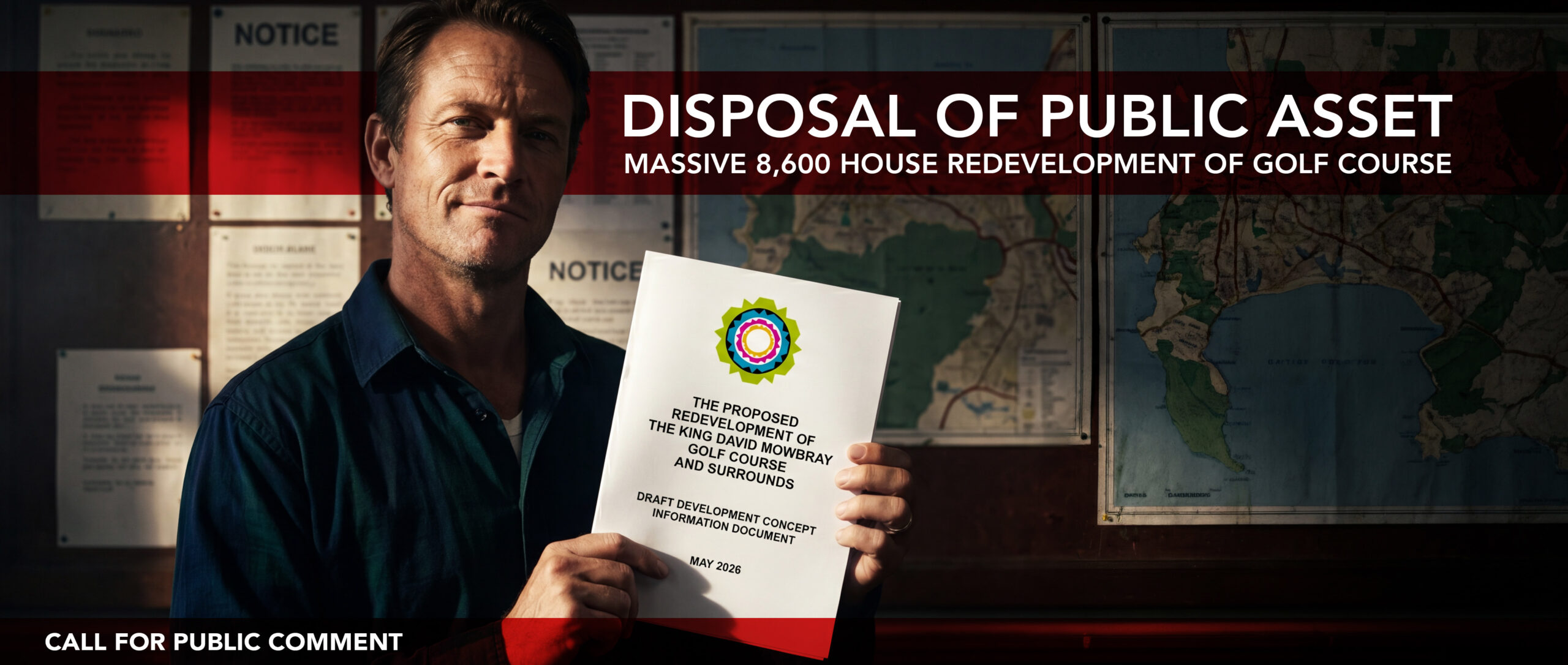
Proposed Permanent Disposal and Redevelopment of the King David Mowbray Golf Course Precinct.
The City of Cape Town is running a public comment period until Monday, 6 July 2026, regarding the proposed permanent disposal and mixed-use redevelopment of 65+ hectares of public land at the King David Mowbray Golf Course.
However, major procedural and factual discrepancies have recently come to light, fundamentally challenging the integrity of this public participation process:
-
- Procedural Anomalies (PAJA Concerns): Following public pushback in 2025 regarding the omission of the golf course itself (Portion B) from the original authorization, the City Council passed a fresh resolution (C39/05/26) on 27 May 2026—coinciding exactly with the launch of this public round. Critics argue this represents an irregular, retroactive attempt to patch a broken legal framework while a live public window is underway.
- Information Blackout: Critical technical foundations—including the City’s official land valuation report, the MATR Regulation 7 feasibility study, the Traffic Impact Assessment (TIA), and the Athlone Wastewater Treatment Works capacity records—have not been made transparently available to the public. Urgent PAIA applications have been filed to unlock these documents by 20 June 2026, meaning citizens are currently being forced to comment completely in the dark.
- The PRASA Contradiction: While the City’s development concept relies heavily on transit-oriented design connected to a proposed new rail station, PRASA’s consecutive Corporate Plans (including the latest published on 30 March 2026) contain absolutely no mention of or allocation for this infrastructure.
Review the official documentation, consider the deep administrative and logistical flaws raised by civic analysis, and lodge your individually counted submission before the 6 July deadline.
click the link for more info, or scroll down to have your say
Have your say – shape your city.

Top concerns
To assist you in drafting your formal submission to the City of Cape Town, we have expanded on the five critical areas of concern identified by technical and civic assessments. You can select one or more of these areas in the form below and use these detailed points to back up your written comments.
-
- The Core Issue
The legal mandate for this public participation process relies on Council Resolution C39/05/26, which was quietly adopted on 27 May 2026—just hours before this public comment period opened. This fresh resolution was introduced because the City’s original 2024 mandate (C28/10/24) failed to legally cover “Portion B” (the actual golf course land). - Why it Matters
Under the Promotion of Administrative Justice Act (PAJA), public participation must be fair and transparent from the outset. Altering the statutory and legal baseline of a land disposal process mid-stream or at the exact moment of public rollout is highly irregular and suggests an attempt to retroactively patch a flawed legal framework.
- The Core Issue
Suggested Wording for Your Comment
“I object to the procedural irregularities defining this process. Pushing through Council Resolution C39/05/26 on 27 May 2026 to retroactively include Portion B right as the public participation phase commenced undermines the fairness of the process under PAJA. The public is being asked to comment on an unstable, rushed legislative framework.”
-
- The Core Issue
The City is asking the public to approve the permanent, irreversible disposal of 65+ hectares of public land while keeping critical feasibility documents hidden from public view. Key items—including the official Land Valuation Report, the MATR Regulation 7 Feasibility Study, and the Traffic Impact Assessment (TIA)—have not been made transparently available. - Why it Matters
Formal requests under the Promotion of Access to Information Act (PAIA) have been filed to force the City to release these records, with a legal deadline of 20 June 2026. Forcing citizens to sign off on a permanent land transfer before June 20, without having access to the financial valuations or traffic models, deprives the public of the evidence needed to make an informed decision.
- The Core Issue
Suggested Wording for Your Comment
“I object to being forced to comment in an informational vacuum. The City must make the official Land Valuation Report, the Regulation 7 Feasibility Study, and the Traffic Impact Assessment fully accessible to the public before asking for a binding decision on the permanent disposal of public land.”
-
- The Core Issue
The City’s Draft Development Concept heavily relies on a “Transit-Oriented Development” model, featuring a proposed new passenger rail station to manage the massive influx of commuters from 8,600 new households. However, a review of PRASA’s consecutive Corporate Plans—including the most recent one published on 30 March 2026—reveals zero mention, allocation, or budgetary planning for this station. - Why it Matters
The City’s traffic congestion and density models are built on a transport link that does not exist in the national rail carrier’s operational or funding horizon. Without this station, a precinct of this size will completely paralyze the surrounding road networks (including the M5, N2, and local Pinelands/Mowbray arteries).
- The Core Issue
Suggested Wording for Your Comment:
“The traffic and transport assumptions in the Draft Development Concept are fundamentally flawed. The plan relies on a proposed PRASA rail station that does not appear in any of PRASA’s Corporate Plans up to March 2026. The City cannot approve a high-density precinct based on unverified, unbudgeted transport infrastructure.”
-
- The Core Issue
The proposed precinct will inject roughly 8,600 residential units and 75,000 square meters of commercial space directly into a localized utility grid that is already failing. The local wastewater infrastructure routes into the Athlone Wastewater Treatment Works (WWTW), an asset already highlighted for severe capacity and compliance issues in the 2022 Green Drop audit. - Why it Matters
The City’s own information documents list “sewer-capacity confirmation” as future work to be done after the public approves the disposal. This reverses logical urban planning: the municipality is asking for a permanent land disposal before confirming whether the local sewer and water grid can physically process the waste of tens of thousands of new occupants without causing an ecological disaster.
- The Core Issue
Suggested Wording for Your Comment
“I object to approving permanent asset disposal before a comprehensive, independent audit confirms that the Athlone Wastewater Treatment Works and the local sewer network can handle a development of this magnitude. Technical capacity must be proven before land disposal is granted, not after.”
-
- The Core Issue
The City is seeking public approval for permanent land disposal before concluding the Environmental Impact Assessment (EIA), Heritage Impact Assessment (HIA), and Water Use Authorizations. - Why it Matters
The King David Mowbray Golf Course sits directly within a critical ecological framework and intersects the sensitive flood lines of the Black River. Approving the permanent disposal of the land before these environmental and heritage protections are legally finalized binds the City to a development pathway before the ecological risks are fully understood or mitigated.
- The Core Issue
Suggested Wording for Your Comment
“The order of events in this planning process is backward. Environmental and Heritage Impact Assessments must precede any decision to permanently dispose of municipal land. By delaying the EIA and HIA until after disposal approval, the City is compromising the objectivity of future environmental oversight on the Black River floodplain.”
Perspectives: What is the debate?
The City maintains that the redevelopment process is entirely “procedurally sound” following the adoption of Council Resolution C39/05/26 on 27 May 2026. Proponents argue that the draft concept represents a vital step toward spatial justice, turning an exclusive recreational area into a vibrant, high-density precinct with 8,600 homes (minimum 30% social housing). They assert that technical studies, transit coordination, and environmental impact assessments will be dealt with thoroughly in the subsequent legislative phases after the land disposal principle is approved.
Opponents argue that the City is executing an administrative “bait-and-switch.” Asking the public to approve an irreversible public asset disposal while keeping essential technical studies (valuations, sewer metrics, and TIAs) hidden behind PAIA walls violates the basic tenets of fair administrative action under PAJA. Furthermore, the revelation that PRASA has zero alignment with the City’s transit claims proves that the project’s planning is prematurely optimised. The community insists that the public participation process must be halted and restarted only when all baseline evidence is public and the legal authorisations are genuinely transparent.