
Advert
Advert – scroll down

-
-
- No I do not support the suggested curriculum 4681
- Yes I do 507
- Not fully 768
-
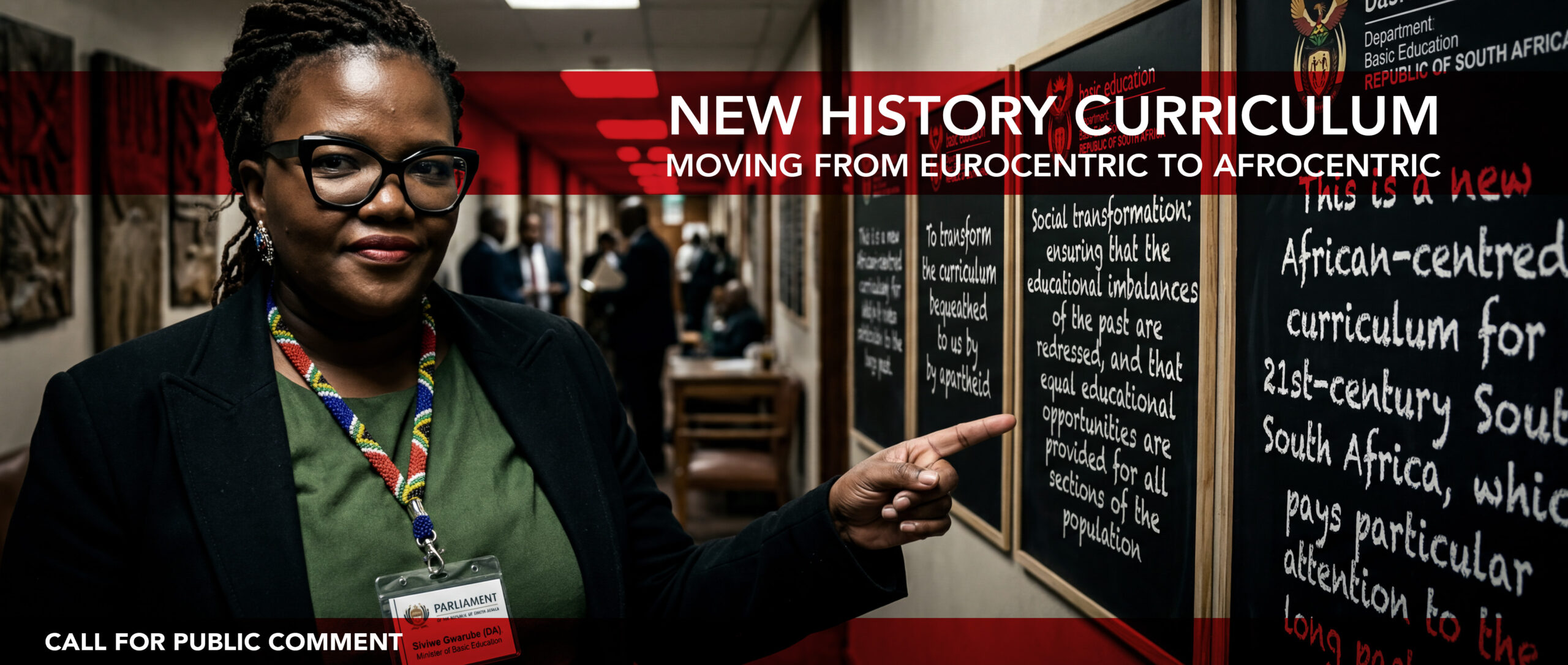
The Department of Basic Education invites you to comment on the Draft New History Curriculum and Assessment Policy Statements for grades 4 – 6, grades 7 – 9 and grades 10 – 12.
Key Highlights of the Draft Proposals
-
- African-Centred Perspective: A primary focus on the “long past” of the African continent and its ancient connections to the world.
- New Methods of Evidence: The intentional inclusion of archaeology and oral history to recover voices and perspectives that were historically marginalised.
- Critical Engagement: Encouraging students to interrogate why certain versions of history are constructed and what roles they play in public memory.
- Specific Case Studies: In-depth studies of ancient civilisations like Mali, Ethiopia, and Great Zimbabwe, alongside modern political history and the birth of South African democracy.
The DBE has explicitly stated that there are “no preconceived outcomes” for this process and that public voices will shape the final product.
click the link for more info, or scroll down to have your say
Have your say – shape the curriculum.

Top concerns
Reference Document: 260320AMENDED_CAPS_DOC_HISTORY_GRADE_4_-_6.pdf
-
- Archaeology as a Primary Source:
Is the scientific focus (DNA, chemical analysis) too advanced for 10-to-12-year-olds? - The “Before Present” (BP) Timeline:
Will teaching students to measure time from “the present” rather than BCE/CE cause confusion? - Focus on Ancient Empires:
Is there a correct balance between Ancient Egypt/Mali and more recent South African history? - Replacement of Traditional Narrative:
Should history be taught through technological themes (Fire, Metals, Transport) or a more standard chronological story? - Assessment through Creative Response:
Are “Posters” and “Short Poems” rigorous enough methods to assess historical knowledge?
- Archaeology as a Primary Source:
 Loading...

 Reload document
  Open in new tab
 Reference Document: 260320AMENDED_CAPS_DOC_HISTORY_GRADE_7_-_9.pdf
-
- Framing of Conflict:
Does the focus on the “100 years’ war” at the Cape provide a balanced view of early colonial interactions? - “Pseudo-Scientific Racism” in Grade 9:
Is the deep dive into the theories of Social Darwinism and Eugenics appropriate for 14-year-old learners? - Inclusion of Initiation Practices:
Are the proposed discussions on indigenous education and initiation handled with the necessary “sacredness” and sensitivity? - Causes of the Mfecane/Difaqane:
Does the curriculum adequately weigh internal factors against external pressures (like the slave trade and European expansion)? - Omission of 20th-Century Global Events:
Does the junior high curriculum focus too heavily on the 19th century at the expense of more modern world history?
- Framing of Conflict:
Loading...
Reference Document: 260320AMENDED_CAPS_DOC_HISTORY_GRADE_10_-12.pdf
-
- Individual Leader Comparisons:
Is the comparative study of P.W. Botha and Oliver Tambo structured to provide an objective analysis of their respective roles? - Academic Schools of Thought:
Is it appropriate to require Matric students to assess “Marxist, Liberal, and Afrikaner nationalist schools of thought”? - The “Creation of Tribes” Theory:
Does the claim that “tribes” are a social and political construct of European colonisation accurately reflect African history? - Argumentative Essay Requirements:
Is the 30% weighting for “Level 3” cognitive tasks (evaluating and defending arguments) realistic for all learners? - The Haitian Revolution Focus:
Is the Haitian Revolution the most relevant case study for understanding human rights in a South African context? - Economic vs. Political Freedom:
Does the Grade 12 curriculum focus too much on current “economic freedom” debates rather than historical events?
- Individual Leader Comparisons:
Loading...
Applicable to all three draft documents
-
- African-Centred Philosophy:
Does the shift to an African vantage point improve inclusivity or risk isolating South African students from the global community? - Reliability of Oral Traditions:
Is the use of “memory” and “spoken history” as reliable as traditional written archives for academic instruction? - Teacher Readiness:
Does the Department have a clear plan to train teachers in these new methodologies (archaeology, linguistics, and oral history)? - Content Overload:
Is the amount of new material (detailed enquiries for every topic) realistic given the standard 15-to-20-hour contact time per term? - Standardization vs. Creativity:
Does giving teachers more “space for local innovations” lead to an inconsistent quality of education across different provinces?
- African-Centred Philosophy:
Perspectives: What is the debate?
The proposed amendments have sparked a national conversation about how we should teach our children about the past. While the Department of Basic Education (DBE) maintains that the goal is to create an inclusive, constitutionally grounded curriculum, various stakeholders have raised concerns about its implementation.
Supporters of the draft proposals generally focus on the need for social transformation and a more representative narrative of human history.
-
- Correcting Historical Bias:
Supporters argue that the current curriculum remains too focused on Eurocentric frameworks and the “achievements of white people,” leaving the vast and rich history of Africa marginalized. - Recovering Silenced Voices:
By intentionally including oral history and archaeology, the new curriculum can recover the experiences of groups whose history was never recorded in traditional colonial archives, such as women and the working class. - Developing Critical Thinkers:
The shift from “rote and uncritical learning” to an enquiry-based model is seen as a way to equip students with the analytical tools to identify bias, propaganda, and ideology in any historical source. - A Broader Worldview:
Supporters point out that “African-centred” does not mean “only Africa”; it means viewing the entire world (including the Americas, Asia, and Europe) from an African vantage point to foster a global consciousness.
- Correcting Historical Bias:
Opponents and concerned groups often raise questions regarding the balance, reliability, and potential for ideological framing in the new draft.
-
- Concerns over Omissions:
Many groups are concerned that by shifting the focus so heavily toward ancient African civilizations, essential elements of world history or modern South African history (such as the full scope of the Boer Republics or the Renaissance) may be under-emphasized or omitted. - Reliability of Evidence:
Critics have questioned whether relying on “memory” and oral traditions is as academically rigorous as using written records, raising concerns that this could lead to a less objective teaching of facts. - Content Overload:
There is a recurring concern among educators that the curriculum is already overburdened. Adding deep dives into archaeology and complex ancient civilizations may make it difficult for teachers to cover the necessary material in the allocated time. - Ideological Risks:
Some argue that a curriculum focused on “social transformation” risks becoming a tool for political or social engineering, rather than a neutral, academic pursuit of the past.
- Concerns over Omissions: