
Advert
Advert – scroll down

0
comments individually delivered to the Minister, so far
-
-
- No I do not support the regulations 11154
- Yes I do 26
- Not fully 178
-
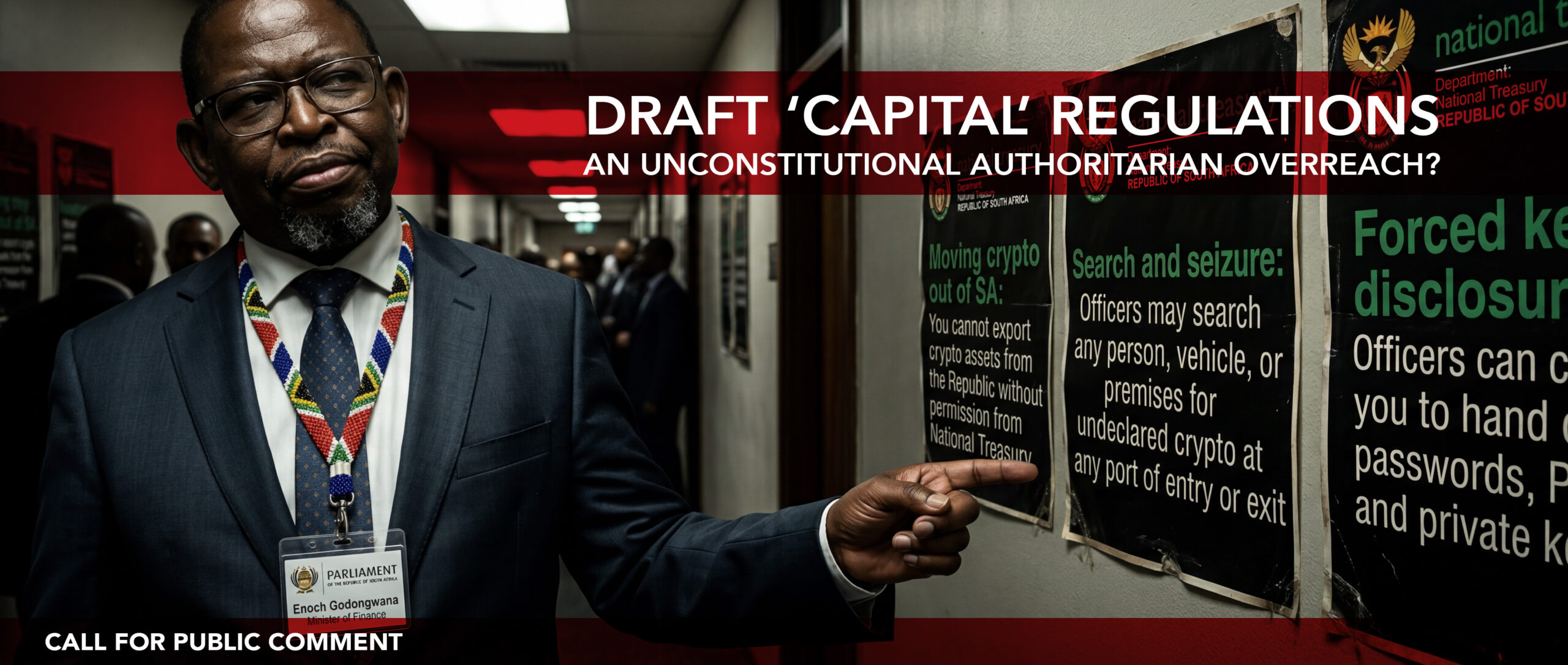
The National Treasury has proposed the Capital Flow Management Regulations, 2026, the most significant change to South Africa’s financial controls since 1961.
While the government frames this as a “modernization” of exchange controls, the draft introduces expansive new powers that extend far beyond cryptocurrency. The draft gives the State the authority to monitor, attach, and potentially seize “anything with a monetary value”. Whether you own a home, hold gold, manage intellectual property, or save in Bitcoin, these regulations change the legal relationship between the State and your private property.
click the link for more info, or scroll down to have your say
Have your say – shape the regulations.

Top concerns
-
- What the Regulation says:
Any resident who becomes entitled to sell gold (excluding jewellery or artistic works) with a value exceeding a determined threshold must offer it to the National Treasury for sale within 30 days. Similar provisions exist for the compulsory sale of declared crypto assets or foreign currency rights. - The Potential Impact:
This effectively limits the ability of citizens to hold physical gold or digital assets as a private hedge against inflation. Critics argue this is a form of forced divestment, where the State can compel you to exchange private commodities for South African Rand (ZAR) at a price the State helps determine.
- What the Regulation says:
-
- What the Regulation says:
The National Treasury may attach any property—including immovable property (land)—if there are “reasonable grounds to suspect” it is involved in a contravention of the regulations. If land is attached, the Treasury notifies the Registrar of Deeds, who must note this attachment against the property’s title deed. - The Potential Impact:
This allows the State to “freeze” a citizen’s home or land based on suspicion alone, without a prior criminal conviction or a court order proving a crime was committed. Once an attachment is noted on a title deed, the owner cannot sell, transfer, or bond the property.
- What the Regulation says:
-
- What the Regulation says:
If an asset is forfeited to the State, the owner must furnish all passwords, personal identification numbers (PINs), or codes necessary for the Treasury to gain access and control. Additionally, enforcement officers have the power to search “articles” (like smartphones) at borders to detect capital movement. - The Potential Impact:
Forcing individuals to hand over private digital keys or passwords may violate the Section 14 right to privacy and the Section 35 right against self-incrimination. Compelling a person to provide the technical means for the State to seize their property is a significant departure from established legal protections.
- What the Regulation says:
-
- What the Regulation says:
“Capital” is broadly defined to include “anything with a monetary value”, anything that can be converted to money, and intellectual property rights (whether registered or unregistered). - The Potential Impact:
By defining capital so broadly, the State potentially gains oversight over almost every form of wealth transfer. This could include the sale of a business process, a patent, or even high-value personal effects to a non-resident, all of which would now fall under strict “export of capital” restrictions.
- What the Regulation says:
-
- What the Regulation says:
Throughout the draft, restrictions on buying, selling, or moving assets only apply if the value is in excess of a “determined threshold”. - The Potential Impact:
The Minister of Finance has the power to set and change these thresholds by notice in the Gazette at any time. This means the public is being asked to comment on a law where the “trigger points” are unknown. A low threshold could criminalise everyday transactions, while a high one might only affect the wealthy—but the draft provides no certainty.
- What the Regulation says:
-
- What the Regulation says:
A person commits an offence if they “negligently or intentionally” make any false or incorrect statement in a declaration. Penalties include a fine of up to R1,000,000 and/or imprisonment for up to five years. - The Potential Impact:
Given the complexity of tracking global assets or digital wallets, a resident could easily make an “incorrect statement” due to a simple error or misunderstanding. The draft allows for criminal prosecution even for “negligent” mistakes, potentially saddling ordinary citizens with criminal records for administrative oversights.
- What the Regulation says:
-
- The Argument:
The regulations seek to repeal the 1961 framework and move toward a risk-based system. Supporters argue this is essential for South Africa to combat money laundering and terrorist financing, maintain international banking relationships, and avoid returning to the FATF “grey list”. - The Strategy:
Proponents believe that by bringing crypto and modern capital flows into a regulated environment, the State can better protect the national economy and ensure that all residents contribute fairly to the tax base.
- The Argument:
Perspectives: What is the debate?
The primary tension lies between the State’s mandate to secure the national economy and the individual’s constitutional right to privacy and property.
-
- National Security:
Modernising the 1961 rules is essential to stop money laundering and terrorist financing, ensuring South Africa remains off the FATF grey list. - Economic Stability:
By tracking the movement of “anything with monetary value,” the State can protect the South African Rand from destabilising capital flight. - Closing Loopholes:
The State argues that if it cannot see or regulate the flow of gold, IP, and crypto, it cannot effectively manage the country’s financial sovereignty.
- National Security:
-
- Erosion of Property Rights:
Forcing citizens to sell gold to the State and allowing the Treasury to freeze land titles based on “suspicion” alone is viewed as a violation of Section 25 of the Constitution. - Constitutional Overreach:
Requiring the surrender of private passwords and allowing device searches at borders compromises the rights to privacy and against self-incrimination. - Economic Risk:
Critics warn that treating all private value as a state-managed resource will discourage foreign investment and drive local innovation to more secure jurisdictions.
- Erosion of Property Rights: