
Advert
Advert – scroll down
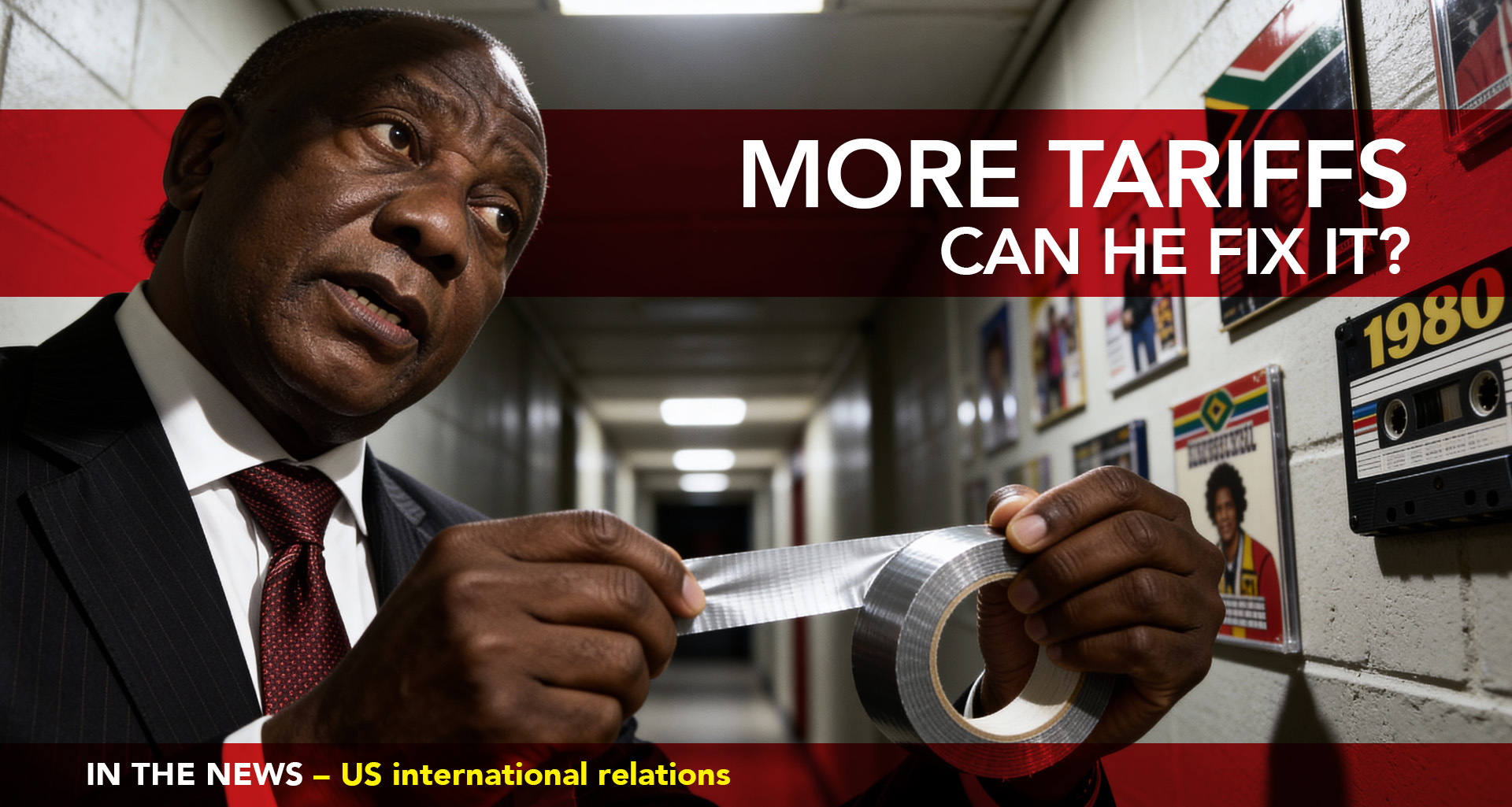
1986 REDUX: WE CANNOT ‘MACGYVER’ OUR WAY OUT OF TRUMP’S TARIFF THREAT
For South Africans of a certain vintage, the headlines this week induced a distinct sense of déjà vu. The United States, leveraging its massive consumer market, is once again threatening to turn off the tap unless South Africa alters its foreign policy.
In 1986, it was the Comprehensive Anti-Apartheid Act (CAAA), passed by the US Congress to force the Nationalist government to abandon institutionalised racism. In 2026, it is an Executive Order from President Donald Trump, threatening a 25% tariff on any nation doing business with Iran—a direct shot across the bow of our “non-aligned” stance.
While the moral contexts are vastly different—1986 was a fight for human rights; 2026 is a transactional geopolitical squeeze—the economic mechanics are terrifyingly similar. And dangerously, so is the temptation to believe we can simply “go it alone” again.
The Weaponisation of Trade
The parallels in the American playbook are striking. Just as the sanctions of the 80s targeted our vulnerabilities—steel, textiles, and agriculture—Trump’s potential tariffs zero in on the exact same sectors.
Then, as now, the message from Washington is binary: “You cannot have our trade dollars if you keep this company.” The threat to our citrus growers in the Western Cape and our steel exporters is not just a policy nuance; it is an existential risk to the 93,000 to 426,000 jobs currently supported by US trade and AGOA.
The “Siege Economy” Trap
There is a seductive counter-argument currently circulating in braai-side conversations: “We survived sanctions before. We built SASOL. We built Armscor. We can become self-sufficient again.”
It is true that the Apartheid government used isolation as a catalyst for industrialisation. When they couldn’t buy oil, they squeezed it from coal (SASOL). When they couldn’t buy NATO weapons, they engineered their own (Armscor).
But we must be clear-eyed about the cost of that “success.” That era of autarky created a “siege economy”—expensive, inefficient, and heavily subsidised by the taxpayer. We paid a massive “Apartheid Premium” for fuel and goods just to survive.
More importantly, the global economy has changed fundamentally since 1986. Back then, a car was mostly steel and rubber. Today, a vehicle rolling off the line relies on microchips from Asia, gearboxes from Europe, and software from America. You cannot “import substitute” a global supply chain. In 2026, if tariffs cut us off from the global ecosystem, we won’t build a new SASOL; our factories will simply close. We cannot “MacGyver” our way out of a trade war in a digitised, globalised world.
The Balance Sheet of Survival
So, what is the wisest move for a government caught between its historical solidarity with the Global South and the economic reality of the West?
The answer lies not in ideology, but in a simple balance sheet.
We currently enjoy a massive R36 billion trade surplus with the United States. Our trade with Iran, by contrast, is negligible—mostly modest agricultural exports.
The “South Africa First” choice is obvious. We cannot sacrifice a R150 billion trading relationship—and the hundreds of thousands of livelihoods it supports—for the sake of symbolic naval drills in Simon’s Town.
The Way Out
Our government needs to execute a strategic pivot, and fast.
First, we need a “Strategic Pause” on high-friction activities. We do not need to publicly denounce our allies, but we must immediately suspend military exercises that serve as a red rag to the American bull. We can frame this domestically as prioritising South African jobs.
Second, we must bypass the bureaucracy. Traditional diplomacy is too slow for the Trump administration. We need to send a high-level delegation to Washington to strike a transactional deal: trading assurances on Iran for the security of our auto and agricultural exports.
Finally, we must mobilise the private sector. The US corporations that manufacture here—Ford, Amazon, and others—are our best lobbyists. They can explain to the White House that hurting South Africa hurts their bottom line.
In the 1980s, we learned that isolation comes with a devastating price. In 2026, we have the opportunity to avoid that cost, but only if we value the paycheques of our workers more than the optics of our foreign policy.
Rob Hutchinson