
Advert
Advert – scroll down
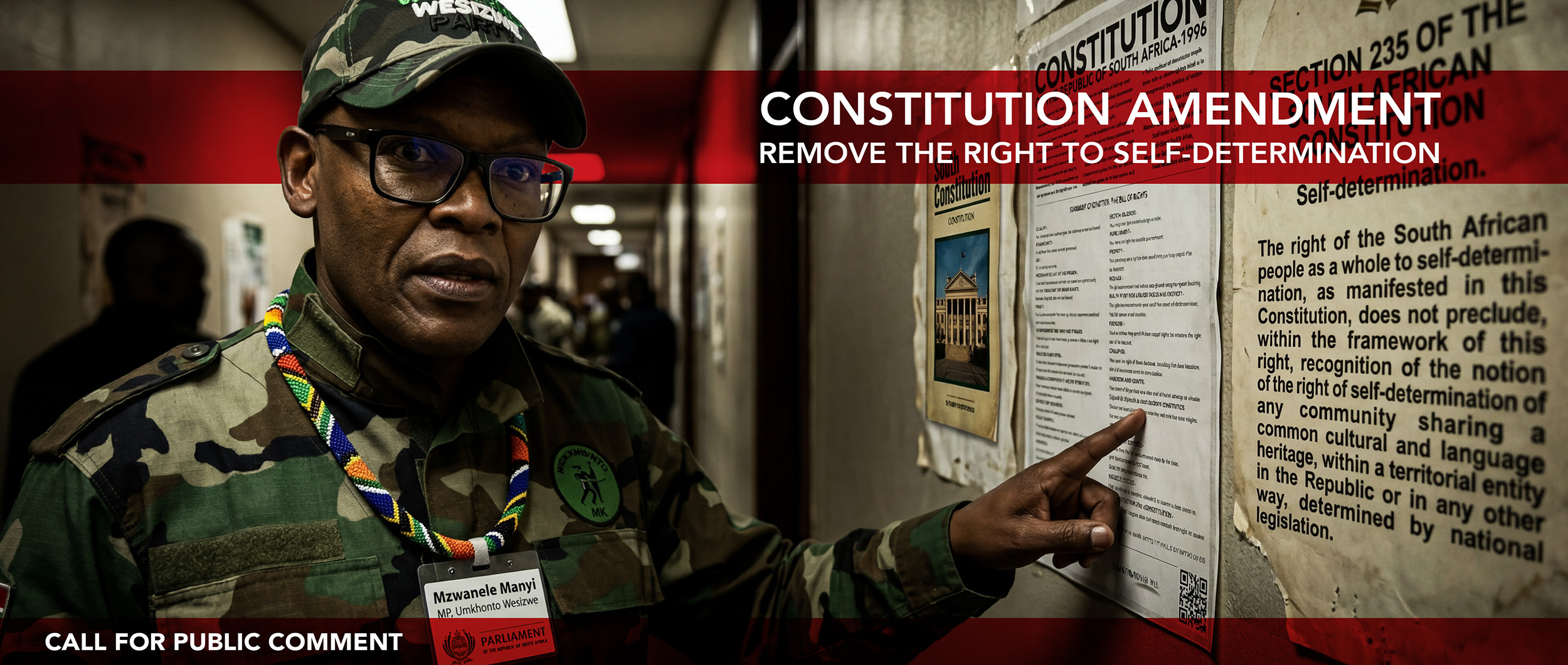

Introduced as a Private Member’s Bill by Mzwanele Manyi, MP (MK Party), the Constitution Twenty-Fourth Amendment Bill seeks to formally remove Section 235 from the Constitution of the Republic of South Africa.
Section 235 is the provision that recognises the right to self-determination for any community sharing a common cultural and language heritage. It allows for the possibility of such a community pursuing self-governance within a “territorial entity” in South Africa, provided this is determined by national legislation.
The Bill proposes the total repeal (abolition) of Section 235. If passed, the explicit mention of a community’s right to self-determination would be deleted from the Constitution.
click the link for more info, or scroll down to have your say
Have your say – shape the paper.

Understanding the Concerns: A Guide for Participants
To help you decide where you stand on the Constitution Twenty-Fourth Amendment Bill, we have detailed the primary arguments surrounding the proposed repeal of Section 235.
-
- The Argument: This concern aligns with the Bill’s proposal that Section 235 is no longer necessary.
- Details: The Bill of Rights already guarantees the right of everyone to use the language of their choice and participate in the cultural life of their choosing.
- The View: Proponents of this view believe that these individual protections, along with the right to form cultural and linguistic associations, provide all the safeguards needed without requiring a separate section for “self-determination”.
-
- The Argument: Section 235 is viewed by some as a theoretical provision that has never been turned into actual law.
- Details: The Bill argues that the section creates “contradictions and ambiguity” because it suggests a right to self-determination that is not clearly defined by legislation.
- The View: Supporters of this concern feel the Constitution should be streamlined by removing “inoperative” sections that create false impressions about what the law allows.
-
- The Argument: Section 235 was a fundamental part of the deal that brought South Africa into democracy.
- Details: Critics of the Bill, such as the CAPEXIT Party, argue that this section forms part of the “negotiated constitutional settlement” intended to accommodate the country’s diversity.
- The View: This concern suggests that repealing the section is a move to “shut down” a promise made during the transition, potentially undermining the trust between different communities and the state.
-
- The Argument: Individual freedoms are not the same as the rights of a community to sustain itself.
- Details: While the Bill of Rights protects an individual’s right to speak a language, opponents argue it does not replace the collective right of a community to maintain its identity and organs of civil society.
- The View: This concern highlights that without Section 235, the Constitution loses its explicit recognition of community-led self-determination.
-
- The Argument: Section 235 is being used to justify semi-autonomous entities that may not follow the Bill of Rights.
- Details: The MK Party has expressed concern that the section creates a “false impression” that communities can form enclaves or entities that operate inconsistently with the broader Constitution.
- The View: This concern is focused on preventing “territorial fragmentation” and ensuring that all entities within South Africa adhere to the same constitutional standards.
-
- The Argument: Removing constitutional options for autonomy might lead to more radical demands.
- Details: Critics argue that Section 235 provides a “lawful, constitutional pathway” for communities to determine their future through peaceful means.
- The View: This concern suggests that suppressing these avenues will not eliminate the demand for self-determination but may instead “strengthen it” by leaving no democratic room for such aspirations.
Perspectives: What is the debate?
Supporters, led by the MK Party, argue that Section 235 is a “dormant” provision that has never been turned into law. They believe it creates a “theoretical basis” for “territorial fragmentation” and allows communities like Orania to operate as “exclusionist enclaves” outside the spirit of a unified South Africa. For them, the Bill of Rights is the only protection needed for cultural and linguistic diversity.
Opponents, including the Cape Independence Party and the Freedom Front Plus, argue that Section 235 is a “non-derogable right” and a cornerstone of the 1994 constitutional settlement. They contend that individual rights (Sections 30 and 31) are fundamentally different from the collective right of a community to sustain and govern itself. They warn that removing this “safety valve” will not eliminate the demand for self-determination but will instead push it toward more radical, extra-constitutional paths.